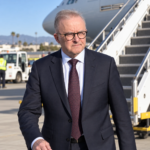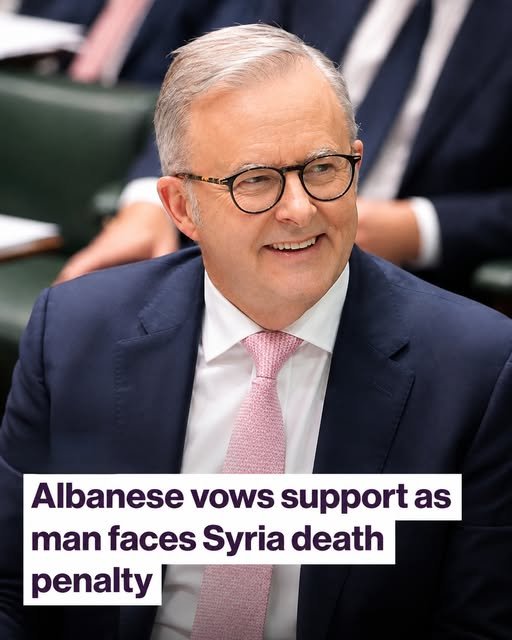
Prime Minister Anthony Albanese says the Australian government is providing support to both the family of a young Gold Coast man facing the death penalty in Syria and the family of the Australian man he is accused of murdering, as the highly unusual case unfolds in a country where Australia has no diplomatic presence.
Patrick Stevenson, 20, has been held in north-western Syria for approximately seven months after being charged over the fatal shooting of fellow Australian Abdullah Glen Charles Burgess in December 2025.
Syrian authorities have charged Stevenson with premeditated murder, an offence that carries the death penalty under Syrian law. If convicted, he could face execution unless the victim’s family grants forgiveness under provisions of Syria’s legal system that allow certain murder convictions to be resolved through a negotiated “blood money” settlement.
Speaking to ABC television, Albanese confirmed the federal government was assisting both families while making clear that the criminal proceedings would ultimately be determined by Syrian courts.
“Legal processes will take their course overseas, of course, and that is appropriate,” the Prime Minister said.
“I feel for the families of the person who’s lost their life, and we’ve connected with them and providing support for them.
“We’re also providing support for the family of the person who’s been charged.”
The case presents one of the most difficult consular challenges faced by the Albanese government in recent years.
Australia does not maintain an embassy or consulate in Syria, severely limiting the Department of Foreign Affairs and Trade’s ability to provide traditional consular assistance, attend court hearings or communicate directly with Syrian authorities.
Instead, Australian officials have relied on indirect diplomatic channels while attempting to monitor developments from outside the country.
According to Australian media reports, Stevenson travelled to Syria in late 2025 after becoming increasingly radicalised while living on the Gold Coast.
His family has said they were unaware of his plans before he left Australia, believing he intended to pursue religious studies overseas. They later learned he had entered north-western Syria after being contacted by Australian authorities.
Syrian investigators allege Stevenson shot Abdullah Glen Charles Burgess inside Burgess’s home in the town of Darkush on 31 December 2025 using an AK-47 rifle.
Burgess, originally from northern New South Wales, had relocated to Syria with his Australian wife and young daughters months before the incident.
Authorities allege the shooting occurred while Burgess’s family was elsewhere inside the house. Stevenson denies wrongdoing and is awaiting the outcome of legal proceedings.
Under Syrian criminal law, premeditated murder is punishable by death.
However, the country’s legal framework also incorporates principles derived from Islamic law that allow the family of a murder victim to pardon an offender in exchange for financial compensation, commonly referred to as blood money or diyah. If such forgiveness is granted and accepted by the court, the death penalty may be avoided, although other penalties can still apply.
That legal mechanism has become central to Stevenson’s prospects.
Whether any agreement could eventually be reached remains entirely a matter for the victim’s family and the Syrian judicial system, and no indication has been given publicly that negotiations are underway.
Stevenson’s parents have spoken publicly about their concerns for their son’s wellbeing.
His mother, Angela Bell, has criticised what she describes as the limited assistance available from Australian authorities, saying officials have repeatedly explained that Australia’s lack of diplomatic representation in Syria significantly restricts what they are able to do.
She said the family had been told diplomatic efforts had achieved little progress and expressed frustration at the absence of direct access to Syrian officials.
The ABC has reported that Stevenson has been held in overcrowded prison conditions for several months while awaiting trial.
His family has also raised concerns about his mental health, saying previous psychiatric assessments identified ADHD, learning disorders and probable autism spectrum disorder before he travelled overseas.
Those issues have not formed part of the criminal proceedings currently before the Syrian courts but have featured prominently in his family’s public appeals for assistance.
The case has also renewed debate about online radicalisation in Australia.
According to investigations reported by Australian media, Stevenson converted to Islam several years before travelling to Syria and allegedly became increasingly influenced by extremist online content before leaving the country.
Authorities have not alleged he was acting on behalf of Islamic State at the time of the alleged murder, and the case is being prosecuted as a homicide matter rather than a terrorism offence.
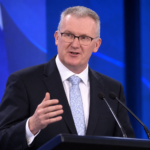
Home Affairs Minister Tony Burke said the case should serve as a reminder of the continuing risks posed by extremist material circulating online.
He urged Australians, particularly younger people, to remain vigilant about content encountered through social media and internet platforms, saying radicalisation increasingly occurs in digital environments rather than through traditional extremist organisations.
The incident also highlights the broader difficulties Australia faces when citizens become involved in serious criminal matters inside countries where Canberra has only limited diplomatic access.
Unlike cases involving Australians detained in nations with established diplomatic relationships, the federal government has little capacity to independently verify evidence, observe legal proceedings or regularly visit detainees in Syria.
That limitation complicates efforts to monitor prison conditions, ensure procedural fairness and provide ongoing consular assistance.
While the government has confirmed it is assisting both families, Albanese has avoided commenting on the allegations themselves, emphasising that the matter remains before a foreign court.
His response reflects the longstanding practice of successive Australian governments not to interfere publicly in criminal proceedings taking place overseas while continuing to provide available consular support where possible.
The Prime Minister’s comments also acknowledge the unusual position confronting Canberra: supporting the family of an Australian accused of a capital offence while simultaneously supporting the family of another Australian whose death forms the basis of the prosecution.
The case has attracted considerable public attention because it combines issues of radicalisation, international law, capital punishment and Australia’s limited diplomatic engagement with Syria.
Australia opposes the death penalty in all circumstances and routinely advocates for clemency when Australian citizens face capital punishment overseas. However, the government’s ability to influence legal outcomes varies significantly depending on its diplomatic relationship with the country involved.
For now, Patrick Stevenson remains in Syrian custody awaiting the continuation of court proceedings.
The outcome will ultimately depend on the evidence presented before the Syrian judiciary, the operation of local criminal law and, potentially, whether the victim’s family chooses to exercise its legal right to grant forgiveness.
Until then, the Albanese government says it will continue providing support to both Australian families while acknowledging that the legal process is one for the Syrian courts to determine.