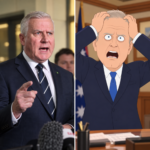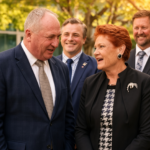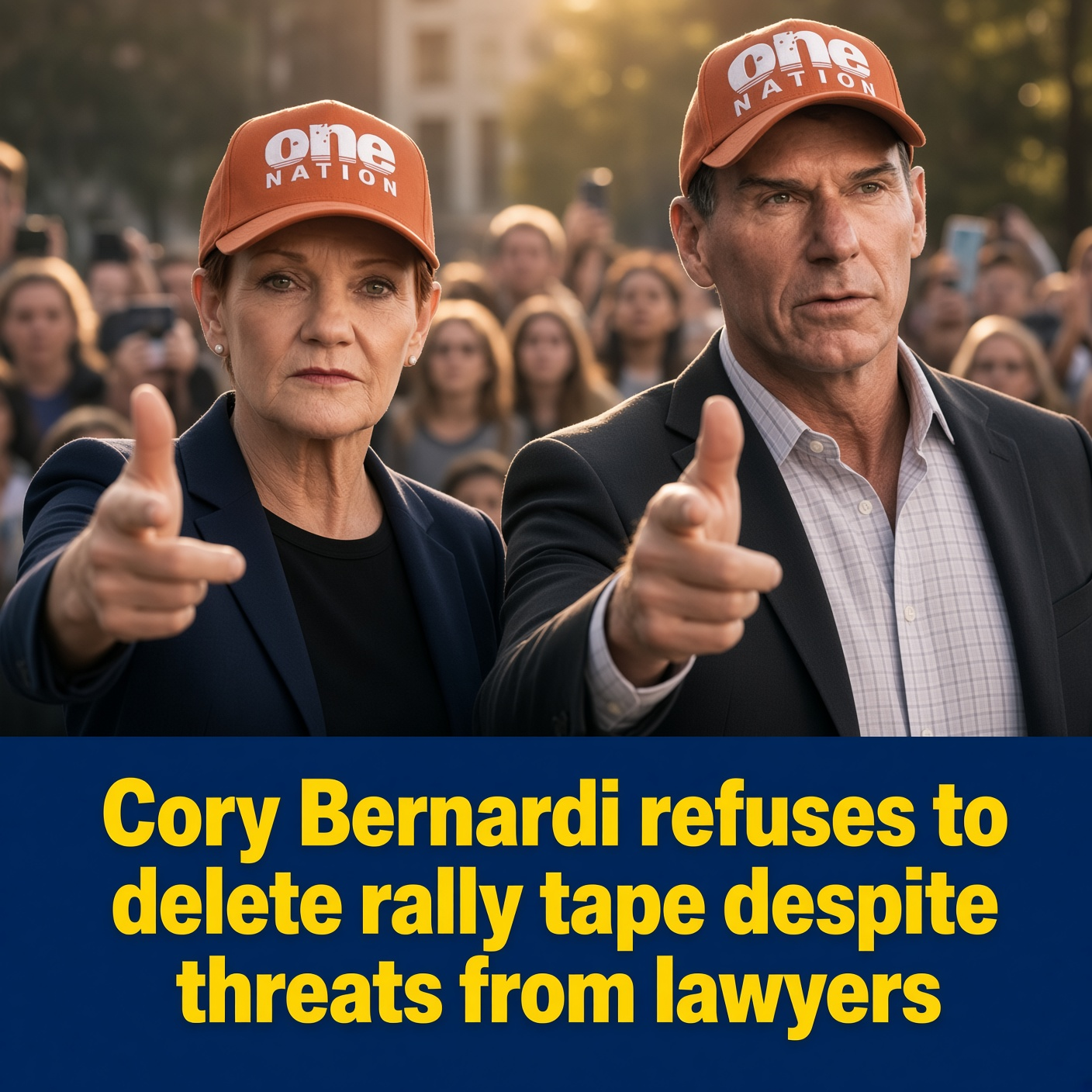
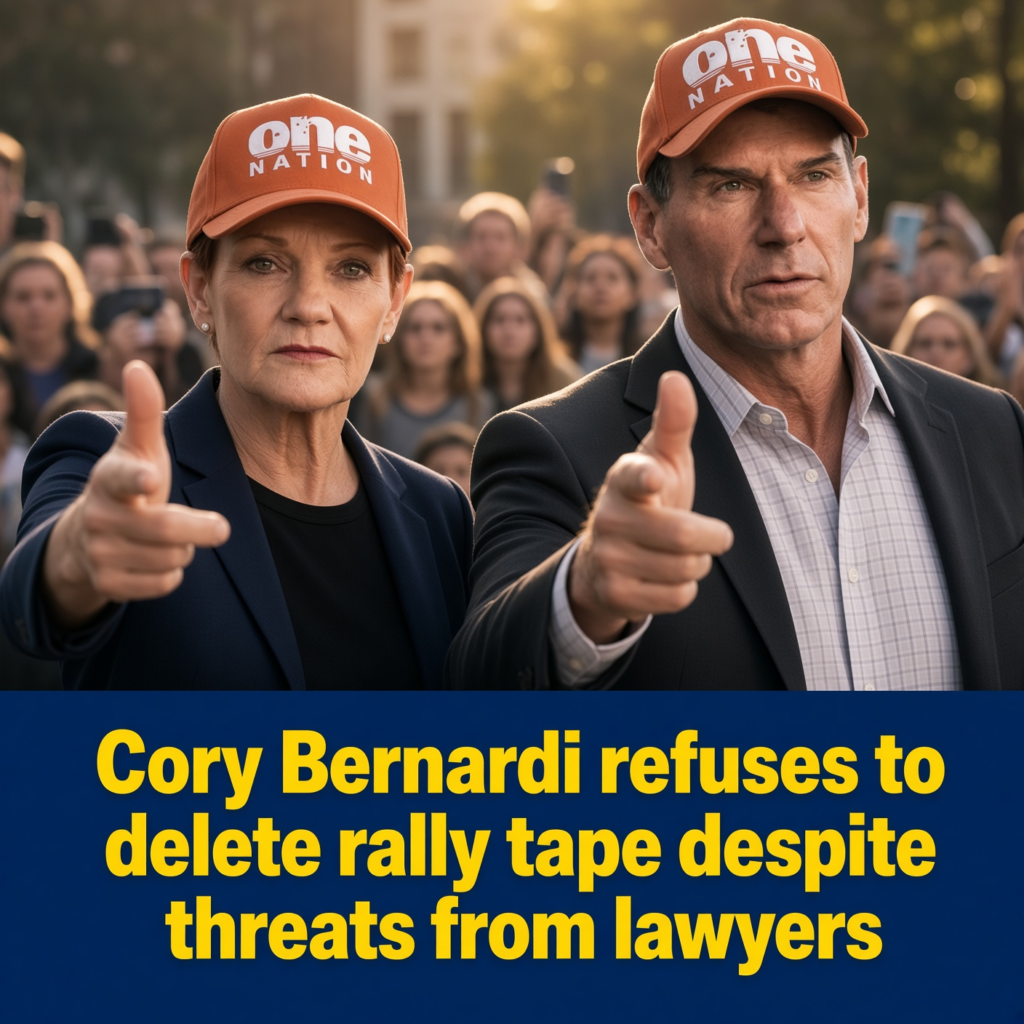
One Nation has refused demands to remove footage of students at an anti-Pauline Hanson protest after the party said lawyers representing parents threatened legal action over a viral video filmed at the public rally.
The dispute has opened a new front in the increasingly bitter argument over the nationwide student walkouts held earlier this month, when thousands of high-school and university students left class to demonstrate against Hanson and One Nation.
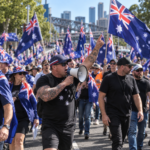
In Adelaide, more than 2,000 students from about 40 schools and colleges were reported to have gathered outside Parliament House on August 13.
One Nation SA leader Cory Bernardi was there as protesters arrived, filming on his phone before becoming involved in a heated political exchange with people attending the demonstration.
Now the argument has moved from the steps of Parliament House to a dispute over whether footage showing young protesters should remain online.
One Nation says parents’ lawyers demanded the video come down
One Nation publicly revealed this week that it had received what it described as formal legal threats from lawyers acting for parents whose children appeared in footage from an anti-Hanson protest.
According to the party, the lawyers demanded that the viral video be deleted.
One Nation has refused.
The party argues the demonstration occurred openly in a public place, with media organisations and cameras present, and says participants could reasonably have expected that their conduct might be recorded.
“Lawyers acting for parents whose children attended a protest against One Nation have sent us formal legal threats,” the party said in its public account of the dispute.
It said the demand was for footage of what occurred at the rally to be removed.
At this stage, however, the complete legal correspondence and the precise legal grounds relied upon by the parents have not been publicly established through independent reporting.
That means the existence and character of the demands should be understood through One Nation’s account unless and until the lawyers or families make their position public.
The footage came from a fiercely anti-Hanson protest
The legal confrontation has its origins in the national “Students Say No to Hanson” demonstrations held across Australia on August 13.
Students walked out of high schools and universities in Adelaide, Sydney, Melbourne, Brisbane and other cities.
The protests opposed Hanson and One Nation on issues including immigration, multiculturalism, LGBTQ+ rights and the party’s broader political agenda.
The National Union of Students was centrally involved in the national action, while a collection of socialist and other left-wing student organisations supported individual rallies.
The protests were unapologetically political.
Students carried anti-Hanson placards, delivered speeches and chanted against One Nation.
More than 2,000 students rallied in Adelaide
The Adelaide demonstration was substantial.
Local reporting estimated more than 2,000 students from approximately 40 South Australian high schools and colleges participated outside Parliament House.
Many were secondary-school students and some attended in school uniform.
The Adelaide action was associated with the nationwide campaign and was supported locally by student activist organisations, including left-wing and socialist groups.
The rally was nevertheless reported as concluding peacefully.
That distinction matters: heated rhetoric and confrontational political speech were recorded, but the broader Adelaide gathering was not reported as descending into mass physical violence.
Cory Bernardi walked straight into the confrontation
Bernardi, who leads One Nation in South Australia and sits in the state’s Legislative Council, encountered the demonstration as he entered Parliament House.
ABC footage showed Bernardi recording protesters with his phone as chants were directed towards One Nation.
He subsequently engaged in a political argument with someone attending the rally.
Bernardi had already been one of the strongest critics of the walkouts.
He accused organisers of politically manipulating young Australians and later called for an investigation into the involvement of schools and teachers.
Organisers rejected that characterisation and defended students’ right to participate in political action.
Strong and profane language was part of the national protests
There is independent evidence that some students at the nationwide demonstrations used highly confrontational and profane language.
In Sydney, protesters were recorded chanting slogans including “Pauline Hanson go to hell”, while another call-and-response chant directed profanity at Hanson.
The Guardian separately reported students deliberately moving behind a person filming the demonstration and chanting profanity about the One Nation leader.
Other slogans accused Hanson and her party of racism and fascism.
One Nation has highlighted such material to argue that the demonstrations went considerably beyond peaceful disagreement with the party’s policies.
One Nation alleges more serious statements were captured
The party and sympathetic media outlets have made more serious claims about material appearing in protest footage, including allegations of violent rhetoric.
Those allegations form part of One Nation’s argument for keeping the videos publicly available.
But the strongest claims require care.
Independent reporting reviewed for this article confirms aggressive and profane anti-Hanson language, but does not sufficiently establish every allegation now being made about calls for executions or specific threats at the Adelaide rally.
Those claims should therefore remain attributed unless additional unedited footage or other evidence establishes exactly what was said, by whom and in what context.
One Nation says public protest brings public scrutiny
The party’s response to the legal demands is based on a broader argument about accountability.
It says students participating in an organised political demonstration outside Parliament House were deliberately seeking public attention.
Media organisations were present.
Placards were designed to be seen.
Chants were intended to be heard.
Speeches were intended to influence political debate.
From One Nation’s perspective, participants cannot seek publicity for their political message and subsequently demand that unfavourable footage of the same event disappear.
That is the principle the party says is behind its refusal to remove the video.
But the presence of minors complicates the argument
The other side of the dispute is more complicated than simply whether an adult political activist can be filmed at a rally.
A significant number of participants were school-aged children.
Some were in uniform.
Publishing identifiable footage of minors to a potentially enormous online audience raises issues that are different from merely recording events occurring in public.
The circumstances in which footage was taken, edited, captioned and redistributed can all become relevant to disputes about publication.
Those issues are particularly significant when material goes viral and attracts intense political commentary.
Whether the parents ultimately possess a successful legal claim is a question that cannot be determined merely from One Nation’s description of the correspondence.
The original protest was already controversial before it happened
The August 13 walkout had generated political arguments well before students reached Parliament House.
Federal Education Minister Jason Clare urged students to attend school instead.
“If people want to protest on the weekend, then fill your boots, but I want you at school when school is on, learning,” Clare said before the national demonstrations.
South Australian Education Minister Lucy Hood took a somewhat different approach, saying decisions about children leaving school ultimately rested with individual parents while also emphasising the importance of regular attendance.
The conflicting reactions reflected a broader debate about where political participation fits within school life.
The organisers said the walkout was necessary
Students and organisers rejected suggestions they were simply looking for an excuse to miss class.
They argued Hanson’s growing political support and One Nation’s policies justified a national response from young Australians.
Protesters raised concerns about migration policy, racism, discrimination and the treatment of minority groups.
Some parents actively supported their children’s participation.
The Guardian reported the case of a Year 8 student whose mother required them to explain why they wanted to attend before agreeing to accompany them.
For those families, attending the demonstration was an exercise in democratic participation rather than political indoctrination.
One Nation saw something entirely different
Hanson and her party viewed the demonstrations through the opposite lens.
One Nation politicians questioned why school-aged Australians were leaving class for protests promoted by socialist organisations.
They argued students were being given a distorted picture of the party and its policies.
Hanson responded to the demonstrations by saying young Australians should instead be protesting over housing affordability, living costs and wage growth.
She argued One Nation was fighting for their economic future even if the protesters did not recognise it.
The students clearly disagreed.
Who organised the protests?
The national movement involved several organisations rather than a single Adelaide organiser.
The National Union of Students played a major role nationally.
NUS president Felix Hughes publicly defended the campaign and the participation of young Australians in political action.
Socialist Alternative organisations and Students for Palestine groups were also visible around the national protests.
In South Australia, reporting before the event identified Socialist Alternative branches at Adelaide and Flinders universities and a high-school anti-capitalist social media group among supporters of the demonstration.
It would therefore be inaccurate to reduce the Adelaide rally to a claim that Hughes and another individual personally recruited all of the school students who attended.
Yasmine Johnson has become part of the wider political argument
Student activist Yasmine Johnson has also featured prominently in commentary surrounding the national movement.
Johnson has been associated with Students for Palestine and Socialist Alternative activism and has appeared in coverage of the anti-Hanson campaign.
Critics of the protests have pointed to those political connections as evidence that the student movement was influenced by established activist networks.
Supporters would describe the same connections differently: as political organising, which is a conventional feature of protest movements.
What cannot simply be assumed is that membership of a political organisation proves individual schoolchildren were coerced into participating.
Claims students were ‘groomed’ go beyond the available evidence
Some commentary surrounding the rallies has described students as having been “groomed” or used as political puppets.
There is clear evidence that organised political groups promoted and participated in the demonstrations.
There is also evidence that school-aged students took part.
But those facts alone do not establish grooming.
Students interviewed by independent media frequently articulated their own political reasons for attending, while some parents openly supported their participation.
Critics are entitled to argue that activist organisations exerted inappropriate political influence; presenting that as proven grooming would go beyond the evidence currently available.
The parents’ legal challenge changes the debate
Until now, most of the argument centred on whether students should have left school and whether political organisations were encouraging them.
The threatened legal action adds a different question.
How much control should young protesters and their families retain over images recorded during an intentionally public political demonstration?
And how should political organisations handle footage of minors when publishing it to audiences far larger than those originally standing outside Parliament House?
Those questions do not have to produce the same answer in every case.
The fact that something happened in public does not automatically resolve every question surrounding subsequent publication.
At the same time, political demonstrations depend on public visibility. Protesters ordinarily cannot expect the political message they deliver publicly to remain private.
One Nation is showing no sign of backing down
For now, the party’s position is unequivocal.
It says it will not erase its record of what happened at the demonstrations merely because lawyers have become involved.
Bernardi and One Nation SA have continued criticising both the conduct recorded at the rallies and the adult political influences they believe were behind the movement.
The families behind the legal demands may see the situation very differently.
Without their complete correspondence or a public statement setting out their case, however, their precise legal and factual arguments cannot safely be assumed.
Another protest is already planned
The dispute may not end with the August rallies.
Organisers indicated after the Adelaide demonstration that they intended to return with further action, with another student mobilisation planned for September.
That means the argument over students, schooling and political activism is likely to continue.
Schools will again face questions about attendance.
Parents will decide whether their children participate.
Activist organisations will continue trying to mobilise students.
And One Nation will almost certainly continue filming, challenging and publicly criticising the movement.
The fight is now about more than Pauline Hanson
The original demonstration was explicitly about Hanson and One Nation.
The dispute that followed has become much broader.
It is now about whether students should leave school to engage in politics.
It is about the influence of organised activist groups.
It is about political language and personal responsibility.
And, following the threatened legal action, it is about what happens when school-aged protesters who deliberately enter a public political arena subsequently find their words and images circulating to audiences of hundreds of thousands.
One Nation says the footage is part of the public record and will stay online. The parents challenging its publication appear to believe a line has been crossed.
If the dispute proceeds beyond threatening letters and into formal litigation, a political confrontation that began on the steps of Parliament House could become a legal argument over the limits of publishing young Australians engaged in public protest.