The Setting: Where Two Worlds Collide
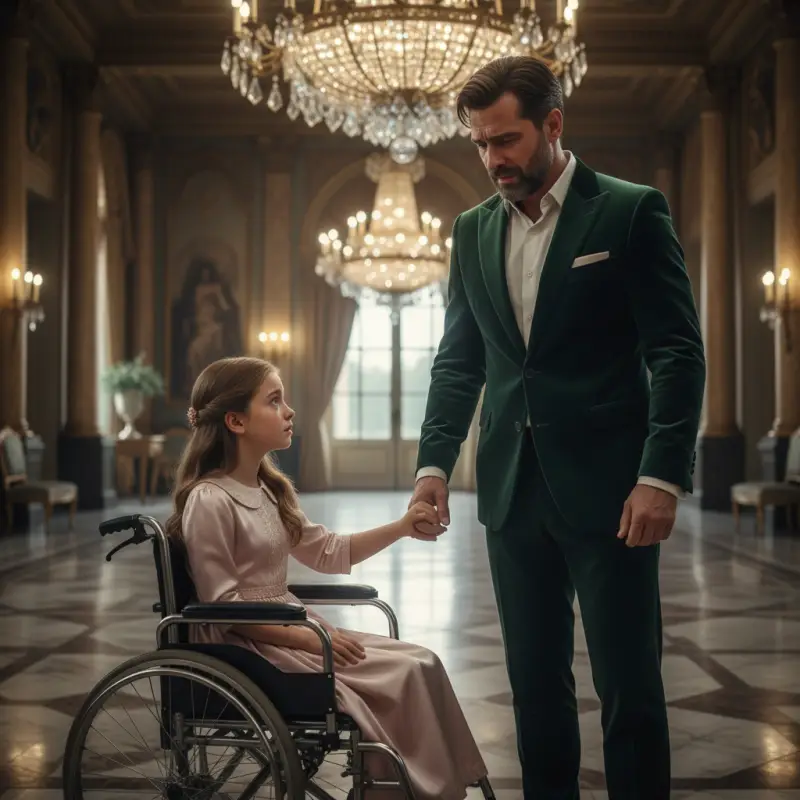
The opulent ballroom foyer serves as more than just a backdrop—it becomes a stage where privilege and poverty intersect in the most unexpected way. The polished marble floors reflect the golden light from an ornate crystal chandelier, creating an atmosphere of refined elegance that seems worlds away from the streets outside. This is a space designed for society’s elite, where appearances matter and boundaries are carefully maintained.
Yet into this rarefied environment walks Leo, an eight-year-old boy whose dusty tan shirt and dirt-smudged face tell a different story entirely. His presence disrupts the carefully curated perfection of the space, creating an immediate tension that speaks to deeper societal divisions. The contrast is stark and intentional—wealth and want existing in the same frame, separated by invisible but powerful barriers.
The Father’s Protective Instinct
Elias, resplendent in his forest green velvet tuxedo, embodies paternal protection in its most visceral form. His immediate response to Leo’s approach—”Keep your distance from my daughter”—reflects not just social prejudice but the fierce protective instinct of a father whose child has already faced enough challenges. Clara, seated in her wheelchair and adorned in pale pink silk, represents vulnerability in multiple dimensions.
The father’s tension is palpable, his body language screaming caution and concern. This isn’t merely about class distinctions; it’s about a parent’s desperate need to shield his disabled daughter from what he perceives as potential harm. His trembling hands and intense gaze reveal a man constantly on guard, hypervigilant about threats to his child’s wellbeing. The weight of responsibility he carries manifests in every protective gesture.
The Child’s Quiet Determination
Leo’s approach defies every social convention present in this gilded space. His words—”Please, don’t be afraid of me”—carry a wisdom that seems to transcend his eight years. There’s something profound in how this street child recognizes fear and seeks to address it directly, showing an emotional intelligence that challenges assumptions about his circumstances.
When he persists with “I won’t hurt her. May I ask her a simple question?”, Leo demonstrates a gentle persistence that speaks to genuine intent. His dirt-smudged face becomes irrelevant against the sincerity of his approach. This moment reveals how authentic human connection can emerge from the most unlikely sources, cutting through barriers of class and circumstance with startling clarity.
The Moment of Connection
As Leo reaches for Clara’s small hand, something fundamental shifts in the scene’s emotional landscape. The physical act of connection—a street child’s dirty fingers touching the pristine silk gloves of privilege—becomes a bridge between two vastly different worlds. Clara’s tear-filled eyes suggest recognition of something deeper than surface appearances, an understanding that transcends the social boundaries her father desperately maintains.
This moment of human touch carries profound significance. In our increasingly divided society, where fear often drives us to maintain distance from those different from ourselves, Leo’s simple gesture becomes revolutionary. The wheelchair that might symbolize limitation transforms into a platform for connection, while the ballroom’s opulence fades into irrelevance against the power of genuine human empathy.
The Father’s Emotional Collapse
Elias’s transformation from protective guardian to openly weeping father represents the scene’s most powerful moment. His tears speak to something deeper than immediate concern—they suggest recognition, perhaps guilt, or the overwhelming realization that his daughter’s healing might come from the most unexpected source. The forest green velvet of his tuxedo, once a symbol of status and control, becomes merely fabric as his composure crumbles.
This emotional breakdown reveals the limitations of privilege in addressing human suffering. All the wealth and protection in the world cannot shield us from life’s deepest wounds, and sometimes healing arrives in forms we least expect. The father’s tears acknowledge both his powerlessness and the profound courage of a child who dares to reach across divides that adults have constructed and maintained.
Beyond the Surface: Implications for Society
This encounter challenges our assumptions about who has the capacity to heal and who needs healing. Leo, despite his obvious material disadvantages, emerges as the agent of connection and potential healing. His approach to Clara transcends social boundaries and speaks to the universal human need for authentic connection.
The scene also illuminates how fear—whether of the other, of vulnerability, or of losing control—can prevent us from receiving the very connections we most need. Elias’s protective instincts, while understandable, initially block the possibility of an interaction that clearly moves all three participants in profound ways.