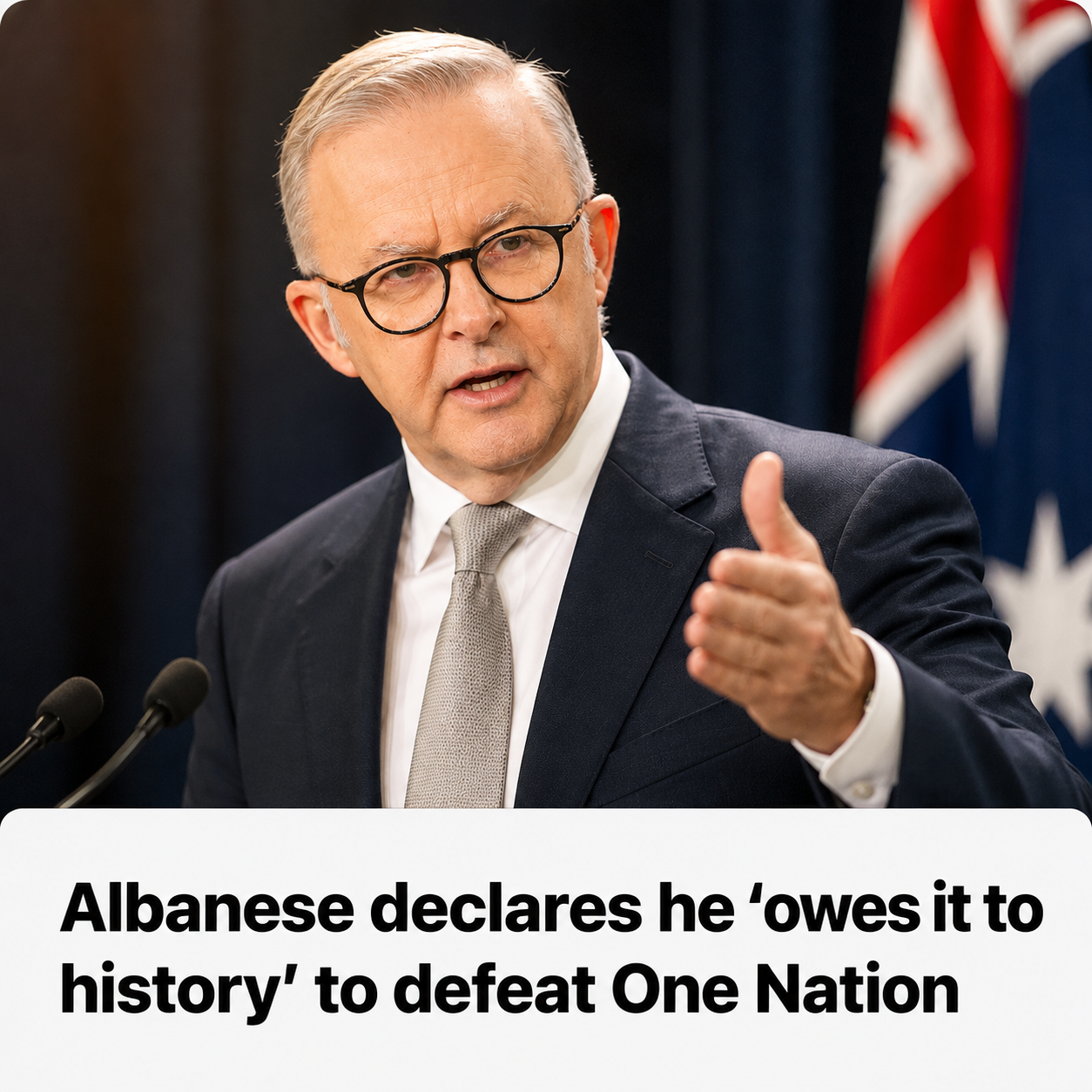
Prime Minister Anthony Albanese has declared Labor “owes it to history” to defeat One Nation, using a major address to party faithful in Brisbane to launch one of his most forceful attacks yet on Pauline Hanson’s resurgent party just hours after it inflicted a historic by-election defeat on Labor in Western Australia.
The timing could hardly have been more politically charged.
Albanese addressed the Queensland Labor State Conference on Sunday morning after One Nation candidate Luke Herdegen seized Secret Harbour from Labor in Western Australia, transforming a party that polled just 8.4 per cent there at the 2025 state election into the dominant force in the electorate.
And nationally, opinion polling is showing One Nation competing at levels that would once have seemed extraordinary.
Rather than treat the party as a temporary protest movement, Albanese used his Brisbane speech to frame its rise as a direct ideological challenge to Labor, multicultural Australia and what he described as mainstream democratic politics.
“We simply must defeat them. We owe it to history. And we will defeat them,” he told delegates.
It was an unusually stark declaration from a prime minister about a minor party — and a sign that Labor now regards Hanson as much more than somebody else’s political problem.
Albanese turns his fire directly on One Nation
The Prime Minister told delegates that “hard right populists” were advancing around the world and accused them of practising politics that was “dangerous, divisive, and downright dishonest”.
He argued that movements such as One Nation exploit public frustration without offering workable solutions, accusing them of distorting facts, spreading misinformation and encouraging Australians to turn against one another.
Albanese then moved from a general warning about global populism to a direct attack on One Nation.
He criticised the party over positions and comments concerning workplace conditions, working from home, domestic violence and multiculturalism.
He also sought to reclaim traditional Labor territory by arguing that One Nation was not genuinely on the side of working Australians.
The Prime Minister pointed particularly to penalty rates, asking delegates how reducing them would help workers in places such as Logan, Gladstone, Strathpine, Ipswich and Mount Isa.
That argument fits a broader Labor strategy that has developed as One Nation has expanded beyond its traditional conservative protest base.
Rather than treating Hanson solely as a threat to the Liberal and National parties, Labor is increasingly presenting One Nation as an economic threat to blue-collar and lower-income voters who might otherwise have regarded it as a vehicle for expressing frustration with Canberra.
The Secret Harbour shock changed the political atmosphere
The speech came less than 24 hours after Labor received a vivid demonstration of what that frustration can look like at the ballot box.
In the Western Australian state seat of Secret Harbour, Herdegen delivered One Nation its first lower-house victory in the state.
The scale of the change was striking.
One Nation’s primary vote surged from about 8.4 per cent at the previous state election to approximately 39 per cent, while Labor’s primary support collapsed into the mid-20s.
After preferences, Herdegen held about 57 per cent of the two-candidate vote against Labor’s Georgia Tree.
The result ended Labor’s decades-long dominance of that stretch of Perth’s southern coastal corridor and demonstrated that One Nation’s national polling strength can, under the right conditions, translate into lower-house seats.
That is politically significant because Australia’s preferential voting system has traditionally made it difficult for minor parties with dispersed national support to convert strong primary votes into seats.
Secret Harbour showed that One Nation can overcome that obstacle when its support is sufficiently concentrated.
It also demonstrated that Labor cannot assume anti-government voters will automatically move towards the Liberals.
The Liberal candidate finished well behind One Nation on primary votes, meaning the protest against Labor largely bypassed the traditional opposition.
One Nation is now competing with the major parties in national polling
The broader polling explains why Albanese devoted so much of his speech to Hanson.
One current national Newspoll has One Nation at 30 per cent of the primary vote, narrowly ahead of Labor on 29 per cent and well ahead of the Coalition on 19 per cent.
A separate RedBridge Group and Accent Research poll paints a slightly different picture, putting Labor on 29 per cent, One Nation on 28 per cent and the Coalition on 22 per cent.
Polls are snapshots, not election results, and different methodologies can produce materially different numbers.
But the broader pattern is difficult to dispute: One Nation is operating at a level of support far beyond the single digits that characterised much of its modern political history.
That changes the strategic equation for both major political camps.
The Coalition risks losing conservative and anti-establishment voters to Hanson.
Labor faces a different but increasingly serious threat among working-class, outer-suburban and regional voters who may combine concerns about housing, immigration, living costs and distrust of established political institutions.
Secret Harbour contained many of those characteristics.
That is why dismissing the result simply as a peculiar Western Australian by-election would be risky.
Queensland makes the warning especially symbolic
Albanese chose Queensland to invoke the history of One Nation for a reason.
The state was the scene of the party’s first spectacular political breakthrough.
At the 1998 Queensland election, One Nation won 11 seats and more than one-fifth of the statewide primary vote, shocking both Labor and the conservative parties.
But the parliamentary organisation quickly fractured.
By the 2001 state election, One Nation was reduced to three seats.
Albanese reminded Labor delegates of that history and argued that electoral success had previously been followed by internal chaos and division.
For Labor, it is an attractive historical comparison.
It suggests today’s surge might ultimately collapse when One Nation moves from protest politics into the harder business of maintaining candidates, discipline and coherent policy across a much larger parliamentary operation.
But there are reasons to be cautious about assuming history will simply repeat itself.
The One Nation of 2026 is operating in a different political environment.
Hanson has decades more parliamentary experience. The party has benefited from collapsing confidence in the traditional two-party structure, and social media allows populist parties to communicate directly with voters without relying on conventional news organisations.
Most importantly, dissatisfaction over housing affordability, migration levels and household finances provides it with issues that are not disappearing merely because Labor attacks the party’s credibility.
Labor says the answer is economic delivery, not just attack
Albanese appeared conscious of that danger in Brisbane.
Although his language about One Nation was combative, he argued that defeating populism required more than denunciation.
His prescription was for Labor to offer Australians a credible expectation that their lives would improve.
The Prime Minister devoted substantial sections of the speech to policies he said demonstrated that approach.
He highlighted tax cuts, cheaper medicines, Medicare investment, Free TAFE, student debt reductions, wage growth and housing measures.
In Queensland, he said there were 691 fully bulk-billing medical practices, an 82 per cent GP bulk-billing rate and more than 740,000 visits to 26 Medicare Urgent Care Clinics.
He also pointed to five consecutive increases in minimum and award wages and a 15 per cent pay increase for early childhood educators.
The political argument is clear.
Labor wants voters to judge populist parties not merely by how effectively they articulate anger but by whether their policy prescriptions would improve household finances and public services.
That is a more durable strategy than simply telling voters One Nation is dangerous.
But it also creates a test for Labor itself.
If voters continue to feel that housing is unaffordable, living costs remain punishing and migration is poorly managed, reciting government achievements may not be enough to reverse the drift.
Some of Labor’s attacks require historical context
The Prime Minister’s penalty-rates attack illustrates the difficulty of reducing a long voting and policy record to a single campaign line.
Hanson said in a 2017 ABC interview that she supported penalty-rate cuts “in principle”, arguing that high weekend labour costs were hurting small businesses.
However, One Nation later voted for legislation designed to prevent reductions in take-home pay following that year’s Fair Work Commission penalty-rate decision.
That does not make Albanese’s broader workplace critique meaningless, but it means the party’s record is more complicated than a simple claim that One Nation consistently voted to abolish penalty rates.
The same scrutiny will increasingly apply to every side.
One Nation can no longer expect to campaign primarily through broad statements about immigration, cost of living or dissatisfaction with government without facing detailed questions about numbers, implementation and trade-offs.
Its recent confusion over whether its proposed 130,000 migration figure referred to net overseas migration, visas or particular categories of arrivals has already demonstrated that vulnerability.
But Labor will also struggle if it responds to legitimate policy disagreements by treating every One Nation voter as motivated by extremism.
The voters who delivered Secret Harbour were casting ordinary democratic ballots.
Understanding why they changed their votes will be more useful to Labor than condemning them for doing so.
The fight is increasingly about who represents working Australia
That is the deeper significance of Albanese’s speech.
For much of One Nation’s recent rise, conventional wisdom held that Hanson was primarily cannibalising the Coalition.
That assumption now looks incomplete.
Labor’s concern is that One Nation can appeal simultaneously to culturally conservative voters, people angry about migration, regional Australians sceptical of climate and energy policy, and working-class households who believe economic growth is no longer translating into personal security.
That coalition does not have to be internally consistent to be electorally powerful.
Populist movements frequently grow precisely because voters with different grievances converge around a shared rejection of established parties.
Labor therefore faces a strategic choice.
It can make One Nation itself the centre of the political contest, highlighting Hanson’s controversial statements, internal disagreements and policy inconsistencies.
Or it can place greater emphasis on the conditions causing voters to search for alternatives in the first place.
Albanese’s Brisbane speech attempted to do both.
He portrayed One Nation as a danger to social cohesion while simultaneously arguing that Labor’s practical achievements on wages, healthcare, education and housing offered the better answer to voter discontent.
Declaring war on Hanson also raises the stakes for Albanese
The Prime Minister’s “owe it to history” language guarantees the comparison will now run both ways.
If One Nation’s support falls and its internal tensions increase, Labor will argue Albanese correctly recognised and defeated a populist threat.
But if Hanson continues gaining votes and seats, every strong attack from the Prime Minister risks reinforcing One Nation’s claim that the political establishment is frightened of its growth.
Secret Harbour has already provided Hanson with a potent piece of evidence for that argument.
One Nation did not merely rise in a survey. It took an actual Labor seat with a huge increase in primary support.
The task for Albanese is therefore more difficult than defeating Pauline Hanson in a rhetorical contest.
Labor must persuade voters who are considering One Nation that their concerns have been heard and that government policy offers them a better material outcome.
Hanson, meanwhile, must demonstrate that One Nation can withstand the far greater scrutiny that comes with moving from protest movement to serious parliamentary force.
Albanese has now made the contest explicit: Labor intends to confront One Nation politically, economically and ideologically. But after Secret Harbour and with national polls placing Hanson alongside — and in some cases ahead of — the major parties, the Prime Minister is no longer warning about a hypothetical threat. He is responding to a party that is already converting voter anger into seats, and the battle to stop it will be decided less by speeches about history than by whether Australians believe their lives are improving now.