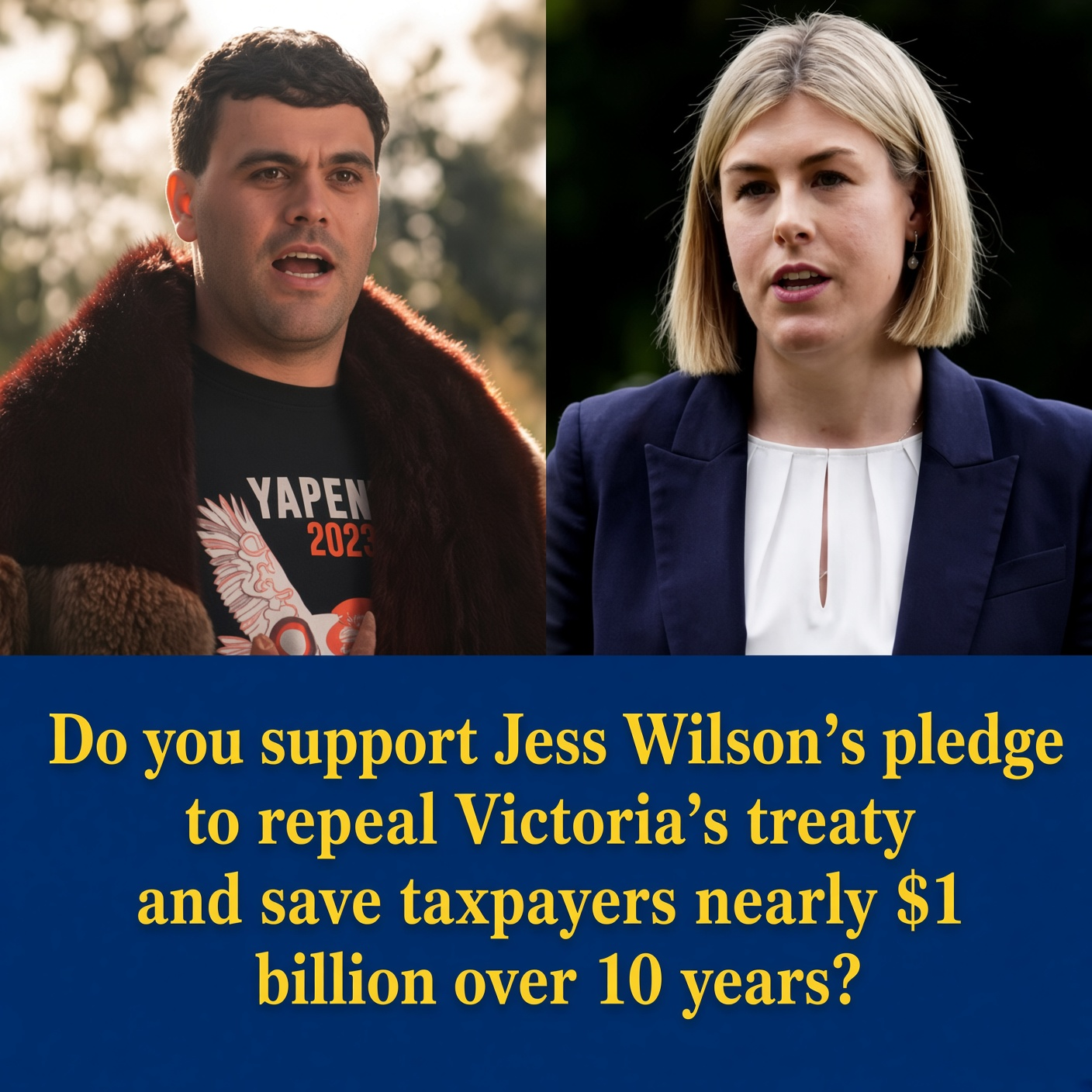
Victoria’s new First Peoples’ Assembly leaders have vowed to press ahead with the state’s historic Treaty as Opposition Leader Jess Wilson campaigns to dismantle the framework if the Coalition wins November’s election.
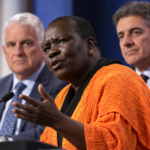
Djaran Murray-Jackson and Meriki Onus have taken control of the Assembly at a pivotal moment for Victoria’s experiment with Indigenous self-determination.
The Statewide Treaty is now law, a new institutional structure known as Gellung Warl has been established and elected Assembly members have begun their four-year terms.
But there is no guarantee that framework will survive the November state election.
Wilson has promised that a Coalition government will repeal Treaty, turning the future of Australia’s first Statewide Treaty with First Peoples into a major election issue.
Two new leaders take control of the Assembly
Murray-Jackson is a returning Assembly member and Dja Dja Wurrung Traditional Owner.
He is also the younger brother of Ngarra Murray, who previously served as a co-chair of the Assembly.
Onus is entering the Assembly for the first time after being elected to represent metropolitan Melbourne.
She is a prominent activist and former adviser and is the sister of independent Victorian Senator Lidia Thorpe, who was previously a Greens politician.
Together, Murray-Jackson and Onus now lead the elected body at the centre of Victoria’s Treaty structure.
Their message to Jess Wilson is already blunt
The pair have shown little interest in avoiding the political confrontation surrounding Treaty.
Murray-Jackson criticised Wilson’s promise to dismantle the agreement, saying the Opposition Leader appeared focused on what she intended to destroy rather than what she would create.
“She’s just talking about all the things she wants to tear down and Treaty is one of those things,” he said.
“I just want to hear something that she’s going to build. That’d be good to hear.”
Onus was equally direct when asked about the uncertainty surrounding their work.
“Let us focus on Aboriginal affairs,” she said. “Let us do our jobs.”
Treaty is no longer merely a proposal
One of the most important facts in the political debate is that Victoria’s Treaty process has moved well beyond consultation and negotiation.
The Statewide Treaty Bill passed both houses of the Victorian Parliament in 2025 and received Royal Assent on November 13.
The Treaty formally commenced on December 12, 2025.
Victoria describes it as the first Treaty with First Peoples in Australian history.
That means a Coalition government would not simply be cancelling negotiations. It would be attempting to repeal an existing legislative and institutional framework.
What exactly is Victoria’s Treaty?
At its core, the Statewide Treaty establishes a formal relationship between the Victorian state and First Peoples.
Its foundations include recognition that multiple Aboriginal nations occupied the land now called Victoria before colonisation.
It also recognises dispossession, violence and exclusion from land and resources, and the intergenerational consequences flowing from those events.
The framework seeks to give First Peoples a greater role in decisions concerning their communities.
Supporters argue Aboriginal Victorians should have substantially more influence over policies and programs intended to improve Aboriginal lives.
What is Gellung Warl?
At the institutional centre of the system is Gellung Warl.
The name comes from Gunaikurnai language and translates as “tip of the spear”.
Gellung Warl was formally established on May 1, 2026.
It evolved from the First Peoples’ Assembly and operates independently from the Victorian government.
It brings together representation, truth-telling and accountability functions under a permanent statutory structure.
There are three major components
The first is the First Peoples’ Assembly itself.
It represents Aboriginal Victorians, advocates to government, participates in Treaty processes and can determine priorities affecting First Peoples.
The second is Nyerna Yoorrook Telkuna, the truth-telling arm intended to promote understanding of colonisation and its consequences and support healing and reconciliation.
The third is Nginma Ngainga Wara.
That body is responsible for monitoring and evaluating progress towards Closing the Gap and scrutinising implementation of relevant recommendations from Victoria’s truth-telling process.
The Assembly is an elected body
The First Peoples’ Assembly consists of 34 members.
Twenty-two are chosen through elections open to eligible Aboriginal and Torres Strait Islander people in Victoria.
The remaining 12 positions are reserved for formally recognised Traditional Owner groups.
The Assembly’s new membership was elected in 2026 and is intended to serve for four years.
Whether members actually complete those terms could depend on November’s election result.
Can Gellung Warl veto Victorian laws?
No.
This is one of the most consequential distinctions in the entire debate.
Official Victorian government material explicitly states that Gellung Warl has no power to veto legislation or government policy.
Victoria’s Parliament retains its sovereignty and can continue to make laws.
The government also retains its authority to govern for all Victorians.
Treaty creates influence, representation and consultation mechanisms — not an Aboriginal veto over the Victorian Parliament.
But Treaty does change the machinery of government
Saying there is no veto does not mean the framework has no institutional power or significance.
When legislation is introduced, members of Parliament are required to address how proposed laws align with Treaty principles and whether consultation with the First Peoples’ Assembly has occurred.
The Treaty framework also anticipates regular engagement between the Assembly and senior government decision-makers.
This can include the state cabinet, departmental leadership and the Chief Commissioner of Victoria Police.
The objective is to embed First Peoples’ participation in decision-making rather than leaving consultation entirely to the discretion of the government of the day.
Gellung Warl is independent of the Treaty minister
The organisation is not subject to the direction or control of Victoria’s Minister for Treaty and First Peoples.
That independence is deliberate.
It is intended to prevent the elected Aboriginal representative body from simply becoming another government department answering to a minister.
Gellung Warl has the legal capabilities of a body corporate.
It can undertake commercial activities, raise revenue, hold shares and conduct charitable activities within its statutory framework.
Who keeps watch over Gellung Warl?
Independence from ministerial control does not mean exemption from scrutiny.
Official material says Gellung Warl is subject to oversight mechanisms applying to other independent Victorian agencies.
That includes the Independent Broad-based Anti-corruption Commission.
The Victorian Ombudsman and Victorian Auditor-General also have relevant oversight roles.
The structure therefore combines institutional independence with established public-sector integrity mechanisms.
Jess Wilson wants the entire framework repealed
The Victorian Coalition has taken a fundamentally different position.
Wilson argues the Treaty model creates expensive bureaucracy without providing the most effective route to improving Indigenous outcomes.
She has pledged that a Coalition government would move to repeal the Statewide Treaty framework.
The Liberals and Nationals had previously participated in a bipartisan Treaty process but withdrew their support before the final agreement became law.
That reversal means Victorians now face a stark policy choice at November’s election.
The Opposition puts the cost near $1bn
Cost has become one of Wilson’s most prominent arguments.
The Opposition commissioned the Victorian Parliamentary Budget Office to examine spending associated with Treaty.
The resulting costing put relevant government expenditure at roughly $950 million across the decade to 2035–36.
That has allowed the Coalition to argue that repealing Treaty could save taxpayers close to $1 billion.
But the meaning of that $950 million figure is disputed.
The government says the $950m figure overstates the Treaty cost
Labor has challenged the Opposition’s presentation of the PBO calculation.
Its argument is that the figure captures expenditure on some programs benefiting Aboriginal Victorians that are not necessarily costs created exclusively by Treaty.
Those programs may continue in some form even if a future government repeals the Treaty legislation.
It is therefore safer to describe $950 million as the Opposition’s PBO-backed costing of Treaty-related government expenditure rather than an uncontested estimate of money that would disappear automatically if Treaty were abolished.
The Coalition says money should go to outcomes instead
Wilson’s broader argument is not simply that Treaty costs too much.
She contends that funding institutional structures such as the Assembly does not itself guarantee improvement in health, education, housing, justice or child welfare.
The Opposition argues money should be directed towards measurable outcomes rather than what it regards as another layer of bureaucracy.
Wilson has said Treaty is not the best mechanism for Closing the Gap.
Her alternative would retain a specific government focus on Indigenous Victorians but remove the Treaty model.
Wilson proposes First Nations Victoria instead
A Coalition government proposes establishing a standalone department called First Nations Victoria.
It would also create an Aboriginal advisory body rather than retaining the current Treaty institutions.
The Opposition says the model would focus on measurable progress across health, education, justice and child and family wellbeing.
It has proposed regular public reporting to demonstrate whether outcomes are improving.
The political argument is therefore not simply Treaty versus no Indigenous policy at all, but a contest between two very different governance models.
Murray-Jackson says the Coalition alternative lacks detail
The new Assembly co-chair is unconvinced.
Murray-Jackson has described the Coalition proposal as having “more holes in it than Swiss cheese”.
He argues Treaty was developed through almost a decade of work involving Aboriginal communities and negotiation with government.
In his view, replacing that framework with a government-created department would move Victoria away from self-determination.
“Treaty has been worked on for the past 10 years and it’s a self-determined process,” he said.
Supporters say self-determination is the central point
For Treaty advocates, the debate cannot be reduced to whether another government department could administer Aboriginal programs more cheaply.
The fundamental proposition is that Aboriginal communities should play a direct role in determining priorities affecting them.
Under conventional government structures, ministers and departments ultimately determine programs, spending and priorities.
Treaty seeks to change that relationship.
Its supporters argue decades of conventional government administration have not closed entrenched gaps, so repeating the same model is unlikely to produce radically different results.
Opponents question whether a separate structure is the answer
Critics begin from a different premise.
They question whether creating permanent institutions specifically representing First Peoples is the best way to improve outcomes in a liberal democracy.
Some object to separate political structures on principle.
Others focus on cost, accountability or the risk that administrative resources will be consumed by institutions rather than frontline services.
The argument is particularly potent after Australians rejected the proposed federal Indigenous Voice to Parliament at the 2023 referendum.
Victoria continued after the Voice referendum
The defeat of the federal Voice did not end Victoria’s Treaty process.
The two projects were legally and institutionally separate.
The Voice referendum proposed altering the Australian Constitution to establish an Aboriginal and Torres Strait Islander Voice at the federal level.
Victoria’s Treaty emerged through state legislation and negotiations conducted over many years.
The Victorian government continued the process after the national referendum was defeated and ultimately legislated the Statewide Treaty in 2025.
The Yoorrook process sits behind much of the debate
Victoria’s Treaty framework was also shaped by the Yoorrook Justice Commission.
The truth-telling inquiry examined the historical and continuing effects of colonisation on Aboriginal Victorians.
Its work ranged across land, policing, child protection, justice and economic exclusion.
The commission delivered its final reports in 2025.
Some of the new Treaty institutions are explicitly designed to ensure recommendations and Closing the Gap outcomes continue to be monitored after Yoorrook itself has finished.
A battle over land and wealth sits underneath Treaty
Murray-Jackson has also pointed to Yoorrook findings when confronted with arguments about Treaty costs.
The commission calculated that Victoria received almost $86 billion in revenue and royalties from land, water and resources between 2010 and 2023.
It found none of that revenue was directly distributed to Traditional Owners.
Treaty supporters use findings like this to argue that discussion of the framework’s cost cannot be separated from the economic history it is intended to address.
Critics, however, dispute whether historical injustice justifies the permanent governance structures Labor has created.
The new leaders say practical outcomes must come first
Murray-Jackson and Onus know the new institutions will ultimately be judged on results.
They have signalled that economic self-determination will be a significant priority.
Monitoring the government’s response to Yoorrook recommendations is another.
Onus has stressed that the Assembly’s work needs to produce tangible change rather than symbolic politics.
“Everything that we do has to make a difference and it has to be transformative for our mob,” she said.
That creates a difficult test for Treaty supporters
Institutional reform can be measured immediately.
Legislation can be passed.
Assembly members can be elected.
Boards and accountability mechanisms can be established.
Closing gaps in health, imprisonment, education and economic opportunity is much harder and takes considerably longer.
Treaty advocates will therefore need to demonstrate that greater self-determination ultimately translates into measurable improvements rather than merely new administrative structures.
The Coalition faces its own test
Repealing Treaty is easier to promise than designing what replaces it.
If Wilson wins government and dismantles the framework, Aboriginal disadvantage will not disappear with the legislation.
A Coalition government would still inherit responsibility for improving outcomes.
It would also have to demonstrate that First Nations Victoria and its proposed advisory arrangements could perform better at lower cost.
Scrapping one model therefore creates an obligation to prove the replacement is more effective.
The political stakes have risen dramatically
When Victoria began its Treaty process years ago, there was substantially greater bipartisan political support.
That consensus has collapsed.
Treaty is now embedded in a fiercely contested state election where Labor is fighting to retain government and the Coalition believes it has a genuine path to power.
The rise of One Nation in Victoria has added another political force strongly opposed to Treaty-style governance.
What began as a long institutional negotiation has become a direct electoral contest.
Recent polling shows Victorians remain divided
A YouGov survey commissioned by First Nations-led advocacy organisation Common Threads and reported in August found 40 per cent of respondents supported Treaty.
Thirty-two per cent opposed it.
A substantial 28 per cent were undecided.
The survey also found most respondents did not consider repealing Treaty a priority for a new government.
The commissioning organisation supports Treaty, an important context when considering the polling, but the figures nevertheless underline how unsettled public opinion remains.
The election could determine whether the Assembly survives
Murray-Jackson and Onus have been elected to lead an institution designed to be permanent.
Yet within months, Victorian voters could elect a government committed to dismantling the legislative framework supporting it.
That makes the Assembly’s current term unusual.
Its leaders must simultaneously begin exercising their new responsibilities and defend the existence of the institution itself.
Few newly elected bodies begin work knowing their future could be decided at the ballot box before the year is over.
Treaty is now something voters can judge in practice
The debate has changed significantly since 2023.
Victorians are no longer being asked to evaluate an abstract concept.
They can examine the legislation.
They can see the institutions.
They can scrutinise their powers, costs and oversight arrangements.
They can also compare those structures with the Coalition’s proposed alternative.
That should allow the November debate to move beyond slogans about either reconciliation or division and towards what each system actually does.
There is no Aboriginal veto over Parliament
Some misconceptions can already be removed from that debate.
Gellung Warl cannot prevent the Victorian Parliament from passing legislation.
It cannot veto government policy.
It does not replace Parliament.
It does, however, institutionalise an elected First Peoples’ voice within Victoria’s system of government and create processes intended to increase consultation and accountability.
Whether Victorians regard that as worthwhile self-determination or unnecessary separate bureaucracy is the genuine political question.
Nor is the $950m argument as simple as it sounds
The Opposition has legitimate grounds to scrutinise every dollar associated with Treaty.
Almost $1 billion over a decade is a substantial figure.
Taxpayers are entitled to ask what outcomes they receive from that spending.
But voters also need to know whether every dollar included in the PBO costing would genuinely disappear under a Coalition government.
If some represents programs for Aboriginal Victorians that would continue under another administrative structure, it cannot automatically be treated as a pure saving from repeal.
Wilson and the Assembly are offering fundamentally different philosophies
Wilson’s model emphasises government responsibility, measurable outcomes and conventional ministerial accountability.
The Treaty model emphasises self-determination, permanent First Peoples representation and a changed relationship between Aboriginal Victorians and the state.
Both sides say their preferred system is more likely to improve Indigenous lives.
Neither should be exempt from demonstrating that claim.
The argument should ultimately be decided by outcomes as well as principles.
November could undo a decade of work — or entrench it
Victoria spent roughly a decade developing the path that produced the Statewide Treaty.
The legislation passed Parliament in 2025.
The Treaty commenced in December.
Gellung Warl was established in May.
Murray-Jackson and Onus are now beginning the next phase.
Yet the entire framework is heading towards an electoral test only months after becoming operational.
If Labor retains government, Treaty will have an opportunity to establish itself and demonstrate whether its institutions can deliver the practical outcomes supporters promise.
If Wilson wins, Victoria could instead become the first Australian jurisdiction not only to establish a Statewide Treaty with First Peoples, but to attempt to repeal one.
The argument is no longer theoretical
For Murray-Jackson and Onus, the immediate task is to make the new structure work.
For Wilson, the task is to convince Victorians that the structure should not exist.
For voters, the challenge is separating several different questions that are often bundled together.
What powers does Treaty actually create?
What does it genuinely cost?
What would replace it?
And, most importantly, which model has the better chance of improving the lives of Aboriginal Victorians?
Victoria has already made history by putting its first Treaty into law. In November, voters may decide whether that history gets a chance to continue.