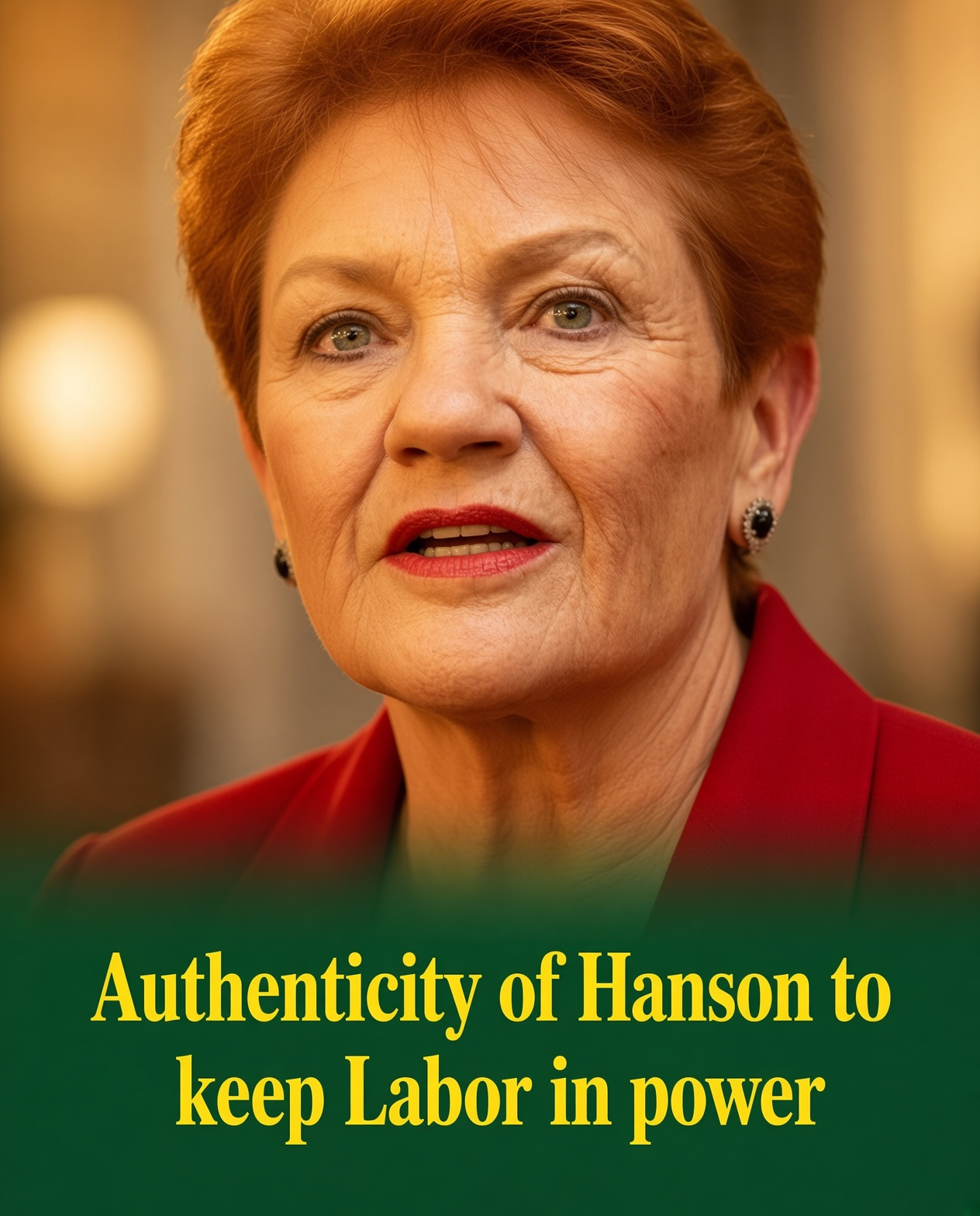
Pauline Hanson’s extraordinary political resurgence is forcing Australia’s major parties to confront an uncomfortable possibility: voters may care less about the thickness of a policy document than whether they believe the politician holding it.
For almost three decades, Hanson has been one of the most recognisable — and divisive — figures in Australian politics.
Governments have changed.
Prime ministers have come and gone.
Political fashions have shifted.
Hanson has remained.
That longevity, once treated as evidence that One Nation belonged permanently on Australia’s political fringe, has unexpectedly become one of her greatest advantages.
As voters become increasingly distrustful of political institutions and increasingly willing to abandon traditional party loyalties, Hanson can make a claim few contemporary politicians can match.
Australians already know who she is.
They may strongly agree with her.
They may intensely dislike her.
But after 30 years, almost nobody can plausibly claim they do not know what Pauline Hanson represents.
And right now, that familiarity is causing a serious problem for the Coalition.
One Nation is no longer a six-per-cent sideshow
The scale of One Nation’s transformation becomes clear when today’s polling is compared with the last federal election.
At the 2025 election, One Nation received about 6.4 per cent of House first preferences nationally, according to the Australian Electoral Commission.
Polling during 2026 has repeatedly put the party above 20 per cent.
Some surveys have placed it above the Coalition.
Some have put it within striking distance of Labor.
A July YouGov poll recorded Labor on 28 per cent, One Nation on 26 per cent and the Coalition on just 20 per cent.
Roy Morgan subsequently put One Nation on 25.5 per cent, again ahead of the Liberal-National Coalition.
More recent Resolve polling reported this week showed Labor on 28 per cent, One Nation on 26 per cent and the Coalition recovering somewhat to 23 per cent.
Individual polls fluctuate.
None should be treated as an election result three years in advance.
But the pattern has persisted for long enough that One Nation’s rise can no longer reasonably be dismissed as a single polling aberration.
The Coalition has the biggest immediate problem
Labor has reasons to worry about One Nation.
But the Coalition has reasons to panic.
Hanson is competing heavily for voters who might once have regarded the Liberals or Nationals as their natural political home.
They include regional voters, outer-suburban households, small-business owners, blue-collar conservatives and Australians dissatisfied with migration, energy policy, housing affordability and the cost of living.
Those voters do not necessarily regard themselves as members of an ideological movement.
Many simply believe the major parties have stopped listening to them.
That distinction is important.
If One Nation’s growth were entirely driven by enthusiasm for a particular policy, the Coalition could theoretically neutralise it by adopting a competing policy.
But if the underlying problem is trust, copying Hanson becomes much harder.
You can copy a policy. You cannot instantly copy authenticity
This is the central argument behind the latest analysis of Hanson’s rise.
Her advantage is not necessarily that One Nation possesses a more sophisticated policy platform than its competitors.
In several areas, the party’s proposals remain contested, incomplete or lacking the implementation detail expected of a government-in-waiting.
Yet Hanson’s supporters often appear willing to tolerate that.
Why?
Because many believe they know what she means even before the detailed policy arrives.
For decades, Hanson has returned to broadly recognisable themes: lower immigration, national sovereignty, scepticism towards political elites, opposition to what she sees as excessive political correctness and a stronger emphasis on Australian citizens and domestic interests.
The political language changes.
The central persona rarely does.
Research suggests personality is a major part of the appeal
Recent polling research supports the proposition that Hanson’s personal political identity matters enormously.
Analysis reported by the Australian Financial Review found that among Australians saying they would vote One Nation, prominent motivations included wanting political change and characteristics associated with Hanson herself rather than detailed attachment to individual policies.
That helps explain why traditional political attacks have sometimes struggled to damage her.
Pointing out that a proposal lacks detail may matter greatly to economists, policy analysts and editorial boards.
It can matter considerably less to a voter whose first question is whether a politician understands why they are angry.
This does not mean policy quality is irrelevant.
A party attempting to govern eventually has to explain how its promises will work, what they will cost and what consequences they will produce.
But elections are fought before governments govern.
And trust is often established before voters read the fine print.
Hanson has survived what would destroy most political careers
Her political history is remarkable partly because of how often it appeared to be over.
Hanson entered federal parliament in 1996.
She lost her seat.
One Nation fractured.
She left the party she helped create.
She unsuccessfully contested numerous elections.
She returned.
She eventually re-entered federal parliament as a Queensland senator.
And now, three decades after becoming a national political figure, she leads a party polling at multiples of the support it received at the 2025 election.
That history gives Hanson something that cannot be produced by a leadership change or campaign consultancy.
Political scar tissue.
Every attack can reinforce the brand
This presents an unusual dilemma for Hanson’s opponents.
Controversy has been embedded in her political identity almost from the beginning.
Criticism from establishment institutions can therefore have two simultaneous effects.
It may persuade Australians who find her views unacceptable.
But among supporters who already believe political, media and cultural institutions are hostile to them, the same criticism can reinforce the belief that Hanson is challenging an establishment determined to silence her.
This does not mean criticism of Hanson is unfair or ineffective by definition.
Her statements and policies should be scrutinised like those of every politician.
It means opponents need to understand the political mechanism they are dealing with.
For some voters, being attacked by institutions they distrust is not evidence against Hanson.
It is evidence for her.
The Coalition cannot decide whether to fight her or imitate her
This is where the centre-right’s predicament becomes particularly severe.
If Liberal leaders attack Hanson aggressively, they risk further alienating voters already moving towards One Nation.
If they imitate her rhetoric, they risk confirming the argument that voters might as well choose the original.
If they move towards the political centre, they potentially leave more space on their right.
If they move right, they risk losing moderate metropolitan seats that have already become increasingly difficult for the Liberal Party.
There is no painless option.
That is the strategic advantage Hanson currently possesses.
Labor benefits from a divided right — up to a point
This explains the provocative argument that Hanson’s resurgence could help keep Labor in government.
It is not because One Nation is a Labor ally.
On many issues, the two parties are bitter opponents.
It is because Australia’s centre-right vote is being divided among competing political vehicles.
A Coalition sitting in the low 20s on primary support faces an extraordinarily difficult route back to majority government.
If One Nation captures voters the Coalition needs to rebuild, Anthony Albanese can potentially remain ahead without Labor itself achieving historically dominant primary support.
Recent polls illustrate the phenomenon.
Labor has frequently remained below 30 per cent while still leading a fractured opposition field.
That is the paradox of Hanson’s success.
One Nation can become substantially stronger while simultaneously making a Labor government harder to defeat.
But primary votes are not seats
There is an enormous qualification.
Australia does not elect governments through a simple nationwide primary-vote contest.
House of Representatives elections are decided electorate by electorate under preferential voting.
Where One Nation’s support is located matters enormously.
So do preference recommendations and voter behaviour.
A party can record a very large national primary vote while converting it inefficiently into lower-house seats if its support is spread broadly rather than concentrated geographically.
This is one of the largest obstacles between One Nation’s impressive polling and a plausible path to government.
Preferences complicate the ‘Labor wins’ theory
There is another reason to avoid assuming that every vote lost by the Coalition to One Nation automatically benefits Labor.
One Nation voters have historically directed a substantial share of their preferences back towards Coalition candidates.
Election analyst Antony Green has documented how One Nation preference flows towards the Coalition increased over time, reaching roughly 65 per cent in 2019.
Preference behaviour can change substantially from election to election, particularly as the party system itself changes.
But the historical evidence illustrates the problem with simply adding national primary-vote figures.
A voter can put One Nation first and ultimately help elect a Coalition candidate ahead of Labor.
Equally, a Coalition voter can preference One Nation in a contest where the major-party candidate has been eliminated.
The next election could therefore produce seat contests Australia has rarely encountered before.
One Nation’s problem is organisational depth
The argument about authenticity also exposes Hanson’s greatest weakness.
One Nation’s political identity remains unusually dependent on Pauline Hanson herself.
The Australian’s current commentary compares that position with European populist parties that have spent years building deeper organisations and broader leadership teams.
A protest party can thrive around one dominant personality.
A governing party requires considerably more.
It needs credible candidates across dozens of electorates.
It needs shadow ministers capable of mastering complex portfolios.
It needs policy development infrastructure.
It needs parliamentary discipline.
It needs advisers, administrators and people capable of negotiating legislation.
It needs a succession plan.
Most importantly, it needs voters to trust people other than its leader.
Hanson cannot personally contest 150 electorates
This may be the most important constraint on One Nation’s next stage of growth.
A voter choosing Hanson in an opinion poll is expressing support for a nationally recognised political figure.
At an election, that same voter receives a ballot containing the name of a local One Nation candidate.
That candidate may be well known.
Or the voter may know almost nothing about them.
For One Nation to convert a national polling surge into a large House presence, Hanson’s personal brand has to become transferable.
That is much harder than generating a national primary-vote number.
Barnaby Joyce changes that equation
One Nation’s recruitment of established political figures potentially helps solve part of this problem.
Barnaby Joyce brings parliamentary experience, national recognition and an existing constituency among regional and conservative voters.
Other candidates with public profiles can similarly make One Nation look less like a vehicle built around a single senator.
But recruitment creates another challenge.
The larger One Nation becomes, the harder it becomes for Hanson personally to control every candidate, message and controversy.
Political movements often discover that scaling successfully is more difficult than gaining popularity.
Policy depth will matter if One Nation keeps rising
There is an irony in Hanson’s success.
The stronger One Nation becomes, the less forgiving voters and institutions will become about gaps in its policy platform.
A party polling six per cent can campaign primarily as a protest movement.
A party polling 25 per cent will be asked what its budget looks like.
How much will its policies cost?
What happens to tax revenue?
How will migration reductions affect labour supply?
How will hospitals obtain staff?
How will housing supply respond?
What happens to universities?
How would its superannuation reforms affect retirement incomes?
What would its energy policies do to investment and electricity prices?
How would its foreign policy operate?
Those questions become unavoidable once voters begin contemplating a party as a potential government rather than merely a vehicle for registering dissatisfaction.
Authenticity gets voters through the door
But Australia’s major parties would be making a serious mistake if they concluded that policy detail alone will reverse Hanson’s rise.
A technically excellent policy presented by a politician voters do not trust may be electorally weaker than an imperfect proposal presented by someone voters believe means what they say.
That is not necessarily desirable.
It is simply part of democratic politics.
Voters assess character as well as spreadsheets.
And Hanson has spent almost 30 years constructing a character that supporters regard as unusually consistent.
The Coalition’s real crisis is trust
The Coalition therefore faces a deeper challenge than recovering a few percentage points in Newspoll.
It needs to give disaffected conservative voters a reason to believe in it again.
Changing leaders cannot automatically do that.
Borrowing One Nation policies cannot automatically do it either.
Neither can simply warning that a vote for Hanson risks helping Labor.
If voters believe the Coalition only adopts positions after discovering through polling that those positions are popular, the contrast with Hanson can become even sharper.
She can say she held the view before it was fashionable.
Her competitors can look as though they arrived after receiving the focus-group report.
That does not make Hanson automatically right
Authenticity and correctness are entirely different qualities.
A politician can sincerely believe a bad policy.
A leader can consistently make an argument unsupported by evidence.
A party can accurately identify public frustration while prescribing a solution that makes the underlying problem worse.
Hanson and One Nation therefore deserve the same scrutiny over costs, implementation and unintended consequences as Labor and the Coalition.
Indeed, if One Nation genuinely wants to govern, it should welcome that higher standard.
Being authentic is enough to become a powerful political insurgent.
It is not enough to administer a country.
Labor should be careful what it wishes for
There is also a danger for Labor in assuming One Nation’s growth is merely a convenient mechanism for destroying the Coalition.
Polling earlier this year showed Hanson drawing support beyond traditional conservative demographics, including some younger and working-class voters.
That means One Nation is not necessarily operating inside a sealed right-wing electoral container.
A prolonged cost-of-living crisis, housing frustration or loss of confidence in government could push voters away from Labor as well.
One Nation’s rise may currently hurt the Coalition most.
There is no guarantee it always will.
Australia may be entering genuinely unfamiliar political territory
For most of modern federal politics, Australians have been able to understand elections primarily as contests between Labor and the Coalition.
Minor parties influenced preferences and the Senate, but government remained overwhelmingly a two-bloc contest.
One Nation’s polling surge challenges that assumption.
ABC analysis earlier this year described the party’s rise as the fastest polling increase in modern Australian politics, after its support moved above 20 per cent nationally and beyond the combined Coalition vote in some surveys.
If anything resembling that three-way contest survives until the next federal election, campaign strategy, preference flows and seat targeting will become substantially more complicated.
Safe seats may cease to be safe.
Traditional Labor-versus-Liberal contests could become three-cornered races.
Regional Australia could become especially volatile.
And voters who once regarded One Nation as a protest vote may increasingly ask whether it could become something larger.
The ultimate test is whether Hanson can build something bigger than Hanson
Pauline Hanson has already achieved something remarkable.
Thirty years after entering federal politics, she has become more electorally relevant rather than less.
Her critics have spent decades predicting her political disappearance.
Instead, she has outlasted generations of Liberal, National and Labor leaders.
That endurance has created the authenticity advantage now troubling the Coalition.
But it also creates One Nation’s defining challenge.
A political identity built over 30 years around one woman now has to become a political institution capable of surviving without depending entirely on her.
If One Nation cannot make that transition, Hanson may remain Australia’s most successful political disrupter while Labor continues benefiting from a divided opposition.
If it can, the consequences will be considerably larger.
Because the important story is no longer simply that Pauline Hanson is taking votes from the Coalition.
It is that millions of Australians appear increasingly willing to abandon the political system that once made the Coalition their automatic alternative to Labor.
The major parties can attack Hanson’s policies.
They can challenge her candidates.
They can scrutinise her numbers.
They can warn voters about the consequences.
But there is one political advantage they cannot manufacture overnight.
After three decades, the Australians voting for Pauline Hanson believe they already know exactly who they are voting for.
For a Coalition struggling to persuade voters what it now stands for, that may be the most dangerous advantage of all.