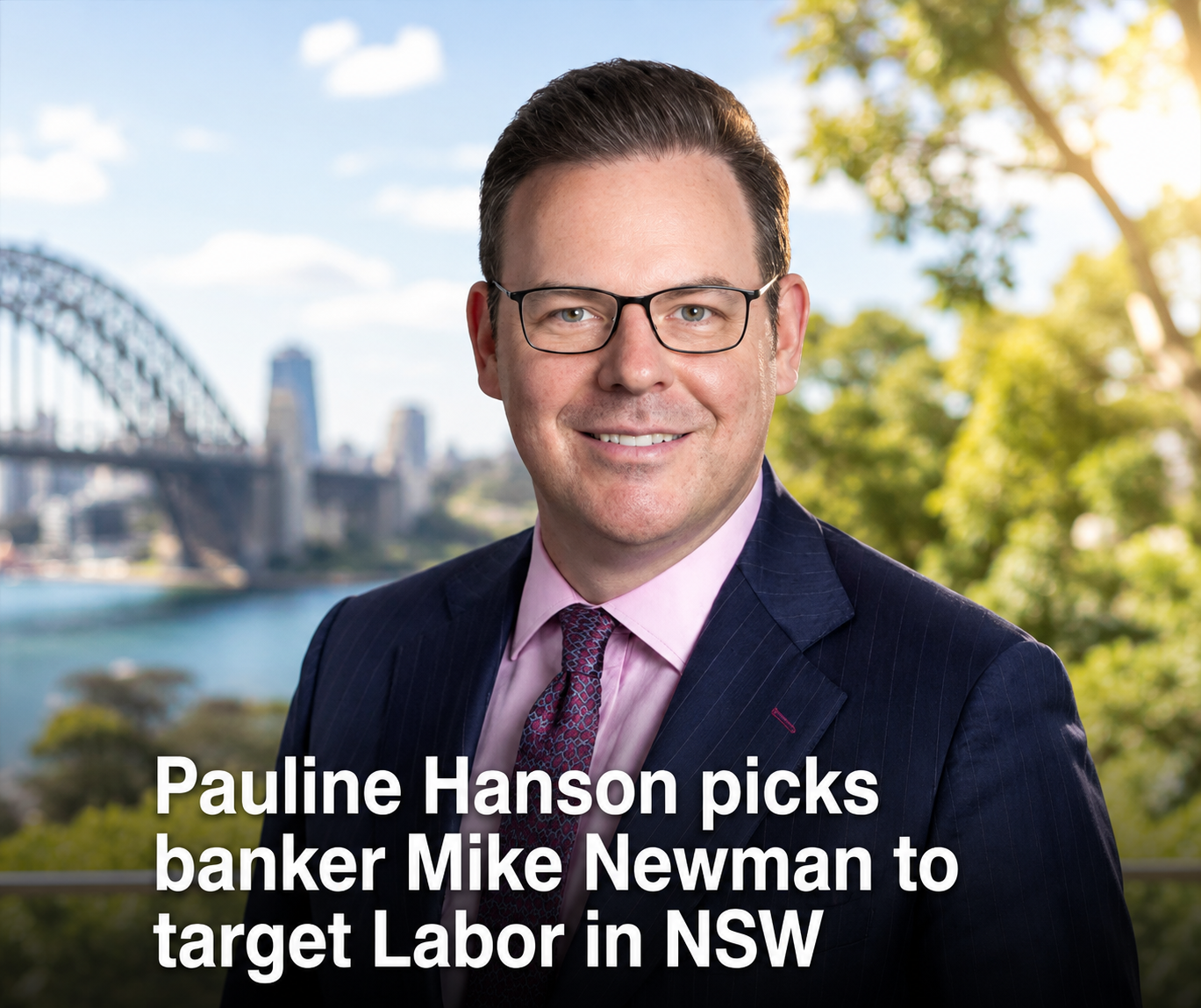
Pauline Hanson has installed former international finance executive and NSW trade commissioner Mike Newman as One Nation’s first major lower-house standard-bearer for the 2027 NSW election, sending him directly into the traditionally Labor-held Hunter seat of Cessnock as the party attempts to convert its rising support into representation at Macquarie Street.
Newman, 54, was formally unveiled on Friday as One Nation’s NSW leader and candidate for Cessnock, while coal miner and cattle farmer Stuart Bonds will lead the party’s Legislative Council ticket.
The appointments give One Nation two candidates with markedly different backgrounds at the top of its NSW campaign: Newman brings decades in international finance, investment and trade, while Bonds has built his political profile around mining, agriculture and the Hunter’s regional industries.
Hanson said Newman’s commercial background made him a strong addition to a party attempting to broaden its appeal beyond its traditional immigration and cultural-policy agenda.
“Mike is another great addition for One Nation,” Hanson said when announcing his appointment.
“He has decades of experience in finance across a range of industries and is very well credentialed.”
The NSW election will be held on Saturday, March 13, 2027, with all 93 Legislative Assembly seats and 21 of the 42 Legislative Council positions up for election.
One Nation sends its new leader into Cessnock
Rather than choosing a more conventional statewide platform for Newman, One Nation is placing its new leader directly into a lower-house contest in the Hunter Valley.
Cessnock is held by Labor’s Clayton Barr, who has represented the electorate since 2011.
The district covers a politically distinctive mixture of former and current mining communities, agriculture, vineyards, tourism and Newcastle’s expanding western fringe.
Labor has dominated the seat for generations. Apart from Liberal Bob Roberts’ victory in the 1988 landslide and his single term before Labor reclaimed Cessnock in 1991, the electorate has remained overwhelmingly Labor territory.
That history makes Newman’s candidacy ambitious.
But the 2023 election also produced a result that helps explain why One Nation sees an opportunity.
Labor’s Clayton Barr won 25,719 first-preference votes, representing 48.73 per cent of the formal vote.
One Nation candidate Quintin King finished second on primary votes with 8,059, or 15.27 per cent.
The Nationals received 11.13 per cent, putting them more than 2,000 primary votes behind One Nation despite the Hunter traditionally being regarded as fertile territory for the Coalition’s regional party.
After preferences, Barr defeated King 73.39 per cent to 26.61 per cent.
That means Cessnock remained a safe Labor seat in 2023, rather than the marginal electorate suggested by some of the rhetoric surrounding Newman’s launch.
But One Nation’s second-place finish gave it an established electoral foothold from which to build.
Newman brings an unusual résumé to state politics
Newman’s professional history is significantly different from that of the typical regional political candidate.
He studied economics and Japanese studies before embarking on a career that would take him deeply into Asian financial markets.
His professional record includes work as a sales executive at Nikko Securities in Tokyo before moving to ABN AMRO, where he worked as an analyst covering aerospace, defence, industrial and automotive sectors between London and Tokyo.
He later became Head of Institutional Japanese Equity Sales at HSBC Securities Japan.
From 2007 until 2015, Newman served as Division Director and Country Head at Macquarie Capital Securities Japan.
He subsequently established Ginga Vale Investments, an advisory business working across Australia, Japan and South Korea.
Newman then returned to government-facing economic work in July 2021 when he became Investment NSW’s Senior Trade and Investment Commissioner for North Asia, covering Japan and Korea and based in Tokyo.
He remained in that position until February 2024.
His background gives One Nation a candidate able to speak from direct experience about international investment, capital markets, Asian business relationships and the interaction between government policy and private enterprise.
It also creates a potential vulnerability: Newman has spent much of his adult professional life outside NSW and must now convince Hunter voters that international experience translates into an understanding of local communities.
Newman puts cost of living and regional industry at centre of campaign
Newman says his campaign will concentrate on economic conditions rather than treating the Cessnock contest primarily as a protest campaign.
“We need to make NSW competitive again,” he said.
“We’ll be focusing on issues like the cost of living, our housing crisis and the neglect of our regional communities and rural industries under Labor.”
He has promised policy settings intended to make it easier for businesses to create jobs and invest in NSW.
At his formal launch, Newman expanded that agenda considerably.
He argued NSW should take lessons from high-growth American states including Texas and Florida, particularly in reducing regulatory burdens and creating a more investment-friendly environment.
Among the measures he has floated are reducing payroll tax, imposing clearer performance measures across the public service and freezing growth in public-sector employment.
Newman has also criticised what he regards as excessive bureaucracy and has argued governments should give businesses greater freedom to operate.
His pitch effectively gives One Nation an economic deregulation agenda to run alongside the party’s established positions on immigration, energy and cultural issues.
Coal and nuclear energy loom over Hunter campaign
Energy policy is likely to become one of the sharpest dividing lines in the Hunter.
Newman says NSW should reverse restrictions on uranium mining and nuclear power and has backed continued investment in coal-fired generation.
He argues the state needs abundant, reliable and competitively priced energy if it wants to maintain manufacturing and attract international capital.
The position aligns closely with One Nation’s broader opposition to net-zero policies and its support for the coal industry.
That message is designed to resonate in a region where coal mining remains economically and culturally significant even as governments pursue a long-term energy transition.
But Labor will contest One Nation’s claim that it has abandoned Hunter industry.
The Minns Government has committed billions of dollars to major regional industrial projects, most notably the intervention designed to secure the future of the Tomago aluminium smelter and thousands of direct and indirect jobs associated with the facility.
The government is also pursuing plans to return passenger train manufacturing to NSW, including production in the Hunter.
Regional Transport Minister Jenny Aitchison has already challenged Newman to clarify One Nation’s position on that program after Bonds questioned aspects of the government’s multibillion-dollar train manufacturing strategy.
It is an early sign of how Labor intends to respond: rather than allowing One Nation to monopolise the language of regional industry, ministers will argue the government is already directing substantial public investment towards Hunter jobs.
Newman faces questions over his connection to Cessnock
Newman’s international credentials produced an awkward moment almost immediately after his announcement.
At Friday’s Singleton launch, journalists questioned whether a candidate who had spent approximately 25 years living and working in Japan had sufficient knowledge of the electorate he now hopes to represent.
Asked to identify a specific Cessnock issue, Newman was unable to nominate one immediately, instead pointing to broader NSW concerns including energy, business competitiveness and regional economic development.
Hanson defended her new state leader, arguing his time overseas did not disconnect him from Australian politics or the issues affecting NSW.
Newman also said he had maintained close connections with Australia while working internationally.
The exchange nevertheless exposes one of Labor’s clearest lines of attack.
Barr has lived in the Cessnock electorate throughout his life and entered Parliament after a career that included teaching and community-sector work.
Newman will therefore need to demonstrate quickly that he is campaigning not merely in a strategically attractive seat, but for its communities.
Stuart Bonds returns as One Nation’s regional campaign heavyweight
One Nation is pairing Newman with one of its better-known Hunter figures, Stuart Bonds.
Bonds, a coal miner and cattle farmer, will lead the party’s NSW upper-house ticket.
He previously demonstrated his electoral appeal at the 2019 federal election when he contested the seat of Hunter.
The result remains one of One Nation’s strongest performances in the region.
Bonds won 22,029 first-preference votes, or 21.59 per cent.
Labor’s Joel Fitzgibbon retained the electorate, but his primary vote dropped 14.2 percentage points to 37.6 per cent. The Nationals received 23.5 per cent, leaving Bonds only 1,913 primary votes behind them.
One Nation had not contested Hunter at the previous election, meaning Bonds’ entire 21.6 per cent represented new primary support for the party.
His message for the state campaign remains heavily focused on resource and agricultural communities.
“Our primary industries like mining and agriculture are under ever-increasing pressure,” Bonds said.
“One Nation backs our miners and our farmers. We back our regional communities.”
Putting Bonds at the head of the Legislative Council ticket allows the party to use that regional profile statewide while Newman concentrates on winning a lower-house seat.
Polling gives One Nation reason for optimism — but not certainty
The strategy comes as polling suggests the traditional Labor-versus-Coalition contest in NSW has become significantly more fragmented.
A DemosAU survey of 1,038 NSW voters conducted from June 15 to 18 reported Labor on 32 per cent of the Legislative Assembly primary vote, One Nation on 27 per cent and the Coalition on 20 per cent.
Most strikingly for the Hunter strategy, the poll reported One Nation at 37 per cent among respondents outside the Sydney basin, compared with Labor on 23 per cent and the Coalition on 19 per cent.
Those regional subsamples should be treated cautiously because they involve fewer respondents than the statewide poll and are not forecasts for individual electorates such as Cessnock.
Other polling has nevertheless confirmed that One Nation has become a substantial force in NSW politics, even if the precise numbers vary between pollsters and surveys.
That distinction matters because statewide support does not translate neatly into Legislative Assembly seats.
One Nation currently has no NSW lower-house representation and has never demonstrated at a general state election that it can convert broad statewide polling into a large number of district victories.
Optional preferential voting adds another layer of uncertainty
NSW’s electoral system also makes predicting the outcome particularly difficult.
Legislative Assembly elections use optional preferential voting.
Voters can simply mark a “1” for their preferred candidate and stop, or continue numbering additional candidates.
That differs from federal House of Representatives elections, where voters must express preferences for every candidate for their ballot to remain formal.
The NSW system means a significant number of ballots can exhaust before the final two-candidate count.
For One Nation, that creates both an opportunity and a challenge.
A sufficiently strong primary vote can place the party in the final count against Labor without relying on the Nationals or Liberals.
But if Newman cannot build enough primary support, preference flows cannot automatically be assumed to consolidate the entire non-Labor vote behind him.
The 2023 Cessnock result illustrates the problem.
One Nation finished second on primary votes but Labor began with almost half the vote and ultimately secured more than 73 per cent of the non-exhausted two-candidate count.
Newman therefore needs substantially more than a modest swing to turn Cessnock into a genuine contest.
One Nation attempts to transform polling into parliamentary power
The wider significance of Newman’s appointment is that One Nation is attempting to build an identifiable state leadership structure before voters go to the polls.
The party has often enjoyed periods of strong support without developing the organisational depth required to compete across dozens of lower-house electorates.
Hanson is now signalling a more ambitious campaign.
Newman provides the public leadership and economic-policy profile. Bonds anchors the upper-house campaign and regional resources message. NSW party president Rebecca Thompson oversees the organisation behind them.
One Nation says it intends to field candidates widely across the state rather than concentrate on only a handful of electorates.
If the party can translate even part of its polling into votes, the consequences could extend well beyond seats it actually wins.
Strong One Nation candidates could reshape contests between Labor and the Coalition, particularly in regional NSW, by taking primary votes from both traditional blocs and changing who reaches the final preference count.
Cessnock will test whether One Nation’s surge has real foundations
For Chris Minns, Newman’s candidacy is not evidence that Cessnock has suddenly become a lost Labor seat.
The 2023 result says otherwise.
But neither can Labor dismiss the challenge.
One Nation already overtook the Nationals on primary votes in Cessnock at the last state election, Bonds has previously demonstrated the party can attract more than one-fifth of first preferences in the federal Hunter electorate, and current polling shows a level of support for One Nation far beyond its historical NSW base.
The party now has to prove those numbers survive the transition from opinion polls to an actual state campaign.
Newman also has to overcome a fundamental local test. His résumé demonstrates extensive experience in finance, trade and international investment, but Cessnock voters will decide whether those credentials matter more than his long period overseas and limited history inside the electorate.
Labor, meanwhile, will point to Barr’s local roots and the Minns Government’s investments in Hunter industry while challenging One Nation to explain how its economic and energy proposals would work in practice.
The contest therefore offers something more useful than the claim that a previously safe Labor seat has already fallen into crisis.
It provides a direct electoral test of One Nation’s transformation in NSW.
If Newman can turn the 15.27 per cent One Nation secured in Cessnock in 2023 into a competitive challenge in March, the party will have evidence that its polling surge is translating into the lower-house seats needed for real influence at Macquarie Street. If he cannot, Cessnock may instead demonstrate the considerable distance between strong statewide polling and actually breaking Labor’s century-old hold on its Hunter heartland.