PART 2
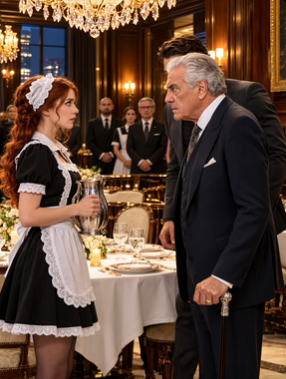
For several seconds after the cane struck the marble, nobody moved.
Then Mateo stepped forward.
“Papa.”
He caught Salvatore lightly by the elbow, but the old man shook him off—not angrily, only impatiently. His attention remained fixed on me.
I could hear the quiet hum of the restaurant’s refrigeration system. Somewhere behind the kitchen doors, a pan clattered and someone immediately hushed it.
Salvatore’s voice was lower when he spoke again.
“Say her name.”
I tightened both hands around the water pitcher.
“Lucia Ferraro.”
His eyes closed.
Something changed in his face.
Until that moment, I had seen only the formidable Sicilian patriarch everyone had warned us about. Now, beneath the expensive suit and stern posture, I saw an old man remembering something he had carried for a very long time.
“Lucia Ferraro,” he repeated.
Mateo looked from his father to me.
“You know her?”
Salvatore opened his eyes.
“I knew her.”
My heart stumbled.
“That’s impossible.”
“Why?”
“My great-grandmother died eleven years ago.”
“I did not say I saw her yesterday.”
There was enough of his earlier sharpness in the answer that, despite myself, I almost smiled.
Salvatore noticed.
To my surprise, so did Mateo.
My manager, Mr. Bell, finally seemed to remember he was responsible for an entire restaurant full of frozen employees.
“Perhaps,” he said carefully, “we could arrange some privacy.”
Mateo nodded.
“The library.”
Bellori had a small private dining room inexplicably called the library because one wall was lined with books no customer had ever opened.
Salvatore picked up his cane.
Then he looked at me.
“You will come.”
It sounded less like an invitation than a fact.
I straightened.
“I’m working.”
My manager made a strange choking sound.
Mateo’s mouth moved slightly.
His father stared at me.
Then, to the astonishment of everyone watching, Salvatore Vitiello nodded.
“You are Lucia’s blood.”
“I’m also scheduled until eleven.”
For one second Mateo turned his face away.
I had the distinct impression he was hiding a smile.
Mr. Bell cleared his throat.
“Tessa, I believe we can spare you for twenty minutes.”
“You said table service was short tonight.”
“We will survive.”
“That sounded almost painful,” I murmured.
Mateo heard me.
“I think he’s having a difficult evening.”
Mr. Bell pretended he hadn’t heard either of us.
I followed the Vitiellos into the library.
Only Mateo and Salvatore came inside. The men who accompanied them remained beyond the doors.
That made me breathe a little easier.
I set the pitcher on the sideboard.
Salvatore sat slowly.
Mateo remained standing.
“Sit,” Salvatore told me.
“I’m fine.”
“Lucia never sat when she was told either.”
That made me pause.
Finally, I took the chair across from him.
“How did you know her?”
Salvatore rested both hands on the silver head of his cane.
“Where did she tell you she came from?”
“Western Sicily. A village outside Santa Ninfa.”
His eyes sharpened.
“And what did she tell you about leaving?”
“Not much.”
That was true.
Great-Grandma Lucia had been a woman of stories, but the stories were almost never about herself.
She talked about olive trees and church bells. About summer kitchens where tomatoes covered every available surface. About goats that escaped at exactly the worst possible moment.
She had taught me old prayers and older insults.
But whenever I asked why she had left Sicily, she would smile and say, Some doors open because you knock. Others open because the wind decides you have stayed long enough.
At eight years old, I had thought that was beautiful.
At twenty-seven, I realized it was an extremely effective way of avoiding a question.
“She came to Chicago when she was nineteen,” I said. “She married my great-grandfather three years later.”
“Antonio Ferraro.”
I stared.
Mateo stopped pacing.
“You knew him too?”
“No.”
Salvatore leaned back.
“I met Lucia before Antonio ever did.”
The room became strangely small.
“How?”
Salvatore looked toward the bookshelves, although I suspected he wasn’t seeing them.
“In 1968, much of western Sicily was struck by earthquakes. Villages were damaged. Families were displaced. Mine was among them.”
I knew the history. Great-Grandma Lucia had mentioned the earthquakes, but only vaguely.
“My father was proud,” Salvatore continued. “Too proud. He would accept help from no one. Lucia was eighteen years old and apparently considered my father’s pride an inconvenience.”
That sounded exactly like her.
“What did she do?”
“She brought food.”
A faint smile touched Salvatore’s mouth.
“My father refused it. She brought more the following day.”
I laughed before I could stop myself.
Salvatore looked pleased.
“On the third day, my father told her never to return.”
“And?”
“She arrived with blankets.”
Mateo finally sat.
“I like her already.”
“You would not have enjoyed being ordered about by her.”
Mateo looked at me.
“I’m beginning to understand.”
I ignored him.
Salvatore continued.
“Lucia’s family had relatives in Palermo and Chicago. They helped several people find temporary places to stay. My mother and younger sister were among them.”
“That doesn’t explain why you reacted like you saw a ghost.”
“No.”
The warmth vanished from his expression.
“Because there is more.”
Mateo leaned forward.
“What more?”
Salvatore looked at his son.
Apparently Mateo truly didn’t know.
That unsettled me more than anything.
“My father had lost nearly everything,” Salvatore said. “When our family began again, Lucia lent him money.”
“How much?”
“Enough.”
I waited.
He sighed.
“Your great-grandmother would not allow him to repay her.”
“That also sounds like her.”
“She said it was not charity. She said one day we would find someone else who needed a door opened.”
Mateo’s gaze shifted toward me.
I didn’t like where this seemed to be going.
“So that’s why I’m here?”
Salvatore frowned.
“What?”
“Some seventy-year-old family debt?”
My chair scraped softly as I stood.
“I appreciate the history, Mr. Vitiello, but I don’t need anyone repaying me for something my great-grandmother did before my grandmother was even born.”
Salvatore’s eyebrows rose.
Mateo studied me.
I reached for the pitcher.
“I have student loans like everyone else. I have rent. I have nursing clinicals beginning again Monday morning, which means I’ll probably survive entirely on coffee until December, but those are my choices. They aren’t your responsibility.”
“Tessa.”
Mateo’s voice was quiet.
I turned.
“That isn’t why my father reacted.”
Salvatore looked irritated.
“You do not know why I reacted.”
“No,” Mateo said. “But I know you.”
There was something unexpectedly gentle in his tone.
Salvatore looked away.
Mateo stood.
“Three months ago, my father asked me to locate someone.”
My fingers tightened around the pitcher handle.
“Who?”
“A descendant of Lucia Ferraro.”
I stared at him.
The silence returned.
“You knew?”
“Not at first.”
“Since when?”
“About five weeks.”
I mentally counted backward.
Five weeks.
Mateo had started coming to Bellori three weeks ago.
My eyes narrowed.
“Table Four.”
He didn’t answer.
“Oh, you have got to be kidding me.”
“Tessa—”
“You didn’t randomly start eating here.”
“No.”
“And you didn’t randomly request me.”
“No.”
“And all those questions?”
He actually had the decency to look uncomfortable.
“Some of those were random.”
“My wrist?”
“You had a burn.”
“My foot?”
“You were limping.”
“My work schedule?”
“I never asked your work schedule.”
“You knew it.”
“Your manager told me.”
I stared toward the closed door as if I might be able to see Mr. Bell through solid wood.
“Wonderful.”
Mateo stepped closer, stopping well outside my personal space.
“I was trying to confirm your family connection without involving you until I knew.”
“You could have asked.”
“Yes.”
I blinked.
That was not the argument I had expected.
“Yes?”
“Yes. I should have.”
No defense.
No excuse.
Just an answer.
Somehow, that took the wind out of my anger.
Salvatore tapped his cane once.
“You are both making this more complicated.”
Mateo gave him a look.
“That appears to be hereditary.”
The old man ignored him.
I sat again, mostly because my knees had suddenly become unreliable.
“Why were you looking for Lucia’s family?”
Salvatore’s fingers tightened around his cane.
“Because she wrote me a letter.”
“When?”
“Thirty-seven years ago.”
“And?”
“I never received it.”
I frowned.
“That doesn’t make sense.”
“It was returned to her. I was moving between countries then. She apparently kept it.”
“How do you know?”
“Because seven months ago, I received another letter.”
“From Lucia?”
“She had been dead ten years.”
A chill moved along my arms.
“Then from whom?”
“A lawyer settling the estate of a distant relative of hers in Palermo. Among some old family papers was a copy of a note Lucia had written. It mentioned me.”
Mateo added quietly, “My father became convinced the original letter might still exist with Lucia’s descendants.”
“And you thought I had it?”
“We didn’t know.”
Salvatore looked at me.
“Do you?”
I shook my head.
“I’ve never seen anything addressed to you.”
“Your grandmother?”
That made me hesitate.
Grandma Rosa was eighty-four and had inherited almost everything Lucia had kept.
Boxes of photographs.
Recipe books.
Embroidery.
Letters tied with ribbon.
She lived in a bright apartment near Lincolnwood now and guarded those boxes like national treasures.
“I can ask.”
Salvatore’s face softened.
“Rosa.”
“You know her name too?”
“I met her once.”
“What?”
“She was four.”
That knowledge felt oddly intimate.
My grandmother had never spoken of him.
“Why would Lucia write you after so many years?”
“That,” Salvatore said, “is what I wish to know.”
I looked at Mateo.
He had known pieces of this.
Not all of it.
That mattered somehow.
“You could have told me.”
“Yes.”
“Why didn’t you?”
He took his time answering.
“Because the Vitiello name makes people cautious.”
That was an understatement.
“And?”
“And I wanted to know whether you were Lucia’s great-granddaughter before I placed my father’s history in the hands of a stranger.”
I should have been offended.
Instead, I understood.
Not completely.
But enough.
My phone buzzed inside my apron.
My break had ended eleven minutes ago.
I stood.
“I really do have tables.”
Mateo glanced toward the dining room.
“My family can survive without water for five minutes.”
“They aren’t my only tables.”
“They are tonight.”
“They still need dessert.”
Salvatore muttered something in Sicilian.
I understood every word.
“So stubbornness is hereditary on your side too?” I asked.
The old man’s head snapped up.
Mateo laughed.
Actually laughed.
It transformed his face so completely that for a second he looked younger, almost ordinary.
Then Salvatore began laughing too.
Outside the library, someone shifted abruptly, probably wondering what impossible event had occurred inside.
I picked up the pitcher.
“I’ll call my grandmother tomorrow.”
Salvatore nodded.
Then, as I reached the door, he spoke.
“Tessa.”
I turned.
“Your great-grandmother was one of the bravest people I knew.”
There was no performance in his face now.
Only gratitude.
“She changed the direction of my family.”
I swallowed.
“I wish she’d told me.”
“Perhaps,” he said, “she believed the story belonged to you only when you were ready to hear it.”
Grandma Rosa answered my call at nine seventeen the following morning.
“Teresina?”
Only she called me that.
“Hi, Grandma.”
“Are you eating?”
“I had toast.”
“Toast is not food.”
“We’ve had this discussion.”
“And you remain wrong.”
I smiled despite the restless night I had spent replaying Bellori in my head.
“Grandma, can I ask you something about Great-Grandma?”
Silence.
Not long.
Maybe two seconds.
But I noticed.
“What about her?”
“Did she know someone named Salvatore Vitiello?”
The silence this time was longer.
My smile disappeared.
“Grandma?”
“Yes.”
One word.
Quiet.
Careful.
“You knew?”
“I knew the name.”
“He says he met you.”
“I was a child.”
“Why did you never tell me?”
“Why would I?”
“Because apparently Great-Grandma helped his entire family after the earthquake, lent his father money, and wrote Salvatore a letter thirty-seven years ago.”
Grandma Rosa breathed slowly into the phone.
“Where did you hear this?”
I sat on the edge of my bed.
“I met him.”
“You met Salvatore Vitiello?”
“At Bellori.”
Another silence.
“And Mateo was there.”
That produced a sound I couldn’t identify.
“What?”
“Nothing.”
“Grandma.”
“I said nothing.”
“You said nothing in the way you always say nothing when it is definitely something.”
She sighed.
“You sound like your great-grandmother.”
“I’ve been hearing that a lot lately.”
I told her everything.
When I finished, Grandma remained quiet for so long that I checked the screen to make sure the call hadn’t dropped.
Finally she said, “Come here.”
“Now?”
“If you can.”
I could.
Saturday was my rare free morning.
Forty minutes later, I entered her apartment carrying two coffees and the almond cookies she pretended not to like.
Grandma Rosa was waiting beside the dining table.
A faded blue metal box sat in front of her.
I stopped.
I knew that box.
It had lived for years on the highest shelf of Great-Grandma Lucia’s bedroom closet.
“What’s in there?”
Grandma folded her hands.
“Things your great-grandmother told me not to throw away.”
“Have you opened it?”
“Not in twenty years.”
My pulse quickened.
Grandma pushed the box toward me.
The tiny latch opened with a soft metallic snap.
Inside were photographs.
Immigration documents.
A rosary wrapped in linen.
Several postcards.
A dried sprig of something that had long ago lost its color.
At the bottom lay three envelopes tied together with a faded green ribbon.
Grandma’s hand covered mine.
“Wait.”
I looked at her.
She seemed suddenly older.
Not frightened.
Sad, perhaps.
Or simply aware that once certain things were known, they could never become unknown again.
“Your great-grandmother believed people should inherit love,” Grandma said, “but not obligations.”
I frowned.
“What does that mean?”
“I don’t know.”
“Grandma.”
“I truly don’t.”
She released my hand.
I untied the ribbon.
The first envelope contained a letter to my grandmother.
The second held old photographs.
The third was thicker than the others.
Across its yellowed front, in Great-Grandma Lucia’s unmistakable handwriting, were six words.
For Salvatore Vitiello, if he asks.
My breath caught.
Grandma Rosa closed her eyes.
I carefully unfolded the letter.
The paper trembled between my hands.
The first sentence stopped me cold.
Dear Salvatore, if you are reading this, then you still believe your family owes mine a debt.
I looked at Grandma.
Then I read the second sentence.
And everything I thought I understood changed.
You must finally know the truth: the debt was never money.
-END OF PART 2, –PRESS NEX PART IN BOTTOM OF PAGE TO READ NEXT PART