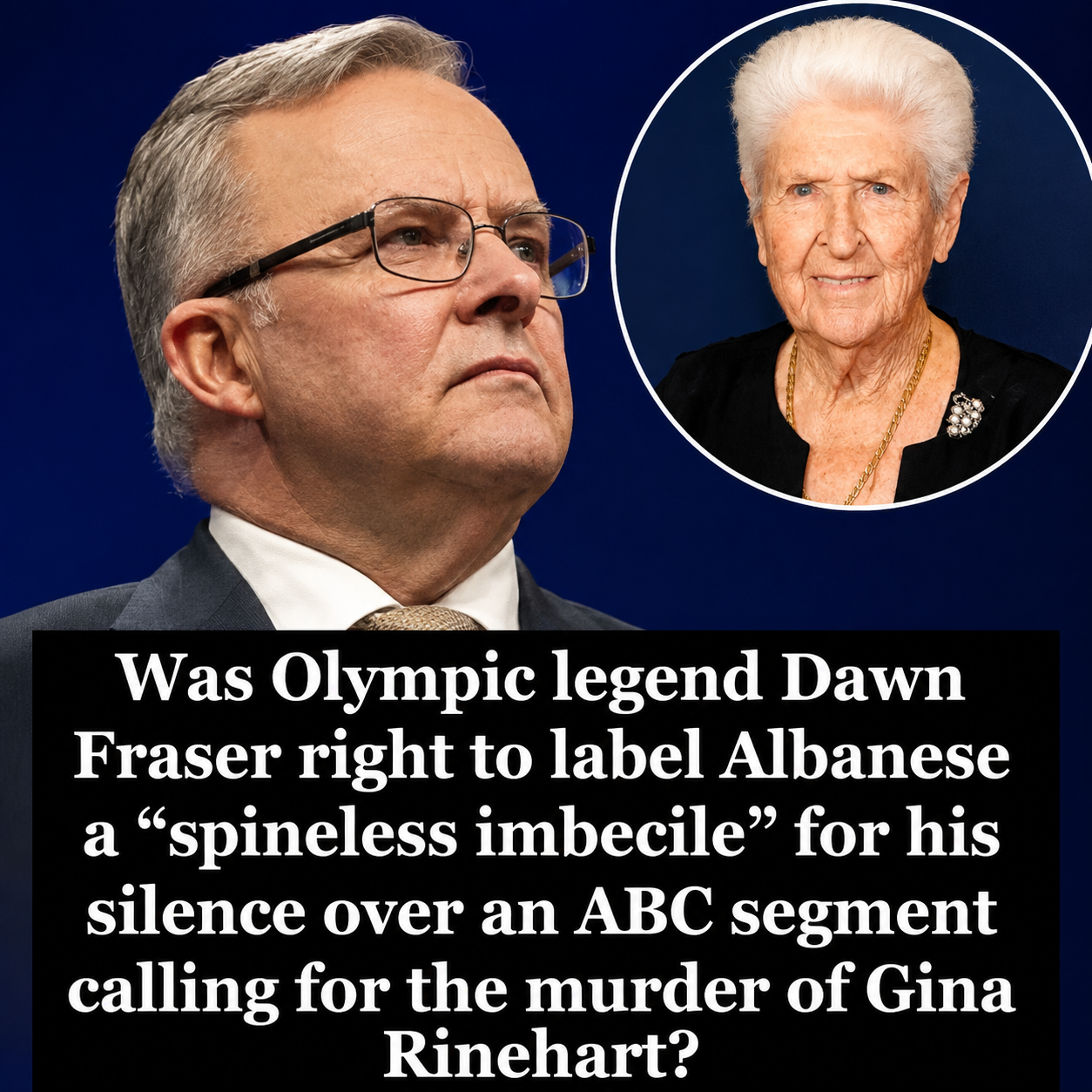
Olympic swimming legend Dawn Fraser has launched a blistering attack on Prime Minister Anthony Albanese, accusing him of remaining silent while the ABC broadcast what she described as unacceptable content targeting mining executive Gina Rinehart.
Fraser’s comments come as legal and political pressure continues to mount on the national broadcaster over a controversial segment aired during the ABC’s Race Around The World program, with Hancock Prospecting pursuing legal action and the ABC Ombudsman conducting an independent investigation into audience complaints.
Writing on social media, Fraser said she was “sick to my stomach” that a taxpayer-funded broadcaster had aired material depicting graphic violence against one of Australia’s most prominent business figures.
She criticised Albanese for failing to publicly condemn the broadcast, calling the Prime Minister “spineless” and accusing him of remaining silent despite the controversy surrounding the program. Fraser argued that allowing such material to be broadcast without public criticism from the nation’s political leadership reflected poorly on both the government and the ABC.
Fraser’s remarks have attracted significant attention not only because of her status as one of Australia’s greatest Olympians, but also because of her long-standing relationship with Gina Rinehart.
Rinehart and Hancock Prospecting have provided substantial financial support to Australian swimming and other elite sports programs over many years, including bonus payments for medal-winning athletes at major international competitions. Fraser has frequently praised those contributions and has appeared alongside Rinehart at numerous sporting events.
The dispute centres on a four-minute satirical film broadcast as part of the ABC’s Race Around The World series on 12 July.
Created by filmmaker Kate McGuinness, the segment concluded with graphic and violent language directed at Rinehart. Critics argued that the closing narration crossed the line from satire into material that appeared to normalise violence against an identifiable individual.
McGuinness later issued a public apology, saying the piece had always been intended as exaggerated, cartoon-style satire rather than any encouragement of real-world violence.
She apologised to anyone offended by the film and said its language was never intended to be interpreted literally.
Despite that apology, Hancock Prospecting maintains the ABC itself has failed to accept responsibility.
The company says it repeatedly requested that the broadcaster remove the segment from its platforms, issue a public apology to Rinehart and investigate how the material was commissioned and approved. After those requests were unsuccessful, Hancock Prospecting commenced legal action against the ABC and several senior executives, alleging multiple civil and criminal law breaches. Those allegations have not been determined by a court, and the ABC has not admitted any legal wrongdoing.
The ABC has confirmed it received legal correspondence and has referred complaints about the program to its independent Ombudsman.
The broadcaster initially defended the segment as editorially justifiable within the context of satirical programming but has declined to comment further while the Ombudsman’s review remains underway.
Although Fraser criticised the Prime Minister directly, several members of the Albanese Government have publicly expressed concern about the broadcast.
Communications Minister Anika Wells described the segment as “unacceptable” while emphasising that the government respects the ABC’s statutory editorial independence. She supported referring the matter to the Ombudsman rather than political intervention in editorial decisions.
Health Minister Mark Butler subsequently called the content “rubbish” and “pretty revolting”, saying it was not the sort of material Australians should expect to see on television regardless of who the target happened to be. Butler also backed the Ombudsman’s investigation while acknowledging he had not viewed the entire segment.
At the time of Fraser’s comments, Anthony Albanese had not made a public statement specifically addressing the segment involving Rinehart. That silence became the central focus of Fraser’s criticism, with the Olympic champion arguing that stronger leadership was required when controversial material is broadcast by Australia’s publicly funded national broadcaster.
The controversy has generated debate well beyond politics.
Supporters of Hancock Prospecting argue the ABC applied inconsistent editorial standards by allowing graphic violent language directed at a well-known individual while maintaining the material was protected satire.
Others have defended the principle of artistic and satirical expression, noting that political and corporate figures have long been subjects of robust criticism in Australian media. Even among those defending satire as a legitimate form of expression, some commentators have questioned whether the language used in this particular segment exceeded reasonable editorial boundaries.
The dispute has also renewed discussion about the responsibilities of publicly funded broadcasters.
Under the ABC’s Editorial Policies, potentially offensive material must be supported by a clear editorial purpose and be appropriate to its context. Whether those standards were met in this case will form part of the Ombudsman’s review, which remains ongoing.
Media law specialists note that the Ombudsman’s investigation and Hancock Prospecting’s legal proceedings serve different purposes.
The internal review will assess compliance with the ABC’s editorial standards, while any future court proceedings will consider the legal claims advanced by Hancock Prospecting. Those judicial issues have yet to be tested before a court.
For Fraser, however, the issue extends beyond legal processes.
Her criticism centres on what she sees as a failure by Australia’s political leadership to speak out against content she considers unacceptable when broadcast by a taxpayer-funded institution. Whether others share that assessment remains a matter of public debate.
What is clear is that the controversy continues to widen, drawing in senior ministers, prominent sporting figures, business leaders and legal experts while placing the ABC’s editorial decision-making under intense public scrutiny.
With the Ombudsman’s investigation still underway and Hancock Prospecting’s legal action progressing, the dispute is likely to remain one of Australia’s most closely watched media controversies in the weeks ahead.