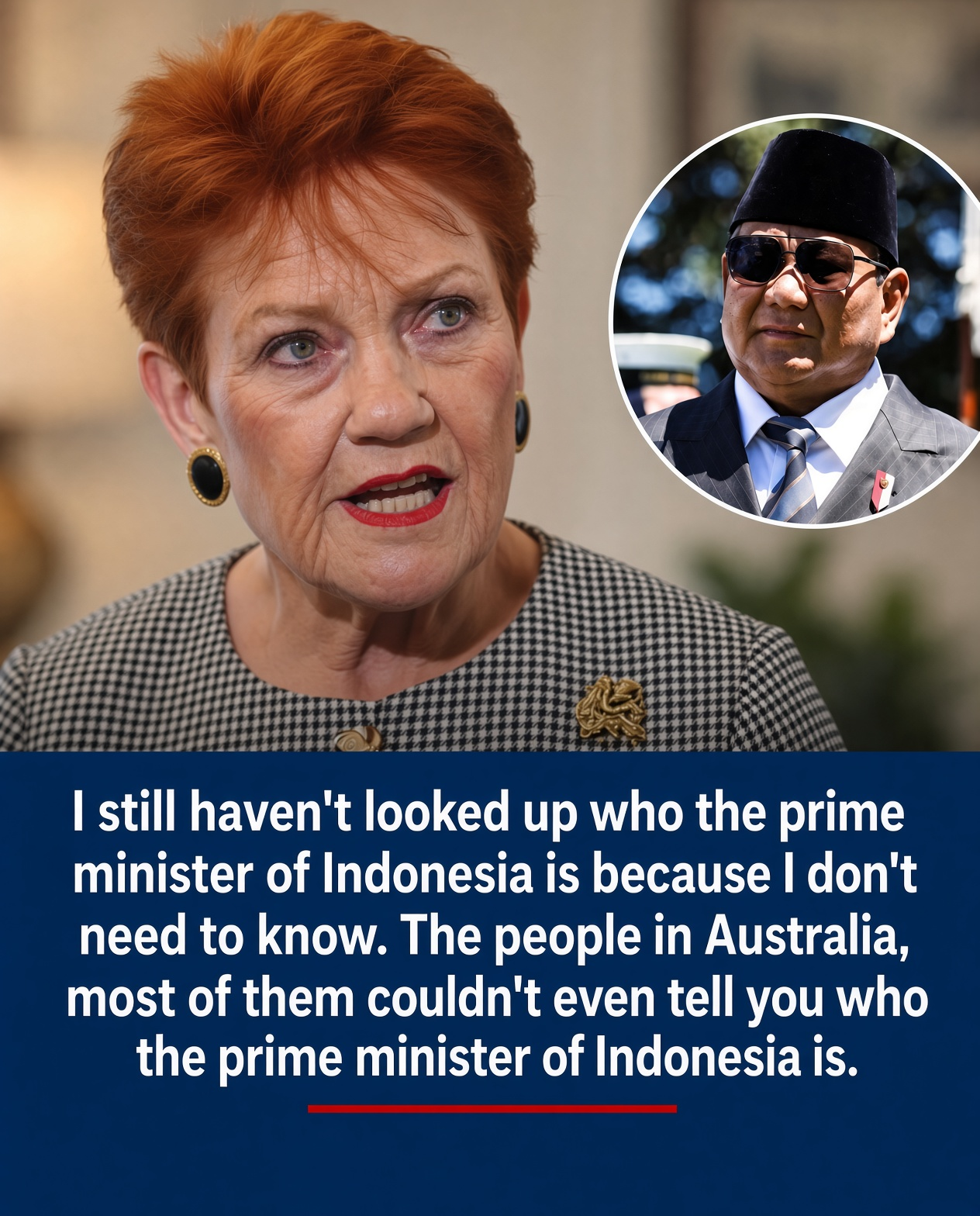
Pauline Hanson has defended her failure to name two of Australia’s most important regional leaders by arguing that most Australians would not know the answers either — but there is one obvious difference: most Australians are not publicly positioning themselves as potential prime ministers.
The One Nation leader has faced renewed scrutiny after struggling to identify Indonesian President Prabowo Subianto and Japanese Prime Minister Sanae Takaichi during an interview for News24’s The Fight for the Right.
Asked about the episode again on Sunday, Hanson remembered Takaichi’s name.
Indonesia remained a problem.
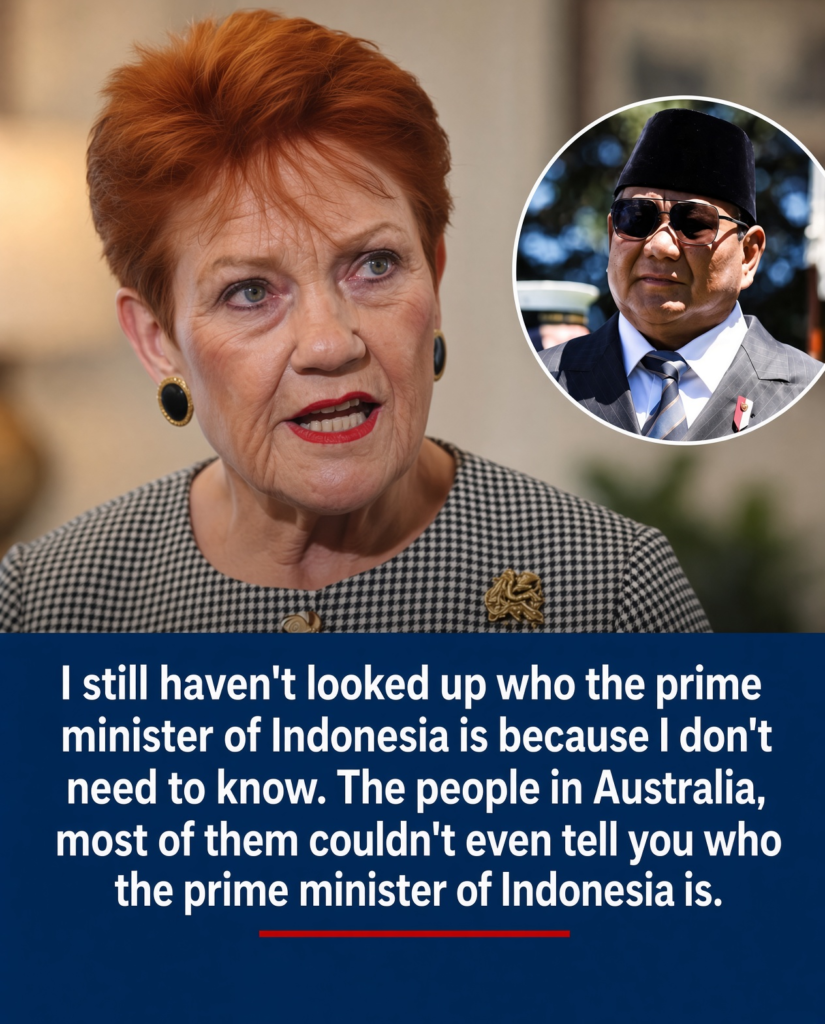
“I do remember Takaichi, but you know what? I still haven’t looked up who the prime minister of Indonesia is because I don’t need to know,” Hanson said.
There is no prime minister of Indonesia.
Indonesia has a presidential system, and its president is Prabowo Subianto.
Hanson then sought to put the mistake into the context of what ordinary Australians themselves know about international politics.
“The people in Australia, most of them couldn’t even tell you who the prime minister of Indonesia is,” she said.
That particular proposition is technically impossible to satisfy because the office does not exist.
But the broader point Hanson was making is clear: she does not believe politicians should be judged by whether they can instantly recall the names of every foreign leader.
She also argued that governments and leaders can change before Australia’s next federal election, questioning the value of memorising names she does not currently need to deal with personally.
“I don’t have to deal with them,” Hanson said.
That defence raises a more consequential question than the original television quiz.
What should Australians reasonably expect a prospective prime minister to know?
Hanson has said she could do the top job
If Hanson were merely being asked to participate in a foreign-affairs trivia contest, the episode would carry little significance.
She is not the Foreign Minister.
She is not the Prime Minister.
And politicians, like everyone else, forget names.
But Hanson has explicitly entertained the prospect of becoming prime minister.
At a Leadership Matters event in Perth on July 21, she was asked whether she could perform the country’s top political job.
Her answer was unequivocal.
“I have no doubt” she could do it, Hanson said.
She qualified that ambition by saying her priority was putting the right person in the right job rather than making the contest about herself.
“It’s not about Pauline Hanson becoming prime minister,” she said.
“I want the right person in the right job. And if someone I believe can do a better job than I can, then go for it.”
That makes the latest defence more politically relevant.
The appropriate comparison is not necessarily between Hanson and an average voter walking down an Australian street.
It is between Hanson and the standard Australians expect from someone asking to be considered capable of leading the Commonwealth.
How the original ‘gotcha’ happened
The controversy began with an advance clip from Chris Kenny’s News24 documentary The Fight for the Right.
Kenny asked Hanson whether she knew who led Indonesia.
She could not remember Prabowo’s name.
Asked about Japan, she also struggled to name Takaichi.
Hanson was, however, able to identify Chinese President Xi Jinping.
Hanson subsequently dismissed the questioning as another media “gotcha” exercise.
There is some force to that complaint.
Political interviews frequently use rapid-fire factual questions because a forgotten name produces an immediately shareable clip while a detailed discussion of policy rarely does.
Knowing a person’s name does not prove a politician understands the country’s economy, military, political system or strategic importance.
Conversely, temporarily forgetting a name does not prove someone knows nothing about foreign affairs.
But Hanson complicated that defence when, given another opportunity days later, she said she still had not looked up Indonesia’s leader and again described him as a prime minister.
The second exchange therefore shifted the story.
The first mistake could easily be explained as a momentary memory lapse.
The later answer became a statement about what Hanson believes she needs to know.
Indonesia is not just another country
The significance of Indonesia makes that distinction important.
Indonesia is Australia’s enormous northern neighbour and one of the countries most consequential to Australia’s long-term security.
The relationship encompasses defence, trade, counter-terrorism, maritime security, education and regional diplomacy.
Prabowo is therefore not simply one name among nearly 200 national leaders.
He is the president of a country central to Australia’s strategic environment.
Recent commentary following Hanson’s initial mistake has pointed out that ignorance about Indonesia is hardly confined to One Nation.
The Australian’s foreign-affairs analysis argued the episode exposed a much wider deterioration in Australia’s knowledge of Indonesia, including declining Indonesian-language study and weakening institutional expertise.
That broader problem actually strengthens rather than eliminates the case for greater knowledge among national political leaders.
If ordinary Australians know too little about their nearest major neighbour, the solution is unlikely to be expecting prospective prime ministers to know equally little.
Japan matters too
Japan occupies an equally important, though different, position in Australian foreign policy.
Australia and Japan have developed an increasingly close strategic relationship covering defence, energy, investment and regional security.
Prime Minister Anthony Albanese met Takaichi in May, with the two leaders agreeing to strengthen cooperation on economic and energy security.
The discussions also covered China, North Korea, the Middle East and cooperation through the Quad.
Takaichi described Australia and Japan as “quasi-allies” and said cooperation between the two countries and their common ally, the United States, was indispensable.
That context makes Japan’s leadership directly relevant to Australia’s national interests.
There is another reason Hanson’s initial inability to name Takaichi attracted attention.
Hanson had been sharply critical of Albanese over a controversial podcast episode involving an alleged remark about the Japanese leader.
Albanese rejected the interpretation of his gesture as sexual.
Hanson’s critics therefore questioned how she could become heavily involved in a controversy concerning Takaichi while being unable to identify her by name when subsequently asked.
Is it really a fair test of leadership?
There is nevertheless a legitimate argument against treating name-recall tests as decisive measures of political competence.
A prime minister does not govern by taking a closed-book examination.
Prime ministers have advisers, diplomats, intelligence briefings, departmental secretaries and extensive briefing materials.
What matters far more than instantaneous recall is whether a leader understands Australia’s interests, can absorb complex information, exercises sound judgement and can build productive relationships with foreign governments.
A politician could memorise the names of every world leader and still be disastrous at foreign policy.
Another could occasionally forget a name while possessing a sophisticated understanding of strategic affairs.
Hanson is therefore entitled to challenge the idea that a single failed quiz proves she is incapable of leadership.
But that is not quite the same as saying she does not “need to know”.
Anyone seriously contemplating the prime ministership would inherit responsibility for Australia’s relationships across the Indo-Pacific from their first day in office.
Indonesia and Japan would be among the most important.
The comparison with ordinary Australians only goes so far
Hanson’s appeal has always rested partly on presenting herself as an ordinary Australian rather than a member of the political establishment.
That helps explain the political logic behind her response.
If many Australians cannot name Prabowo, why should journalists use the same failure to portray Hanson as uniquely uninformed?
It is a potent anti-establishment argument.
But seeking the prime ministership necessarily changes the standard.
Most Australians could probably not explain the details of AUKUS procurement, the Pacific security architecture, the National Cabinet system or the federal budget either.
They are not required to.
The prime minister is.
Australia does not expect every voter to possess the knowledge required to manage the machinery of the Commonwealth.
It expects the people seeking to run that machinery to demonstrate substantially greater preparation.
That is why the most important part of Hanson’s latest response is not that she forgot Prabowo’s name.
It is that she said she did not need to know it.
One Nation is no longer being judged as a protest party
The episode also reflects a larger transformation underway around One Nation.
As the party’s electoral support has grown, Hanson is increasingly being scrutinised not merely as a political insurgent but as the leader of a party asking Australians to consider it a serious alternative to the established major parties.
That inevitably changes the questions.
A minor protest party can campaign largely on identifying problems and attacking governments.
A prospective governing party must demonstrate that it can administer departments, manage the economy, command national security institutions and represent Australia internationally.
Hanson herself has encouraged that higher level of scrutiny by saying she has no doubt she could perform the prime minister’s job.
One Nation is also developing increasingly detailed proposals in areas including migration, counter-terrorism, housing and superannuation.
Its recently reported foreign terrorist fighter legislation, for example, would alter several Commonwealth laws in an effort to prevent people associated with terrorist organisations from returning to Australia.
Once a party asks to be taken seriously on national security and foreign affairs, knowledge of Australia’s regional partners becomes more difficult to dismiss as trivia.
The real test is bigger than two names
None of this means Australians should decide Hanson’s fitness for office based on whether she can recall Prabowo Subianto on demand.
That would reduce a serious leadership question to television entertainment.
The better test is considerably broader.
What would a Hanson-led government seek from Indonesia?
How would One Nation manage Australia’s relationship with Japan?
How would it approach China?
Would its proposed migration restrictions complicate relationships with neighbouring countries?
How would Hanson balance trade interests against national-security concerns?
What would One Nation do with AUKUS, the Quad and Australia’s Pacific relationships?
Those questions reveal far more about readiness for government than a memory test.
But knowing who sits across the table is still a reasonable place to start.
Hanson is correct that most Australians do not spend their days memorising the names of foreign presidents and prime ministers.
They have jobs, families, mortgages and household bills to worry about.
They employ governments to handle international relations on their behalf.
And that is precisely why the comparison with the average Australian ultimately breaks down.
Most Australians do not aspire to become prime minister.
Pauline Hanson has said she could do the job.
If One Nation’s rise continues, voters are entitled to judge her accordingly.