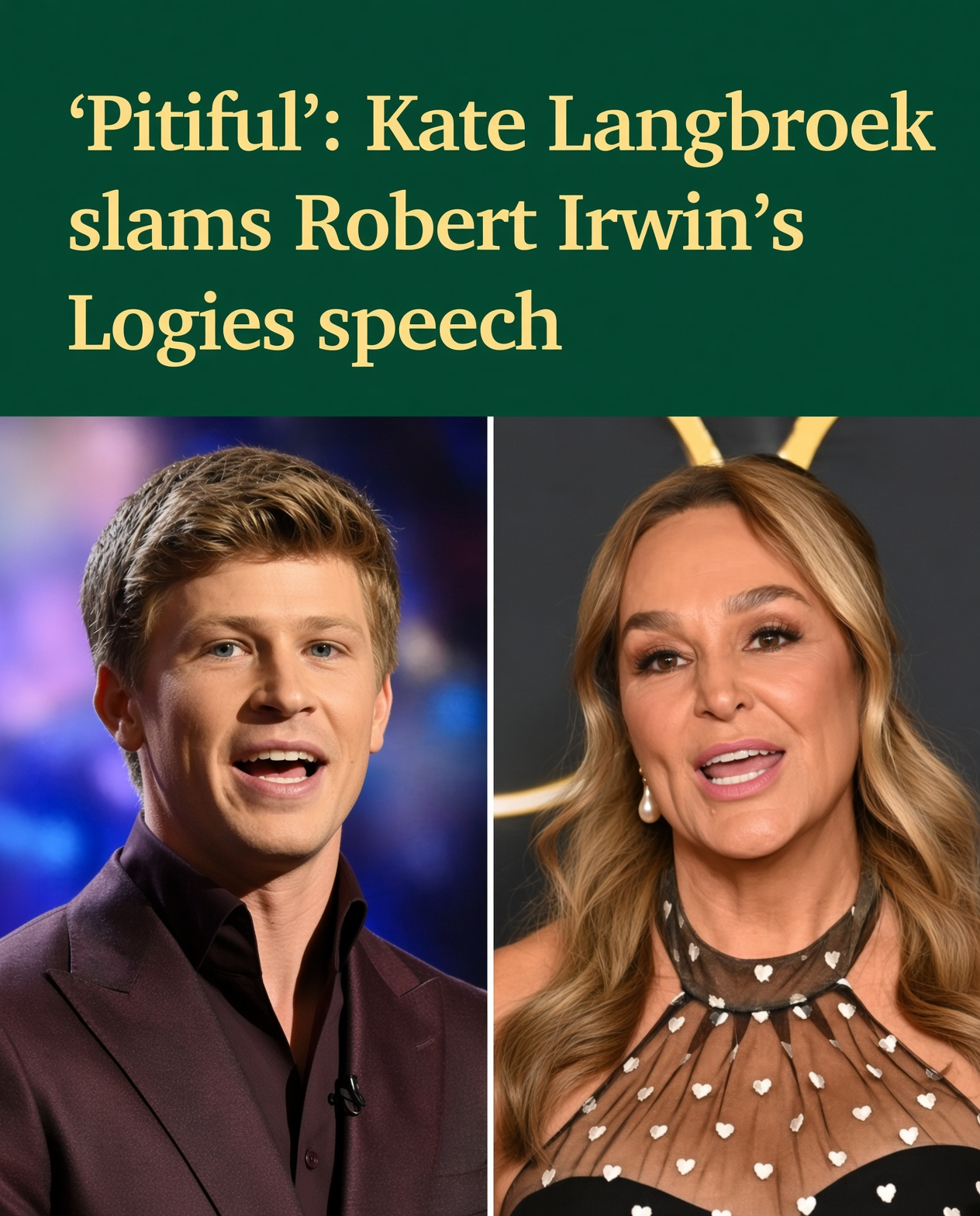
Kate Langbroek has unloaded on Robert Irwin’s Logies opening monologue, questioning the “integrity” of jokes aimed at Karl Stefanovic and Dave Hughes and accusing the room of behaving like a “pack of animals” as it laughed along — even though both men targeted by the jokes say they were not offended.
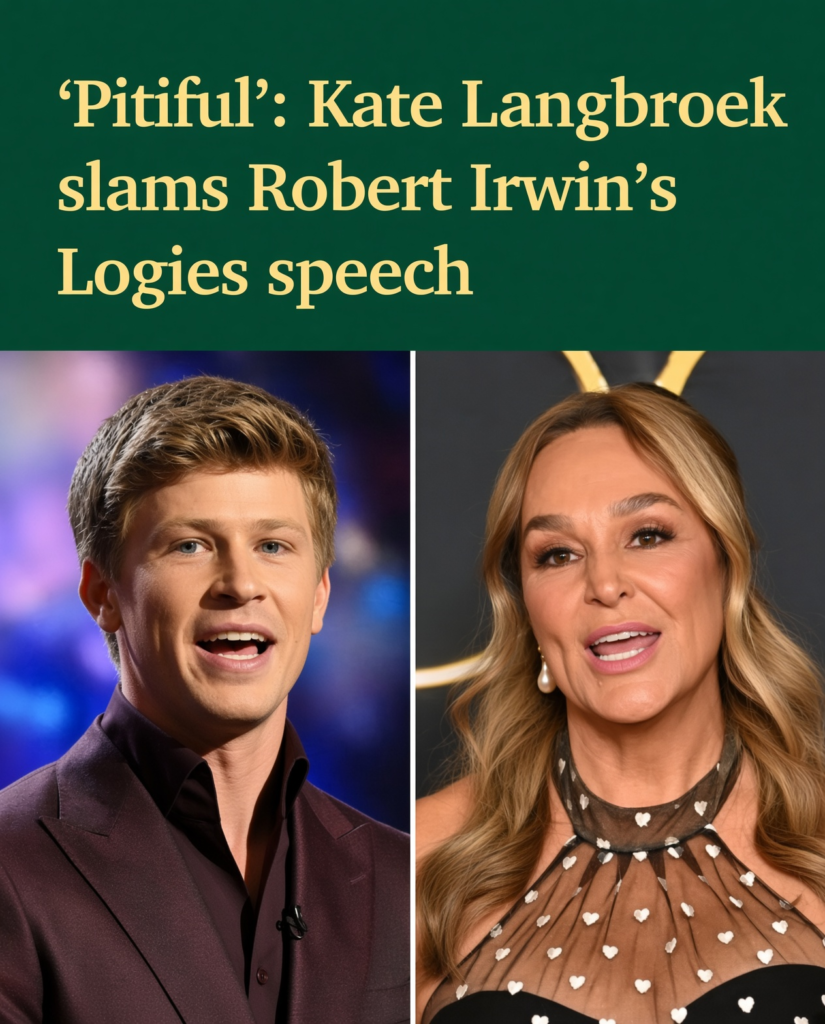
The veteran broadcaster’s fiery reaction has added another chapter to the debate surrounding Irwin’s debut as host of Australian television’s night of nights.
Langbroek initially enjoyed what she described as Irwin’s “really bright and bubbly” opening, but her reaction changed sharply when the 22-year-old began roasting two veteran television personalities who were absent from the ceremony.
“I just went, ‘God, what are you doing?’” Langbroek said.
Langbroek takes aim at Irwin’s Logies jokes
Speaking on Melbourne’s Fifi, Fev & Nick radio show, Langbroek said the jokes targeting Stefanovic and Hughes were unnecessary.
Her strongest objection was not simply that the jokes were insulting.
Roasting celebrities has long been part of awards ceremonies, including previous Logies hosted by comedians considerably more aggressive than Irwin.
Instead, Langbroek argued the jokes represented something she regarded as more troubling: an industry turning on people it had celebrated for years after their public standing changed.
She questioned whether joining that pile-on showed integrity.
What Robert Irwin actually said
Irwin became the youngest person to host the Logies when he took charge of the 2026 ceremony on Sunday night.
His opening was energetic and deliberately self-deprecating, with jokes about Australian television, rival networks and his own sudden elevation into one of the industry’s biggest jobs.
Then came Hughes.
Irwin joked that Channel 10 was developing a reboot of the comedian’s former television program Hughesy, We Have A Problem.
The proposed new title: “No, Seriously, Hughesy, We Have A Problem.”
The joke drew laughs.
But Irwin had saved the sharper political line for Stefanovic.
‘To the right … the far right’
Irwin told the audience Stefanovic had not RSVP’d to the Logies.
That meant, he joked, organisers did not need to hire quite as many bartenders.
But a spare seat had nevertheless been reserved for the former Today host.
“It’s over there to the right,” Irwin said.
“The far right.”
The audience laughed.
It was an unmistakable reference to Stefanovic’s increasingly outspoken political persona following his departure from mainstream television and move into independent podcasting.
Why Stefanovic had become a target
Stefanovic’s public image has changed significantly during 2026.
The veteran broadcaster left mainstream television following controversy over his interview with British activist Tommy Robinson on The Karl Stefanovic Show.
Stefanovic has since spoken more openly about his political views and his dissatisfaction with Australia’s direction.
In a new conversation with Hughes, Stefanovic said he had experienced an “epiphany” about 10 months earlier and wanted greater freedom to speak about issues that concerned him.
That political transformation supplied the setup for Irwin’s “far right” punchline.
Langbroek didn’t find it funny
For Langbroek, Stefanovic’s long history in Australian television made the moment particularly uncomfortable.
She pointed out that he had spent about three decades in the industry.
For years, Stefanovic was not merely tolerated by the Logies establishment — he was one of its most recognisable personalities.
His exploits at the awards became part of Australian television folklore, including occasions when he returned to breakfast television the following morning after a very big night.
Langbroek’s question was why an industry that had enjoyed those antics for years suddenly appeared so comfortable laughing at him from the other side.
‘Suddenly there’s a pile-on?’
Langbroek specifically connected the change in treatment with Stefanovic interviewing someone sections of the industry strongly disliked.
Her argument was that one controversial interview should not erase decades of professional history.
She questioned the speed with which an established industry figure could move from being celebrated to becoming a target.
That, rather than the technical quality of one joke, appeared to be the source of her anger.
To Langbroek, the laughter represented a broader cultural pile-on.
Then she turned to Dave Hughes
The second joke hit even closer to home.
Langbroek has a long personal and professional relationship with Hughes, having worked alongside him extensively during their radio careers.
Hughes has also become considerably more outspoken politically.
He recently appeared at a Victorian Liberal Party campaign event in Geelong and has increasingly used social media and other platforms to comment on government and politics.
Irwin’s “Hughesy, We Have A Problem” joke therefore landed amid a broader argument over Hughes’ increasingly public political positions.
‘Pack of animals’
Langbroek’s criticism then widened from Irwin to the reaction around him.
She compared the behaviour she was witnessing to animals responding to a shift in power.
“It’s like they’re just a pack of like animals who, the second where they sense the power shift, they’re like, oh, let’s get stuck in,” she said.
She did not clearly identify every person included in “they”.
The comment appeared to be directed more broadly at those participating in what she regarded as the sudden pile-on against Stefanovic and Hughes.
Langbroek questions the ‘integrity’ behind the jokes
Her criticism eventually came down to one word: integrity.
Langbroek suggested the attacks on the two men lacked it.
For someone who had initially enjoyed Irwin’s energetic opening, the change in tone clearly surprised her.
She did not present her criticism as a rejection of Irwin personally.
Instead, she appeared disappointed that the famously upbeat wildlife conservationist had participated in jokes she regarded as unnecessarily aligned with a wider cultural pile-on.
‘I just found it a bit s***’
Langbroek ultimately offered a considerably less diplomatic assessment.
“I just found it a bit s*** to be honest,” she said.
It was a striking verdict on a hosting performance that had otherwise received considerable praise.
Irwin’s debut included dancing, comedy and his familiar wildlife persona, with live reptiles becoming part of the ceremony.
The 22-year-old also went home as a Logie winner himself, taking the Bert Newton Award for Most Popular Presenter.
But Stefanovic himself isn’t angry
There is an important complication in Langbroek’s defence of Stefanovic.
Stefanovic does not appear particularly bothered by Irwin’s joke.
Asked about the roast after the ceremony, he made clear he was not holding a grudge against the young host.
He joked that becoming angry with Irwin would be like becoming angry with Bambi.
In other words, one of the people Langbroek believes was unfairly targeted appears to have taken the joke in precisely the spirit of an awards-night roast.
Hughes isn’t angry either
Hughes’ response has been even more relaxed.
He skipped the Logies this year, instead appearing around the Victorian Liberal campaign event in Geelong.
Speaking after the ceremony, Hughes said being mentioned by Irwin had actually made him proud.
He later discussed the jokes directly with Stefanovic.
His assessment was hardly furious.
Hughes described the material as “quite tame really” and acknowledged that it got laughs.
Hughes knows something about roasting a Logies room
Hughes is also unusually well qualified to judge an awards-night roast.
He hosted the Logies multiple times between 2016 and 2019.
That role required him to perform essentially the same task Irwin faced on Sunday: walk onto a stage filled with powerful television personalities and make jokes at their expense.
Stefanovic even suggested during their recent conversation that Hughes had delivered stronger material during his own Logies appearances.
The exchange sounded more like two television veterans assessing another host’s comedy than two victims nursing serious grievances.
Sam Pang loved Irwin’s performance
Langbroek’s assessment also contrasts sharply with that of Sam Pang.
Pang knows the hosting job particularly well after fronting the Logies for the previous three years.
He also became one of the biggest winners of the 2026 ceremony when he took home the Gold Logie.
Pang described Irwin’s performance as “magnificent”.
He called the young host a “very likeable, talented young man” and praised him for bringing his own style to the ceremony.
Irwin was always going to be different from Pang
The contrast between the two hosts was obvious before the ceremony began.
Pang is a professional comedian whose awards-show persona relies heavily on dry sarcasm and pointed jokes about the television industry itself.
Irwin is a wildlife conservationist and television presenter whose public image has traditionally been considerably more wholesome.
His appointment as Logies host therefore represented a deliberate tonal change.
That may also explain why the Stefanovic joke attracted so much attention: audiences were not necessarily expecting Robert Irwin to deliver one of the evening’s sharpest political punchlines.
Even Langbroek liked the beginning
Her reaction reinforces that distinction.
Langbroek did not dismiss Irwin’s entire performance.
She liked his dance entrance.
She described the early presentation as bright and bubbly.
Her objection began when the monologue moved from Irwin’s natural upbeat persona towards pointed jokes about people she knew.
For Langbroek, that tonal shift apparently made the material feel less authentic.
Was it really Robert’s joke?
The controversy also raises an obvious feature of major awards ceremonies that can disappear when audiences react to the host.
Televised monologues are generally collaborative productions.
Hosts commonly work with teams of professional comedy writers and producers, with jokes refined and approved before broadcast.
The person delivering a punchline is therefore not necessarily its sole author.
But Irwin was the host, delivered the material and inevitably owns the public reaction to it.
The Logies has always roasted its own
Nor was Stefanovic uniquely singled out by a new tradition.
Australian television awards have a long history of personalities making fun of one another.
Pang’s three years as host were particularly associated with jokes at the expense of networks, executives and celebrities.
Hughes himself has performed the same function.
That creates a reasonable counterargument to Langbroek’s criticism.
If prominent television personalities can be celebrated by the Logies, surely they can also be roasted by it.
But politics made these jokes different
There was nevertheless an additional layer to Irwin’s material.
The Stefanovic punchline was explicitly political.
Calling his imaginary seat “far right” was a direct reference to the broadcaster’s recent political controversies.
Hughes’ changing public profile has similarly become entangled with politics.
That means the jokes did more than tease two celebrities about their careers.
They implicitly located both men inside Australia’s increasingly polarised political debate.
That is what makes the argument bigger than one monologue
Langbroek’s criticism touches on a wider question facing Australian entertainment.
How should an industry treat stars who begin expressing political opinions that differ from those of colleagues or audiences?
Political disagreement does not automatically amount to cancellation.
Nor does a joke at an awards ceremony establish an organised campaign against anyone.
But Langbroek clearly believes a social mechanism exists in which once-popular figures can rapidly become acceptable targets after crossing an ideological line.
Her attack on Irwin was ultimately an attack on that perceived culture as much as it was on two individual jokes.
Stefanovic says speaking freely matters more now
The former Today host has himself embraced the shift.
In his latest podcast conversation with Hughes, Stefanovic said he wanted to speak more freely about the direction of Australia.
He also suggested his independent work was connecting with ordinary people in ways he found meaningful.
Hughes similarly said his political commentary may have affected professional opportunities but that traditional media was already facing significant financial pressure.
Both men therefore appear prepared to accept some professional or social criticism in exchange for greater freedom to express their views.
And neither needs Langbroek to be offended for them
That may be the most interesting twist in the controversy.
Langbroek is considerably angrier about the jokes than their targets appear to be.
Stefanovic laughed them off.
Hughes called them tame and said he was pleased to receive a mention.
Both are experienced entertainers familiar with being mocked publicly.
Their reactions do not invalidate Langbroek’s broader argument about pile-on culture, but they do make it difficult to portray Irwin’s monologue as causing serious personal offence.
The audience is entitled to laugh too
Similarly, the Logies audience laughing at a punchline does not necessarily prove that everyone in the room shares a political position or has turned against Stefanovic and Hughes.
It was an awards ceremony.
A host delivered jokes.
The audience laughed.
For many viewers, that may be the beginning and end of the story.
Langbroek sees something deeper in that reaction, but her interpretation remains an interpretation rather than an established fact about the motivations of everyone in the room.
Irwin’s debut was bigger than two jokes
The controversy can also obscure what was otherwise a major career moment for Irwin.
At 22, he became the youngest Logies host.
He brought his wildlife background onto the stage, danced through his opening and presided over a ceremony celebrating 70 years of Australian television.
He also won Most Popular Presenter.
The ceremony itself produced significant moments, including Sam Pang’s Gold Logie victory and Deborah Mailman’s historic Hall of Fame induction.
Reviews of Irwin’s performance were mixed in places, but substantial sections of the audience and television industry praised his debut.
Robert Irwin has discovered the other side of hosting
Hosting the Logies means more than walking on stage and keeping a television broadcast moving.
It means becoming the person responsible for jokes delivered in front of an industry that includes friends, rivals, former colleagues and political opponents.
For years, Pang and Hughes accepted the consequences that came with that job.
Now Irwin has experienced them too.
A few seconds of material about Stefanovic and Hughes have generated days of argument about politics, loyalty, comedy and the culture of Australian television.
Langbroek has made her position unmistakable
She believes the jokes were unnecessary.
She believes the broader reaction reflected an ugly willingness to pile onto people after their standing within an industry changes.
And she clearly expected something different from Irwin.
But Stefanovic and Hughes have offered an equally important response.
They laughed.
That leaves Australians with a rather unusual post-Logies dispute: the people being defended are considerably less upset than the person defending them.
Whether Irwin’s jokes represented harmless awards-night roasting or something more revealing about Australia’s increasingly political entertainment culture will depend largely on the viewer.
But one thing is clear: Robert Irwin’s first Logies monologue got people talking long after the awards were handed out.