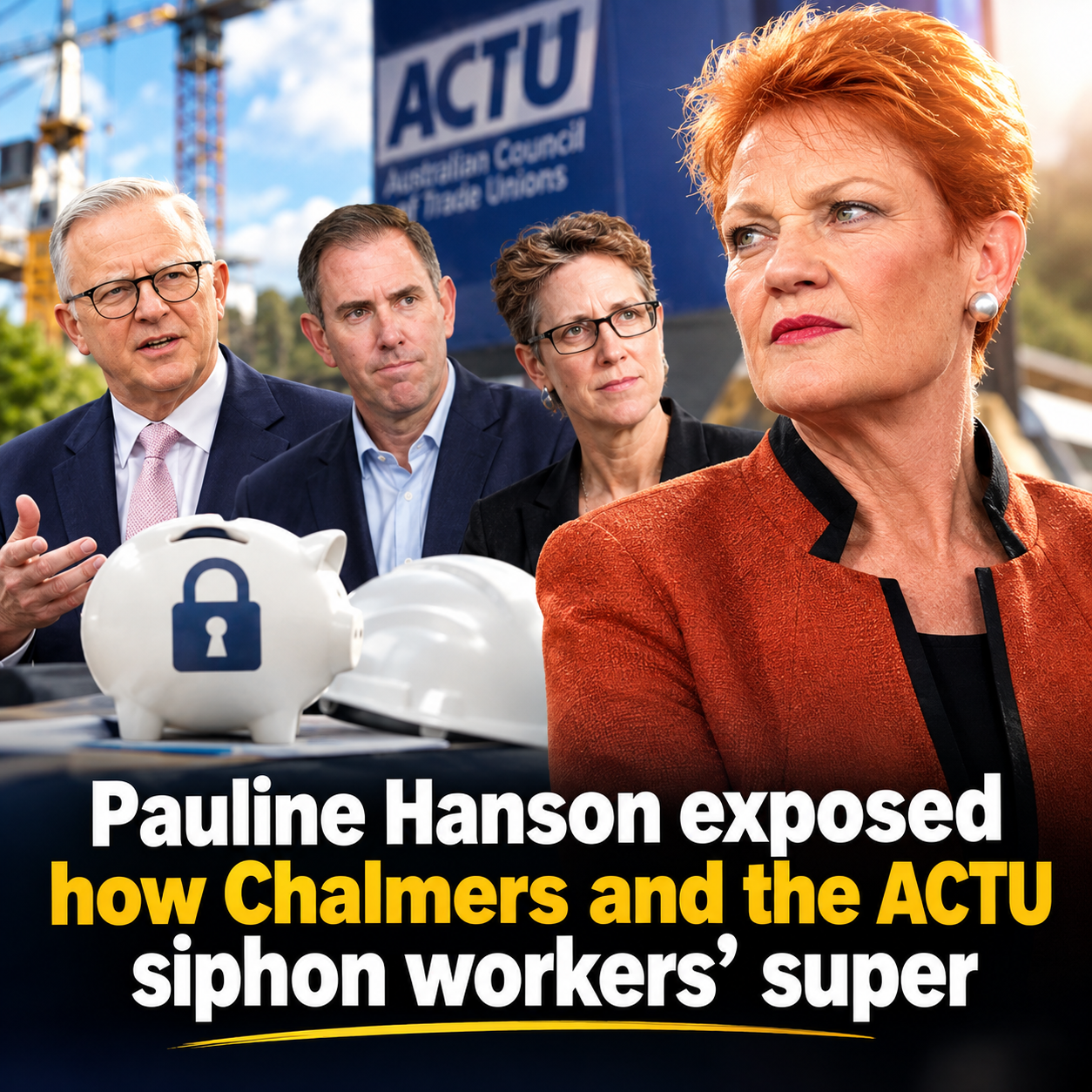
Australia’s escalating political battle over compulsory superannuation has put a largely overlooked financial network under fresh scrutiny, with mandatory disclosures revealing millions of dollars flowing from major industry funds to unions, employer organisations, marketing bodies and superannuation lobby groups.
The payments are legal and publicly disclosed, and there is no evidence that major industry funds such as Cbus are secretly making political donations to Labor.
But the figures illuminate a longstanding feature of Australia’s $4 trillion-plus retirement system that is becoming politically significant as Treasurer Jim Chalmers, unions and One Nation fight over who should control workers’ compulsory retirement savings and when Australians should be allowed to access them.
Cbus, one of the country’s largest industry funds, disclosed $1.37 million in payments to industrial bodies during the 2024–25 financial year, alongside $24.74 million in promotion, marketing and sponsorship expenditure.
Its audited accounts also reveal substantial transactions with sponsoring organisations including unions and the Master Builders Association, as well as payments to organisations involved in superannuation advocacy and marketing.
The figures do not establish a direct transfer of retirement savings into Labor campaign accounts. Cbus explicitly reports that it made no political donations during the financial year.
What they do reveal is a complex institutional ecosystem connecting industry super funds, trade unions, employer associations, lobby organisations and investment vehicles — at the same time those organisations are becoming increasingly vocal participants in the national argument over the future of compulsory super.
Cbus discloses $1.37m in industrial body payments
Cbus’ own mandatory disclosure for the year ending June 30, 2025 records $1,373,368 under the category of “industrial body payments”.
The fund says these payments relate to partnership arrangements that can include marketing, events and education services designed to promote Cbus and increase membership.
The same disclosure records $24,737,893 in promotion, marketing and sponsorship expenditure, $9,502,407 in remuneration expenditure and $49,570,762 in related-party payments.
Cbus cautions that the categories can overlap, meaning the figures cannot simply be added together to produce a total amount spent.
Most significantly for claims that the fund directly bankrolls political parties, its disclosure records $0 in political donations.
That distinction is central to understanding the controversy.
Payments from a super fund to a union for directors’ fees, sponsorship, marketing or another service are not the same transaction as a union subsequently making a political donation to the Labor Party.
There are documented financial relationships at both stages, but public disclosures do not by themselves establish that the money entering a union from a super fund is the same money later donated to Labor.
CFMEU-related payments were larger than $261,000
Cbus’ audited financial statements provide considerably more detail about transactions with its sponsoring organisations.
For the 2024–25 financial year, the accounts record $261,617 in directors’ fee payments associated with the Construction, Forestry and Maritime Employees Union.
But that was only one category.
The same table records another $702,240 in industry partnership payments and $279,701 in rental payments associated with the CFMEU, producing total reported payments of $1,243,558.
The figures require context because they cover different commercial and governance arrangements rather than a single unrestricted payment to the union.
Cbus also reported payments to other sponsoring organisations.
The Australian Workers’ Union was associated with $232,734 in directors’ fees and industry partnership payments, while the Communications, Electrical, Electronic, Energy, Information, Postal, Plumbing and Allied Services Union was associated with $577,815.
The Australian Manufacturing Workers’ Union was associated with a net $78,301 across the categories reported in the table.
Employer organisations receive money through the same structure.
Master Builders Association was associated with $122,843 in directors’ fee payments, $416,161 in industry partnership payments and $11,297 in rental payments — a total of $550,301.
That is important because the system is not accurately characterised as exclusively transferring money from workers’ accounts to unions.
Employer organisations also participate in industry-fund governance and receive payments.
Why unions have seats inside industry super funds
The relationship is partly a product of the way Australia’s industry superannuation system was constructed.
Under the Superannuation Industry (Supervision) Act, basic equal-representation rules apply to relevant employer-sponsored funds, providing for representation of employers and fund members in their governance.
Trade unions have historically played a major role in nominating member representatives, while employer organisations nominate representatives from their side.
AustralianSuper provides a clear example.
The fund publicly states that its board contains equal numbers of directors representing members and employers, with independent directors also able to be appointed.
Its shareholders are the Australian Council of Trade Unions, through ACTU Super Shareholding, and the Australian Industry Group.
That means the union movement is institutionally embedded in the governance structure of some of Australia’s largest industry funds.
But representation on a board does not mean a union owns members’ retirement savings.
Super trustees and directors operate under legal duties governing the management of members’ money, including obligations to act in members’ financial interests.
The current controversy is therefore less about whether unions have formal links with industry funds — they plainly do — and more about whether payments arising from those relationships provide sufficient value to members.
Senate scrutiny has already focused on the payments
The issue predates the latest confrontation between Hanson and Chalmers.
A Senate Economics References Committee report examined super-fund governance and related-party transactions, including payments by Cbus and AustralianSuper.
The committee recorded that Cbus’ 2023–24 annual report showed more than $2.8 million paid or payable to sponsoring organisations through partnership arrangements, directors’ fees and rental payments, including more than $1.8 million associated with the CFMEU.
It also highlighted AustralianSuper’s disclosure of about $1.2 million in related transactions involving four unions during that financial year.
Liberal Senator Andrew Bragg has been one of the most persistent critics of the arrangements.
His analysis of mandatory disclosure data for 2022–23 claimed industry super funds paid more than $16 million to unions and another $21.5 million to Industry Super Australia and the body that became the Super Members Council.
Bragg argued those payments demonstrated an unhealthy financial relationship between compulsory retirement savings and organisations connected to the union movement.
Industry funds reject the implication that the expenditure is inherently against members’ interests, arguing marketing, partnerships and advocacy can build scale, reduce costs and improve outcomes.
Cbus also pays major super lobby organisations
The financial links extend beyond unions and employer associations.
Cbus’ 2025 audited accounts show it paid Industry Super Australia $1,776,401 in advertising fees and another $197,305 in other fees.
Industry Super Australia provides marketing and policy advocacy services to participating funds.
Cbus separately paid the Super Members Council of Australia $613,734 in membership fees.
The Super Members Council advocates publicly on superannuation policy and represents profit-to-member funds.
That becomes politically relevant when such organisations campaign against proposals to expand early access to super.
Critics argue members are effectively financing organisations that lobby governments on the rules governing those same members’ savings.
The counterargument is familiar across industry associations: collective policy advocacy can protect members’ interests and improve the regulatory environment in which funds operate.
The dispute is ultimately over whether members receive sufficient financial value from that advocacy — and how much discretion trustees should have to spend money on it.
Hanson ignites fight over the 12 per cent guarantee
The disclosure debate has returned to prominence because compulsory super itself has suddenly become a major federal political battleground.
Australia’s Superannuation Guarantee reached 12 per cent on July 1, 2025.
Employers are generally required to make compulsory contributions for eligible employees, with the system designed to accumulate savings that are preserved until retirement except in specified circumstances.
Pauline Hanson has challenged how restrictive that preservation model should remain.
She has rejected reports that she wants simply to abolish compulsory super, saying Australians should instead have greater capacity to access their savings for major needs including housing and medical expenses.
“Your superannuation belongs to you,” Hanson said while responding to criticism of her position.
One Nation has also indicated it wants to review the 12 per cent compulsory contribution rate, although the party has not yet released a fully developed policy detailing withdrawal limits, eligibility requirements and safeguards.
The distinction is important.
A proposal to allow broader early access or reconsider the contribution rate would substantially change superannuation policy, but it is not identical to abolishing universal compulsory super.
ACTU launches its defence of compulsory super
The union movement has responded aggressively.
ACTU Assistant Secretary Joseph Mitchell accused Hanson and Liberal Senator Andrew Bragg of threatening a retirement system that unions regard as one of their greatest policy achievements.
The ACTU argues compulsory preservation allows workers to accumulate meaningful retirement balances and warns that expanding early withdrawals would reduce compound returns and leave more retirees dependent on the Age Pension.
That argument has considerable economic support.
Critics of using super for housing deposits have repeatedly warned that releasing additional purchasing power into a supply-constrained housing market could push property prices higher while reducing retirement balances.
Supporters of greater access respond that home ownership itself is a major determinant of financial security in retirement and question the value of preserving retirement balances while younger Australians struggle with housing costs today.
The dispute therefore involves a genuine policy trade-off rather than a simple choice between keeping or stealing workers’ money.
Chalmers wants the next election fought over super
Treasurer Jim Chalmers has seized on the argument and described the coming federal election as a potential “referendum” on superannuation.
Labor sees political advantage in portraying itself as the defender of compulsory retirement savings against One Nation and super-sceptical elements of the Coalition.
Hanson and her allies are attempting to reverse the framing.
Their argument is that compulsory contributions ultimately belong to individual Australians and government should not impose unnecessarily rigid restrictions on how people use their own savings during periods of financial pressure.
The rhetoric on both sides has moved faster than the detailed policy.
One Nation has not proposed a complete, legislated replacement for the current system, while Labor’s claim that its opponents collectively intend to destroy universal super goes beyond the positions formally adopted across the opposition parties.
Mortgage stress gives early-access argument political force
The debate is unfolding against worsening household financial pressure.
Roy Morgan estimated that 1.606 million Australian mortgage holders were “At Risk” of mortgage stress in the three months to June 2026.
That represented 30.3 per cent of mortgage holders, up 68,000 people in a month.
The rise followed renewed Reserve Bank interest-rate increases during 2026.
Those numbers help explain the political attraction of proposals allowing households to tap accumulated super before retirement.
For a family struggling to service a mortgage or a younger Australian unable to assemble a home deposit, a substantial super balance can appear paradoxical: significant personal wealth exists on paper but remains inaccessible for immediate housing needs.
Preservation advocates counter that solving today’s housing affordability problem by reducing tomorrow’s retirement savings merely shifts financial pressure between generations and could increase future Age Pension expenditure.
Super capital and national priorities raise another argument
The political battle extends beyond early withdrawals.
Labor has increasingly discussed Australia’s enormous superannuation pool as a potential source of private capital for economically productive national investments, including housing and the energy transition.
Industry funds themselves have pursued that conversation.
In 2023, AustralianSuper, Australian Retirement Trust, CareSuper, Cbus, HESTA, Hostplus, Rest, UniSuper and industry-fund-owned IFM Investors produced a joint blueprint identifying ways governments could make Australian energy-transition projects more attractive to superannuation investors.
The document emphasised that funds must pursue strong risk-adjusted returns and act in members’ financial interests.
It did not propose simply taking super savings to pay government bills.
Rather, it sought regulatory and policy settings that would create investable projects capable of attracting private retirement capital.
That distinction matters because super funds already invest across infrastructure, property, equities, debt and private markets. Investing in an electricity transmission project is not equivalent to government spending members’ balances: the fund acquires an investment from which it expects a return.
Nevertheless, critics become concerned when governments publicly nominate preferred national investment priorities, arguing trustees may face political pressure to direct capital towards projects that suit government policy.
The legal obligation remains that investments must be justified in members’ interests.
The money trail is real — but it is more complicated than a political slush fund
The public disclosures reveal a financial network worthy of scrutiny.
Industry super funds do make substantial payments to unions, employer associations and organisations that participate in public policy debates.
Unions separately provide millions of dollars in political support to Labor.
Union organisations also play formal roles in nominating directors to some major industry super funds.
Those facts create legitimate questions about governance, related-party transactions, transparency and whether expenditure delivers measurable value to members.
But they do not establish that compulsory super contributions are being secretly funnelled through funds into Labor campaign accounts.
Cbus’ own disclosure is particularly relevant: alongside its $1.37 million of industrial body payments and almost $24.74 million in promotion, marketing and sponsorship expenditure, it reports zero political donations for FY2024–25.
The stronger question is therefore not whether a hidden political donation has been uncovered, but whether Australians are comfortable with the institutional relationships that exist openly within the industry-super model.
That question will become harder to avoid as Chalmers, Hanson, unions and Coalition super critics turn retirement savings into an election issue.
With 12 per cent compulsory contributions flowing into a retirement system managing trillions of dollars, the argument is no longer simply about how much Australians save. It is increasingly about who influences the institutions managing those savings, what those institutions are permitted to spend members’ money on, and how much control individual Australians should have over the wealth accumulated in their name.