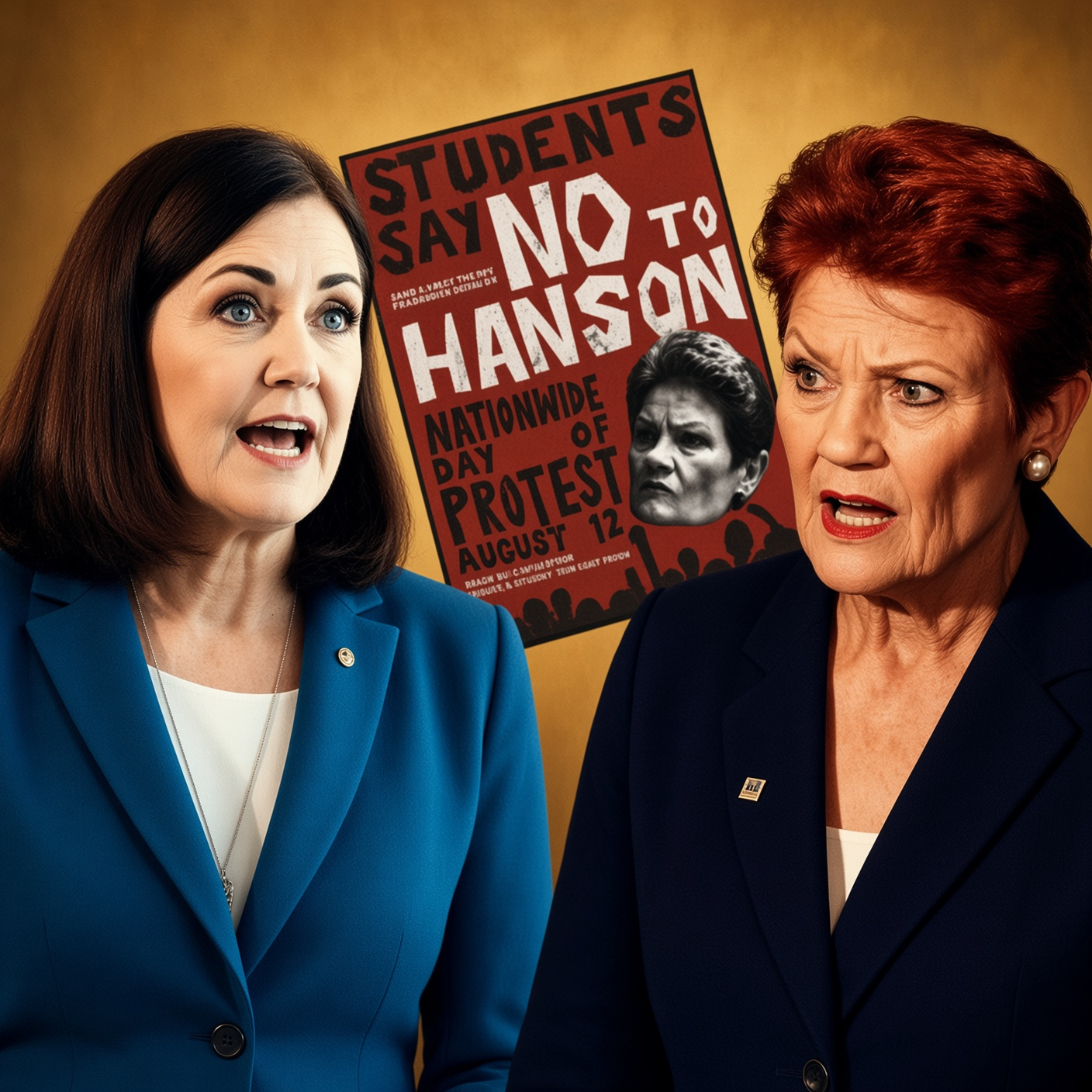
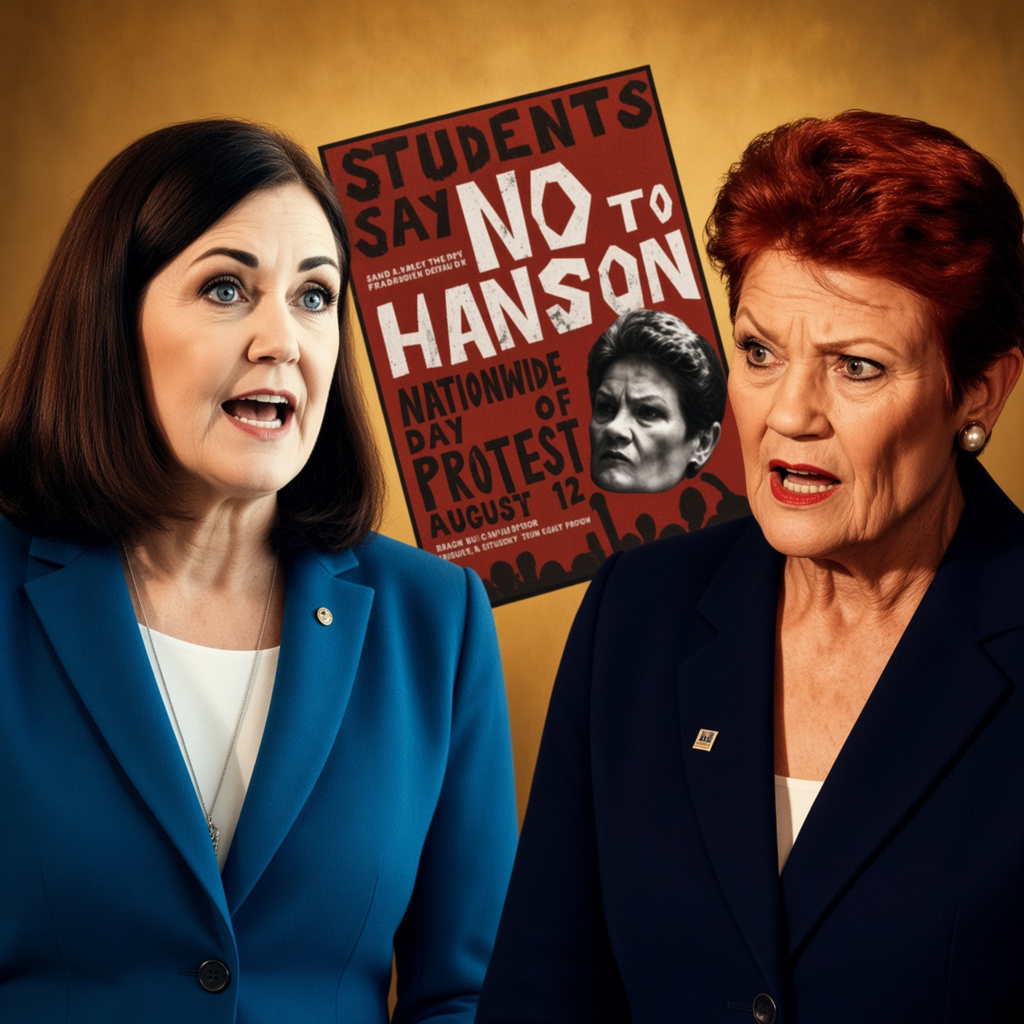
Liberal Senator Sarah Henderson has called for police to investigate alleged death threats against Pauline Hanson captured during last week’s nationwide student protests, while demanding scrutiny of any teachers or schools found to have encouraged children to leave class and attend the demonstrations.
The intervention follows the emergence of video showing people attending anti-One Nation demonstrations using violent language when asked what they would do to the party’s leader.
Henderson said political disagreement could not excuse threats of violence.
“That was completely abhorrent, what some of those students said, including threats to kill,” Henderson told News24 on Sunday.
She said police should examine whether any criminal offences had occurred.
“The threat to kill Pauline Hanson was completely abhorrent. Frankly, the police must investigate because threats to kill are unlawful.”
Henderson then broadened her criticism to the role of schools and teachers.
“I also want to see any school which participated in this protest and encouraged their students to attend; they also need to be investigated,” she said.
Her comments add another dimension to a controversy that began as a nationwide student protest against One Nation but has increasingly become a debate over political violence, school attendance and the role teachers should play in student activism.
Thousands of school and university students participated in demonstrations around Australia on Thursday, with rallies staged in Sydney, Melbourne, Brisbane and other locations.
The demonstrations were organised by the National Union of Students and associated activist groups under a campaign opposing the growing electoral support for Hanson and One Nation.
Students carried signs attacking One Nation’s positions on immigration, race and other political issues and chanted slogans against Hanson.
In Melbourne, hundreds gathered outside the State Library.
Some students were joined by parents, while political figures including former Victorian Greens leader Samantha Ratnam addressed the gathering.
ABC footage showed a Hanson-themed piñata being broken apart during the Melbourne protest.
In Sydney and Brisbane, police separated One Nation supporters from the broader demonstrations.
But footage subsequently circulated by One Nation shifted attention from the rallies’ political message towards comments made by individual participants.
In one recorded exchange, a person attending the protest was asked what she would do if Hanson were present.
She responded with language describing shooting and killing the senator.
Another participant proposed bringing back the guillotine when discussing what should happen to people he regarded as fascists.
When challenged about the contradiction involved in opposing fascism while advocating the execution of political opponents, the participant acknowledged the irony.
Those remarks have now triggered calls for authorities to determine whether any of the comments crossed the line from offensive political rhetoric into unlawful threats.
There is an important distinction.
Calling political speech disgusting, extreme or threatening in ordinary conversation is not the same thing as establishing that a criminal offence has occurred.
That determination depends on the precise words, context, intention and applicable criminal law, and ultimately belongs to police and prosecutors rather than politicians or media organisations.
Henderson’s demand is therefore for an investigation, not evidence that anyone appearing in the footage has already been convicted or even charged.
The available reporting does not establish that the National Union of Students instructed participants to threaten Hanson or that violent comments represented the official position of rally organisers.
Nor would remarks made by individual protesters automatically establish responsibility on the part of every student who attended.
But the footage presents an obvious political problem for organisers who promoted the rallies as opposition to racism and political extremism.
Advocating violence against a political opponent undermines that message and provides One Nation with powerful material to argue that hostility towards the party has itself become extreme.
Hanson had already condemned the demonstrations before the latest footage emerged.
Responding to students who walked out of school, she argued they should instead protest about issues such as housing affordability, stagnant wages and cost-of-living pressure.
One Nation politicians have also accused left-wing activists and teachers of influencing young people against the party.
Barnaby Joyce claimed “socialist teachers” were helping turn students into political props, while Hanson has repeatedly argued schools should teach young Australians how to think rather than what to think.
Henderson’s intervention takes that argument a step further.
Rather than merely criticising teachers politically, she wants authorities to investigate cases where teachers may actually have encouraged students to miss school for the protests.
Some material circulating after the demonstrations has added fuel to that allegation.
In video reported by News Corp, one student said teachers had not directly instructed students to attend but claimed they had not discouraged them either.
The student described teachers as supportive of students going to the demonstration and recounted one teacher joking positively about absent classmates attending the protest.
That is evidence of what a student said about teacher behaviour.
It is not independently established evidence that a particular teacher ordered students to leave school, that a school officially endorsed the protest or that an education law was breached.
Those distinctions matter if Henderson’s demand for investigations is to move beyond political rhetoric.
There is already evidence that education authorities did not officially endorse students skipping class.
Federal Education Minister Jason Clare said ahead of the protests that while Australians have a democratic right to protest, high school students should be at school during school hours.
Victorian political and education authorities delivered a similar message.
Premier Ben Carroll and Education Minister Gabrielle Williams emphasised the importance of students remaining in class, while Balwyn High School reportedly advised that absences associated with the demonstration were not sanctioned.
The legal question around school attendance is more complicated than simply declaring that every student who attended a protest during school hours broke the law.
Education legislation differs between states and territories.
In Victoria, for example, schooling is compulsory for children and young people aged from six to 17 unless an exemption applies.
Parents and carers have an obligation to ensure their children attend, while schools must record attendance and reasons for absences.
Principals also have responsibilities for determining whether explanations for absences are reasonable under the state’s attendance framework.
There are formal exemptions from compulsory attendance in specified circumstances, although simply wishing to participate in a political demonstration does not appear among the standard exemption categories published by Victoria’s Department of Education.
NSW likewise maintains formal procedures governing exemptions from the requirement for children to attend school.
That means an unexplained or unapproved absence can certainly create an attendance issue.
It does not mean every teenager appearing at a political rally during school hours can automatically be described as having personally committed a criminal offence.
The distinction becomes even more obvious because the demonstrations included university students and other participants who are not subject to compulsory school-attendance requirements.
Any investigation into teachers would therefore need to establish considerably more than the fact that some school-aged protesters were absent from class.
Authorities would need to determine what particular teachers did, what they told students, whether any absence was authorised and what relevant departmental or legal obligations applied.
The broader debate over teachers and political activism is unlikely to disappear with the protests.
One Nation’s rapid rise has created a political environment in which schools themselves are increasingly becoming part of the contest.
Hanson and her allies argue young Australians are being exposed to overwhelmingly progressive political assumptions in classrooms and universities.
Student organisers reject that characterisation.
They say young people are capable of forming their own political opinions and should be able to publicly oppose policies they believe threaten multiculturalism, minority communities and their futures.
Several students interviewed at Thursday’s rallies explicitly framed their participation as democratic engagement.
A Year 12 student interviewed by the ABC in Melbourne said the upcoming Victorian election would be the first in which they could vote and described the protest as a way for people under 18 to express their political views.
A 15-year-old participant said her parents supported her decision to attend.
That presents a legitimate debate about youth political participation.
Young people do not lose their right to political opinions simply because they attend school.
Schools also have an important role in teaching civics, democratic institutions, political history and critical thinking.
The contentious question is where civic education ends and partisan political encouragement begins.
A teacher explaining why students have a right to protest is different from instructing them which party to oppose.
A teacher privately approving of a student’s political views is different again from organising an unauthorised school walkout.
Those distinctions will be critical if Henderson’s demand produces formal inquiries.
The emergence of death-threat footage has nevertheless changed the political context substantially.
The protests were initially covered primarily as evidence of organised youth opposition to Hanson amid One Nation’s dramatic rise in national support.
The debate is now also about whether increasingly hostile political rhetoric is producing unacceptable behaviour.
That concern is not entirely theoretical.
Separate from the student protests, a female One Nation staff member in her 60s was allegedly assaulted while working at the party’s stand at Brisbane’s Ekka agricultural show.
The party says the woman suffered a broken rib and required hospital treatment after an altercation involving several people.
Queensland Police said they were aware of the incident, although reporting on Monday indicated no formal complaint had yet been lodged.
The alleged assault and the student-protest footage are separate events, and there is no basis to suggest the people involved in one were responsible for the other.
But together they are intensifying concern within One Nation about the physical safety of politicians, candidates, staff and supporters.
That concern deserves to be separated from ordinary political disagreement.
Australians can regard Hanson’s policies as racist, dangerous, beneficial, necessary or anything in between.
They can campaign against her, organise demonstrations, vote against One Nation and use harsh political language within the boundaries of the law.
Threatening political violence presents a different issue.
Democratic politics depends on the ability of people with profoundly different views to participate without fearing physical attack.
That principle applies equally regardless of whether the threatened politician comes from One Nation, Labor, the Coalition, the Greens or any other party.
Henderson’s call therefore contains two questions that should not be collapsed into one.
The first is whether individuals appearing in protest footage made threats serious enough to warrant police investigation.
The second is whether teachers or schools improperly encouraged compulsory-school-age students to abandon classes for partisan political activity.
The first belongs primarily to law enforcement.
The second requires evidence about individual schools, teachers, attendance records and departmental rules.
At present, there is considerably stronger public evidence for the existence of the disturbing comments than there is for a coordinated effort by schools to send children to the demonstrations.
The videos show that extreme language was used.
Reports also show some students believed individual teachers were sympathetic to their participation.
But sympathy is not the same as instruction, and a student’s account is not by itself proof of institutional involvement.
That is precisely why an evidence-based investigation, if authorities consider one warranted, would be preferable to assuming guilt from political affiliation.
The same standard should apply to the alleged threats.
They should not be dismissed as harmless merely because the intended target is a polarising politician.
Nor should everyone at a protest be treated as responsible for statements made by a handful of participants.
The protests were intended to demonstrate that young Australians were prepared to mobilise against One Nation.
Instead, some of their most extreme moments have handed Hanson and her political allies a new argument.
They can now ask why demonstrations promoted as resistance to intolerance contained people apparently discussing killing a senator — and whether adults in positions of authority did anything to encourage children to be there.
Henderson wants both questions formally examined.
Whether police and education authorities find grounds to take that further will depend not on the politics of Hanson or her opponents, but on what the evidence shows actually happened.