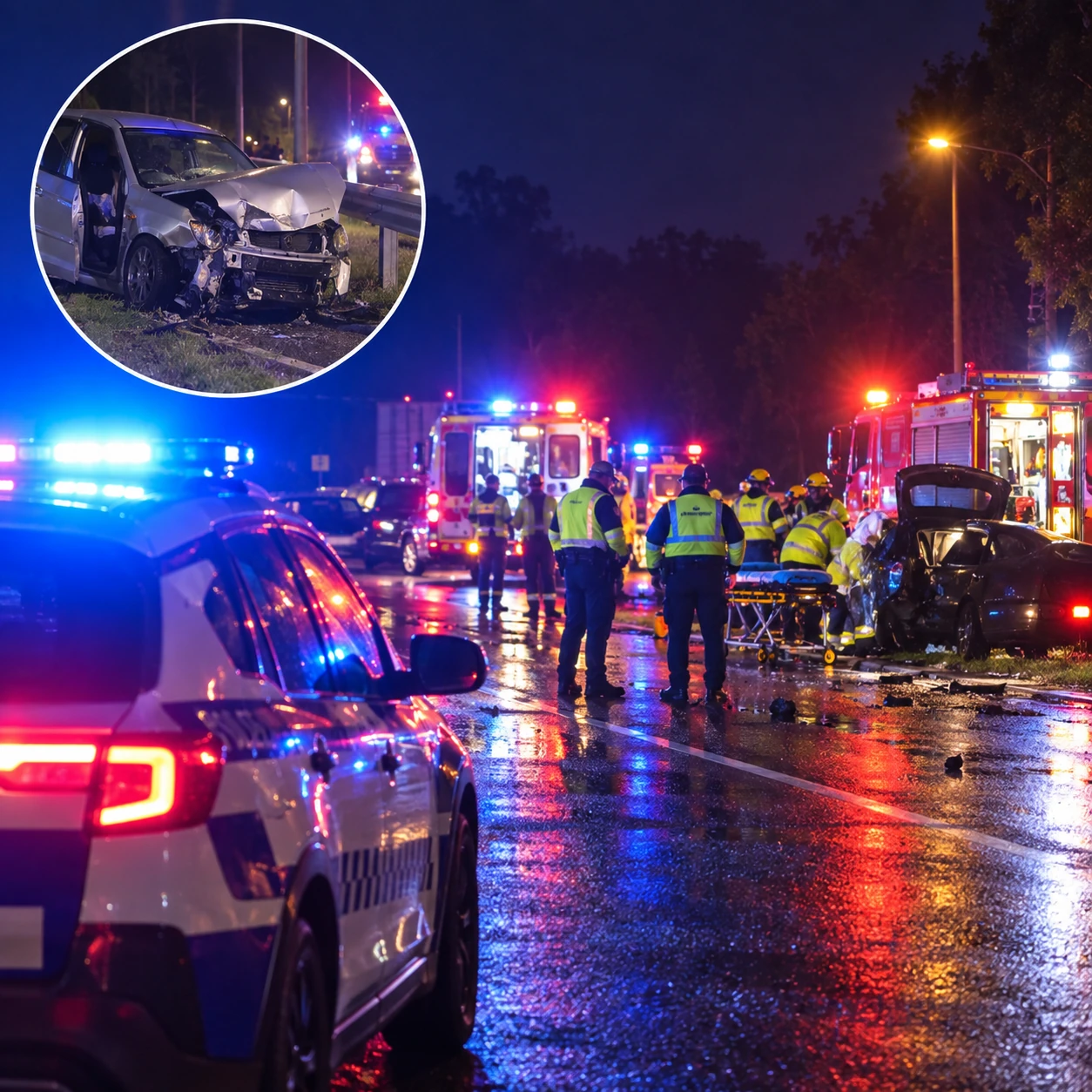
An 11-year-old girl has died and a 35-year-old woman remains seriously injured after a two-vehicle crash at Moana, south of Adelaide, prompting South Australia Police to appeal for witnesses and dashcam footage.
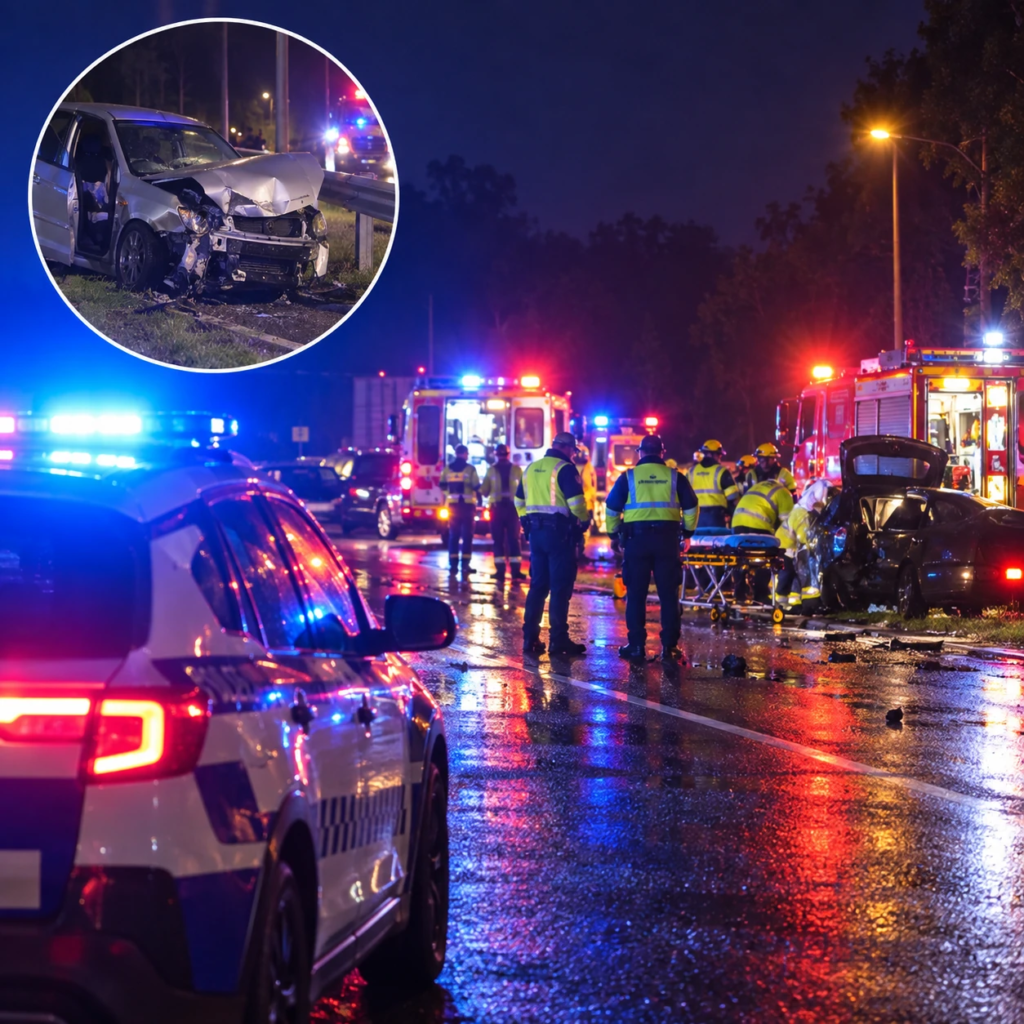
Emergency services were called to Commercial Road about 6.45pm on Tuesday after a Nissan sedan and Subaru station wagon collided. The girl, from Christie Downs, was a passenger in the Nissan and died at the scene.
The Nissan’s driver, a 35-year-old Christie Downs woman, was taken to hospital in a serious condition. The Subaru driver, a 37-year-old man from Seaford Meadows, was taken to hospital with minor injuries and has since been discharged.
Major Crash officers attended the scene and are investigating how the collision occurred. Police have asked anyone who witnessed the crash or has dashcam footage from the area around the time of the collision to contact Crime Stoppers.
No finding has been made about responsibility for the crash. Until investigators establish the circumstances, it would be inappropriate to speculate about speed, distraction, impairment, road conditions or any other possible cause.
Commercial Road was closed between Griffiths Drive and Dalkeith Road while emergency crews worked at the scene and investigators examined the vehicles and roadway. Serious crash scenes can remain closed for hours because evidence that appears minor can later become important.
Investigators typically document vehicle positions, tyre marks, debris fields, road surfaces, lighting, traffic controls and damage patterns. Modern vehicles can also contain electronic data that assists with reconstructing speed, braking and other events immediately before a collision.
Witness accounts remain important even when technical evidence is available. A motorist may have seen one of the vehicles seconds before the crash, observed traffic conditions or recorded footage that captures movements outside the immediate collision point.
Dashcam video is particularly valuable because it can provide an objective time-stamped record. Police therefore routinely ask drivers who passed through an area around the relevant time to check recordings even if they did not directly see the collision.
The death is the 81st life lost on South Australian roads this year, according to SAPOL. The road toll is not a measure of blame in any single case, but each fatal crash adds to the broader challenge facing road-safety authorities.
Children are among the most vulnerable people affected by serious road trauma because they are almost always passengers rather than decision-makers. A child killed in a collision leaves consequences extending far beyond the immediate scene to family, classmates, schools and the local community.
For first responders, incidents involving children can also be particularly confronting. Police, paramedics, firefighters and bystanders may be exposed to traumatic scenes while simultaneously trying to provide urgent care and secure the area.
South Australia’s road-safety strategy, like those in other states, is built around the idea that fatal and serious injuries should not be accepted as an inevitable cost of travel. That approach combines safer roads, safer vehicles, enforcement, speed management, driver education and emergency response.
Not every crash can be prevented by one measure. Intersections, roadside design, lighting, vehicle age, traffic density and human behaviour can interact in different ways. Investigators therefore focus on the facts of an individual collision before broader policy conclusions are drawn.
Commercial Road is a key route through Adelaide’s southern suburbs, carrying local traffic between residential areas and coastal communities. The Tuesday evening timing meant the collision occurred during a period when many people were travelling home, shopping or moving between local destinations.
Police have not announced whether weather or visibility played any role. The official statement simply records that the two vehicles collided and that the investigation is continuing.
That restraint is important. Early photographs of a crash can encourage viewers to infer direction, speed or fault from vehicle damage, but reconstruction requires more information than a single image can provide.
Vehicle damage can be affected by impact angle, crumple zones, secondary movement and differences in mass. A car that looks more heavily damaged is not necessarily the vehicle that caused the collision.
The same caution applies to hospital outcomes. The Subaru driver’s minor injuries and the serious injuries suffered in the Nissan do not by themselves establish what happened before impact.
Major Crash investigators will also consider medical and toxicology information where legally relevant, but results are not usually available immediately. If police later identify evidence supporting charges, that information will be dealt with through the criminal justice process.
At this stage, the public role is mainly to assist with evidence and respect the privacy of those affected. Police have released the ages and suburbs of the people involved but have not publicly named the child.
That allows authorities to seek witnesses while giving the family space before further personal details enter the public record. In fatal crashes involving children, privacy is especially important because siblings, classmates and extended family may be processing the death at the same time as media attention grows.
Schools and community organisations often provide counselling after the sudden death of a young person. The impact can extend to children who were not at the crash but knew the victim through school, sport or neighbourhood connections.
The seriously injured woman also remains at the centre of the event. Her treatment and recovery may continue long after the road has reopened and public attention has shifted.
Road trauma can involve surgery, rehabilitation, psychological injury and long periods away from work or family responsibilities. The consequences are therefore not fully captured by the initial classification of injuries at the scene.
Police investigations into fatal crashes can take months. Officers may obtain expert reports, analyse devices, inspect vehicles and interview witnesses before deciding whether there is evidence of a criminal offence.
If no charge is laid, a report may still be prepared for the Coroner, who can examine the circumstances of the death and make findings or recommendations where appropriate.
The process is deliberately methodical because criminal liability requires more than proof that a tragedy occurred. Investigators must determine whether any person breached the law and whether that breach caused the death.
For road users, the incident is another reminder of the unpredictability of ordinary travel. A routine Tuesday evening trip ended with one child dead, one adult seriously injured and another driver taken to hospital.
The strongest immediate contribution from the public is evidence. Anyone who travelled on Commercial Road around 6.45pm on 22 September and has dashcam footage has been asked to review it and contact police if it may show either vehicle or the collision.
Fatal crashes also generate a formal chain of evidence that extends beyond the roadside. Vehicles may be seized for mechanical inspection, officers can obtain hospital records where legally authorised, and collision specialists can build scaled reconstructions using measurements from the scene. If investigators identify a defect, traffic-control issue or road-design factor, that information can also be referred to the relevant transport authority. The process is intended to establish what happened before decisions are made about charges, coronial findings or safety changes.
The 81st road death figure also places the tragedy within a year-long statewide toll, but it should not turn an individual child into a statistic. Road-safety data helps governments decide where enforcement and infrastructure are needed; each number still represents a person whose death has a lasting effect on relatives and friends.
As investigators continue their work, the confirmed facts remain limited but devastating: an 11-year-old girl died at the scene, a 35-year-old woman was seriously injured, a 37-year-old man suffered minor injuries, and police are working to establish why the two vehicles collided.