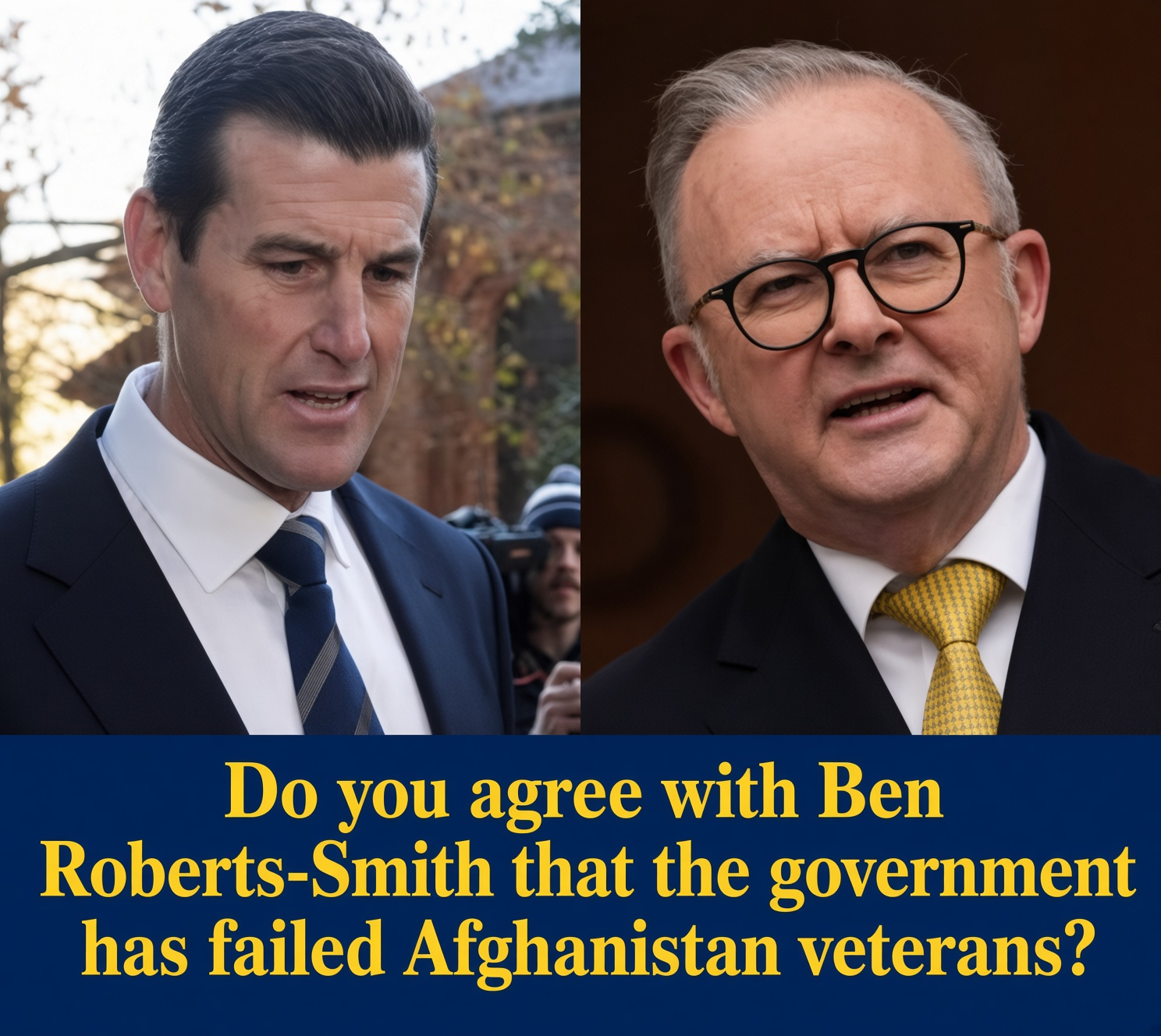
Ben Roberts-Smith has accused successive Australian governments of failing a new generation of Afghanistan veterans, warning the nation risks repeating the mistakes made after Vietnam as Anthony Albanese paid tribute to those who served 60 years after the Battle of Long Tan.
The former SAS corporal and Victoria Cross recipient delivered the warning at a Vietnam Veterans’ Day service in Hervey Bay, Queensland, where about 500 people gathered to commemorate Australians who served in the Vietnam War.
Roberts-Smith drew a direct comparison between the treatment endured by many Vietnam veterans after they returned home and what he believes is happening to Australians who served in Afghanistan.
“There is now another generation of veterans that have been and continue to be let down by the very officials that sent them to war,” he told the gathering.
His remarks landed at a particularly sensitive moment for the Albanese government, which is already confronting an escalating dispute with veterans over planned changes to allied healthcare.
Australia marks 60 years since Long Tan
Vietnam Veterans’ Day is observed each year on August 18, the anniversary of the Battle of Long Tan.
This year’s commemoration carried particular significance.
It marked six decades since Australian troops fought one of the most famous engagements of the Vietnam War in a rubber plantation in Phuoc Tuy province.
Eighteen Australians were killed in the battle.
Long Tan has since become a powerful symbol of the service and sacrifice of Australia’s Vietnam generation.
More than 60,000 Australians served
More than 60,000 Australians served in Vietnam during Australia’s involvement in the conflict between 1962 and 1975.
Hundreds never returned.
Thousands more came home carrying physical injuries and psychological trauma that could remain with them for decades.
For many, however, returning to Australia did not bring the recognition earlier generations of veterans had received.
The bitter public divisions surrounding the Vietnam War followed the soldiers home.
Albanese pays tribute to Vietnam veterans
Prime Minister Anthony Albanese acknowledged Vietnam Veterans’ Day in Canberra on August 18.
Speaking at a National Farmers’ Federation event at Parliament House, Albanese described the commemoration as “a really important day in our calendar”.
He acknowledged veterans attending the event and paid his respects to those who served.
Across the country, commemorations remembered the Australians who died, those who returned home and the families who lived with the consequences of the conflict.
The anniversary also revived memories of how poorly many Vietnam veterans were treated after their service.
They came home to a divided country
Australians who fought in Vietnam returned to a nation deeply divided over the war.
Opposition to Australia’s involvement had grown dramatically during the conflict.
Conscription became a major political issue.
Anti-war demonstrations filled Australian streets.
And the distinction between opposition to the war and attitudes towards those who fought in it was not always maintained.
Many veterans felt ignored, misunderstood or blamed for political decisions they had not made.
Recognition took years
Australia’s treatment of its Vietnam veterans eventually changed.
Public recognition grew.
The national welcome-home parade in Sydney in 1987 became a landmark moment.
Vietnam Veterans’ Day developed into an established national commemoration.
Long Tan became firmly embedded in Australia’s military history.
But for veterans who spent years feeling forgotten, later recognition could never entirely erase what happened when they first came home.
Roberts-Smith says Australia has learned only half the lesson
That history formed the foundation of Roberts-Smith’s address in Hervey Bay.
He acknowledged that Australia eventually corrected much of its treatment of Vietnam veterans.
But he argued governments had failed to apply the lesson to those who fought more recently.
“Too many were met with silence, misunderstanding or indifference,” he said of the Vietnam generation.
He then warned that Afghanistan veterans were experiencing their own version of institutional abandonment.
‘The very officials that sent them to war’
Roberts-Smith directed his criticism not merely at one minister or one political party.
He blamed “recent successive governments and bureaucrats”.
His argument was that responsibility for veterans does not end when a deployment ends.
Governments make decisions to send Australians into combat.
Those governments and the institutions that follow them therefore retain an obligation to support personnel when they return.
“Whatever our views of war, we must never lose sight of those who are asked to fight it,” Roberts-Smith said.
Australia spent two decades in Afghanistan
Australia’s involvement in Afghanistan extended from 2001 until 2021.
Thousands of Australian Defence Force personnel deployed during the conflict.
For some, there were multiple deployments.
Forty-one Australian soldiers died as a consequence of their service in Afghanistan.
Many more returned with physical injuries, post-traumatic stress and other conditions that continued long after they left the battlefield.
The consequences of Australia’s longest war did not end with the final withdrawal.
The Royal Commission found systemic failures
Roberts-Smith’s criticism comes against a background far broader than one commemorative speech.
The Royal Commission into Defence and Veteran Suicide spent years examining the systems surrounding serving and former Australian Defence Force personnel.
Its work involved hundreds of witnesses and thousands of submissions.
It examined military culture, transition out of Defence, mental health, Department of Veterans’ Affairs processes, compensation and the experiences of veterans’ families.
The commission identified systemic problems in institutions that were supposed to support serving personnel and veterans.
The Royal Commission delivered 122 recommendations
Its final report was delivered in September 2024.
It contained 122 recommendations for reform.
The scale of that package demonstrated how extensive the commissioners believed change needed to be.
The recommendations extended across Defence, veterans’ administration, suicide prevention, transition, governance, culture and accountability.
This makes it difficult to dismiss concerns about the treatment of modern veterans as merely political rhetoric.
Australia’s most comprehensive inquiry into Defence and veteran suicide found serious problems requiring substantial reform.
But saying nothing has changed would also be wrong
There is an important qualification.
The existence of systemic failures does not mean the Albanese government has taken no action.
Its formal response agreed to 96 Royal Commission recommendations and agreed in principle to another 18.
Seven were noted and one was not supported in part.
Implementation has continued since then.
Significant reforms to veterans’ support arrangements commenced on July 1, 2026.
A simpler veterans system is being built
Among the reforms is an attempt to simplify the legislative framework governing veterans’ entitlements.
The complexity of compensation and rehabilitation arrangements had long been a source of frustration.
Veterans could find themselves navigating different legislation depending on when and where they served or were injured.
The government has also established the new Veteran and Family Wellbeing Agency.
Those changes are part of the response to precisely the institutional failures Roberts-Smith is criticising.
The question is whether reform is happening fast enough
That distinction matters.
A government can accept recommendations and still fail veterans if implementation is too slow, poorly designed or ineffective.
Conversely, the existence of continuing problems does not prove every reform has failed.
That is why independent scrutiny of implementation is now so important.
A dedicated inquiry is examining how Commonwealth agencies are progressing the Royal Commission recommendations.
Its task includes assessing timeliness and whether implementation meaningfully meets the commission’s intent.
Veterans are fighting another battle in Canberra right now
The timing of Roberts-Smith’s speech could scarcely have been more politically charged.
As Australia commemorated Vietnam Veterans’ Day, another group of veterans was in Canberra fighting the government over planned changes to allied healthcare.
The dispute concerns a new $5,000 annual threshold for reviewing the clinical effectiveness of allied-health treatment funded through the Department of Veterans’ Affairs.
Critics commonly describe it as a $5,000 cap.
Veterans with complex physical injuries or PTSD fear they could face additional bureaucracy when their annual treatment exceeds that figure.
The government says $5,000 is not a hard treatment ceiling
The government’s description of the policy is more nuanced.
It says $5,000 will trigger a clinical review rather than automatically terminate healthcare.
Veterans with demonstrated clinical needs above the threshold will be able to receive additional support.
The broader reform package also increases fees paid to allied-health providers.
Labor argues this will make it easier for veterans to find practitioners willing to treat them.
But opponents fear another approval process could become another obstacle for people already navigating a complicated system.
The dispute exploded on the eve of Vietnam Veterans’ Day
A delegation of veterans and advocates travelled to Parliament House to protest the changes.
Veterans’ Affairs Minister Matt Keogh initially declined to meet them.
After political pressure intensified, a meeting was arranged.
Members of the delegation subsequently accused Keogh of behaving dismissively during the encounter, allegations the minister has disputed.
Keogh did, however, publicly acknowledge that his original decision not to meet the group was wrong.
‘I got it wrong’
In Parliament on Vietnam Veterans’ Day, Keogh thanked the veterans for eventually meeting with him.
He then made an unusually direct admission.
“I acknowledge that I got it wrong in not agreeing to meet with them last week when that initial request came in,” he said.
The concession did not end the controversy.
Veterans’ advocates and opposition politicians continued pressing the government to abandon the new threshold.
Calls were also made for Keogh to lose the veterans’ affairs portfolio.
Albanese was forced into the dispute
The controversy eventually reached the Prime Minister.
Senior advisers from Albanese’s office met the veterans after they remained in Canberra for another day.
Albanese also encountered members of the delegation at Parliament House and greeted them personally.
The Prime Minister has continued to back Keogh.
But the episode created an uncomfortable contrast on the very day the government was commemorating Australians who had once returned from war feeling ignored by their country.
That parallel gives Roberts-Smith’s speech its force
Vietnam and Afghanistan were profoundly different conflicts fought in different eras.
The experiences of their veterans cannot simply be treated as identical.
Vietnam veterans returned to a society torn apart by conscription and mass anti-war protest.
Afghanistan veterans generally received far greater public respect for their service.
Roberts-Smith’s comparison is therefore primarily about institutional responsibility, not identical public treatment.
Modern veterans face different problems
For Afghanistan veterans, the challenge is less likely to be protesters confronting them on their return.
It can instead involve navigating compensation systems, accessing mental-health care, transitioning into civilian employment and maintaining treatment for chronic service-related injuries.
Some veterans must repeatedly explain conditions that developed during military service to different parts of government.
Families can also carry substantial burdens.
The Royal Commission demonstrated that administrative systems themselves can become a source of distress.
Veteran suicide transformed the national debate
The establishment of the Royal Commission followed years of campaigning by veterans, families and advocates.
Its hearings exposed painful experiences across generations of military personnel.
The commission examined suicide and suicidality but repeatedly encountered broader institutional issues surrounding military life and the transition out of it.
It heard about delays, complicated claims, poor communication, mental-health problems and experiences of families trying to navigate the system.
Those findings mean the standard for judging government veterans policy has fundamentally changed.
Promises are no longer enough
Governments can announce new agencies, funding packages and legislative reforms.
But veterans ultimately experience the system through whether appointments are available, claims are processed, injuries are recognised and treatment continues when it is needed.
That is where implementation matters more than political announcements.
A reform cannot be called successful merely because Parliament passed it.
Its success depends on what happens to the veteran trying to use it.
Roberts-Smith says MPs need to make an effort
After the Hervey Bay ceremony, Roberts-Smith said his own experiences had given him a stronger understanding of what Vietnam veterans endured when they returned home.
He urged politicians currently in government to ensure modern veterans were treated properly.
His warning was that Australia should not allow another generation to experience a long period of neglect before eventually acknowledging that mistakes were made.
The lesson of Vietnam, in his telling, is that recognition delivered decades late is not an adequate substitute for support when veterans actually need it.
Phillip Thompson was singled out for praise
Roberts-Smith pointed to politicians including Queensland MP and former soldier Phillip Thompson as examples of representatives pushing veterans’ concerns within government institutions.
Thompson, an Afghanistan veteran himself, has been among the strongest parliamentary critics of the government’s allied-health changes.
He has argued veterans with serious injuries and complex mental-health conditions could rapidly exceed the proposed $5,000 threshold.
The current fight has therefore become intensely personal for MPs who served in the same generation Roberts-Smith says is being let down.
Roberts-Smith’s own legal position cannot be ignored
There is also significant context surrounding the speaker himself.
Roberts-Smith is one of Australia’s most decorated former soldiers, having received the Victoria Cross for Australia and the Medal for Gallantry for his military service.
But he is currently facing five criminal charges alleging the war crime of murder arising from his service in Afghanistan.
Roberts-Smith denies the allegations and has said he will fight to clear his name.
The charges remain allegations to be determined through the criminal justice system.
The criminal case and veterans debate are separate questions
Roberts-Smith’s legal circumstances inevitably affect the public attention surrounding his appearances.
They should not, however, be confused with the factual question of whether Australia’s veterans support systems have serious problems.
That question has been examined independently and extensively by the Royal Commission.
Nor does agreement with Roberts-Smith on veterans policy imply any conclusion about the criminal allegations against him.
Those are separate matters requiring separate evidence.
He received strong support at Hervey Bay
Roberts-Smith was warmly received at the Queensland service.
Those attending included veterans, veterans’ families and members of the broader community.
He received applause during his speech and people queued to be photographed with him afterwards.
Members of the Partners of Veterans Association also expressed support.
For those attending, his warning about the treatment of contemporary veterans clearly resonated.
Vietnam veterans know what delayed recognition costs
That resonance is significant.
The Vietnam generation has lived through a complete transformation in how Australia remembers its service.
Many went from feeling marginalised after returning home to being publicly honoured decades later.
The nation eventually acknowledged that disagreement over a war should never have diminished respect and support for those sent to fight it.
The question Roberts-Smith posed at Hervey Bay was whether Australia has really absorbed that lesson.
Afghanistan veterans should not need to wait decades
There should be no requirement for history to repeat itself before institutions act.
Modern Australia possesses far more knowledge about PTSD, suicide risk, transition from military service and the long-term effects of combat than it did after Vietnam.
It also possesses a detailed Royal Commission report explaining where systems have failed.
Governments therefore cannot plausibly argue that the problems are unknown.
The challenge now is turning knowledge into practical support before another generation spends decades demanding recognition of failures that were already documented.
But accountability also requires acknowledging progress
A fair assessment cannot stop at criticism.
The current government has responded to the Royal Commission.
Major structural reforms are underway.
A simpler veterans-entitlements framework has commenced.
A new wellbeing agency has been established.
Implementation is subject to continuing independent scrutiny.
The proper test is therefore not whether government has done nothing, but whether what it is doing is sufficient, timely and effective.
The $5,000 controversy will test that promise
The allied-health dispute provides an immediate real-world test.
The government says the reforms will improve provider access while targeting clinically ineffective over-servicing.
Veterans fear the review threshold could create additional bureaucracy for those with the greatest treatment needs.
Both propositions can be tested.
The government has time before the new arrangements begin in July 2027 to demonstrate exactly how veterans with complex conditions will be protected.
If treatment is interrupted or veterans are forced through lengthy approval processes, the policy will reinforce precisely the distrust the Royal Commission said needed to be addressed.
Long Tan is about more than remembering the dead
Vietnam Veterans’ Day inevitably commemorates sacrifice.
It remembers the 18 Australians killed at Long Tan and all those who lost their lives during the broader conflict.
But commemoration also carries an obligation to learn.
The treatment of Vietnam veterans after they returned home has become part of that national lesson.
Respecting service cannot begin and end at a memorial ceremony.
So has government failed Afghanistan veterans?
There is substantial evidence that Australian institutions have failed serving personnel and veterans in important ways.
The Royal Commission’s findings make that impossible to dismiss.
Veterans and families have documented problems involving mental health, transition, compensation, administration and access to support.
In that broader sense, Roberts-Smith’s warning has a substantial factual foundation.
But it would be too broad to conclude that every government response has failed or that no meaningful reform has occurred.
The Albanese government has accepted or accepted in principle the overwhelming majority of the Royal Commission’s recommendations and has begun major structural changes.
The real verdict will come from veterans themselves
Government can measure implementation through legislation passed, agencies created and recommendations formally accepted.
Veterans will measure it differently.
Can they obtain treatment?
Can they navigate DVA without unnecessary distress?
Can families obtain support?
Can personnel leave Defence and build stable civilian lives?
And when veterans travel to Canberra because they believe a policy threatens their healthcare, will the minister responsible sit down and listen?
Those practical tests will determine whether Australia has truly learned from Vietnam.
Sixty years later, Long Tan still carries a warning
The Australians who fought at Long Tan could not have imagined the political arguments that would surround veterans policy six decades later.
But the fundamental obligation has not changed.
A country that asks its citizens to fight assumes a responsibility that continues long after they remove their uniforms.
Vietnam veterans learned painfully what happens when that obligation is neglected.
Afghanistan veterans should not have to wait decades for Australia to decide whether it failed them too.
That was the central warning from Roberts-Smith at Hervey Bay — and amid the Royal Commission reforms and the government’s current confrontation with veterans over healthcare, it is a warning Canberra cannot comfortably dismiss.