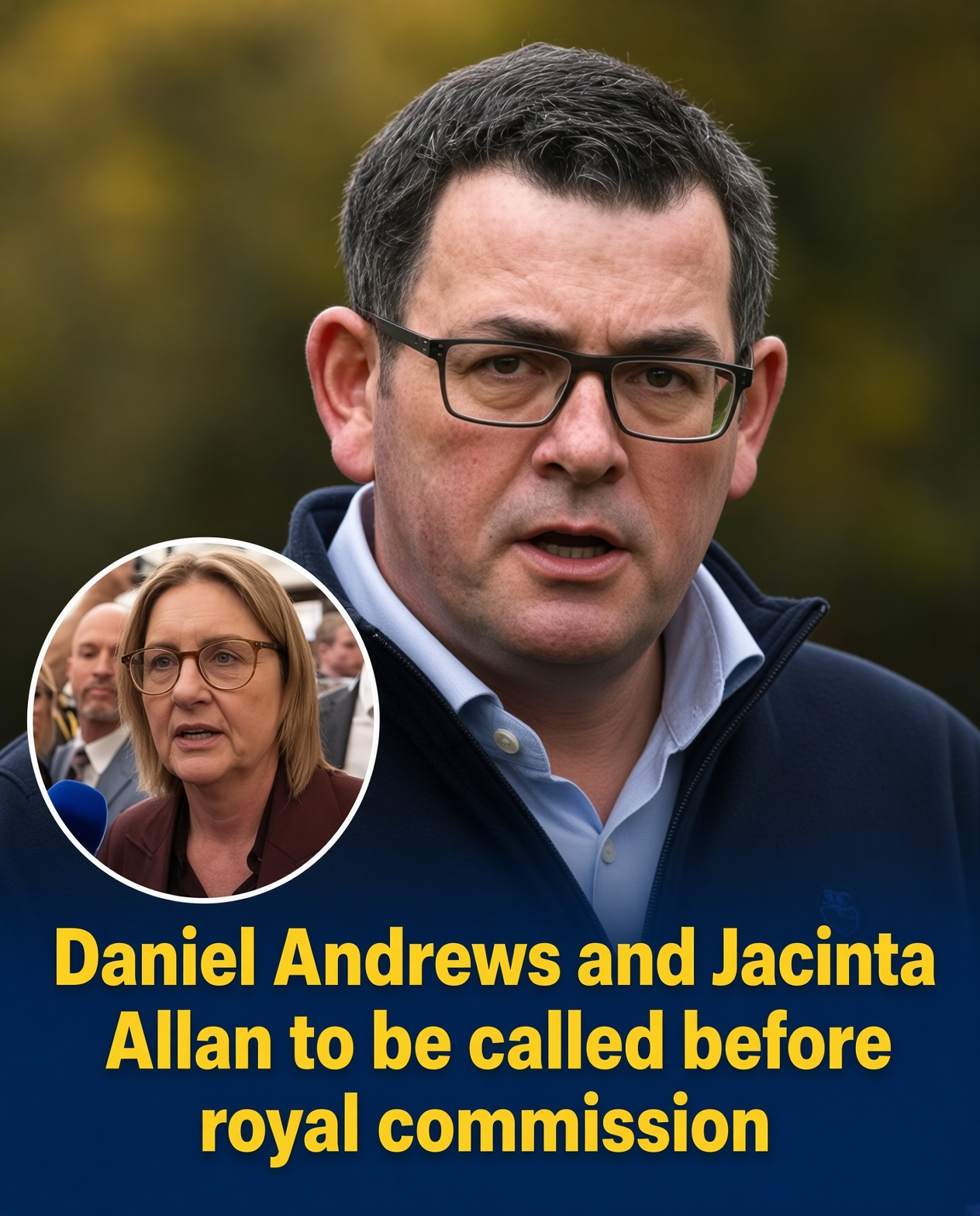
Daniel Andrews and Jacinta Allan could be compelled to give evidence before Victoria’s sweeping new $50 million construction royal commission after Premier Ben Carroll declared that “nothing is off limits” in the investigation into corruption, criminal conduct and serious misconduct surrounding the state’s major infrastructure projects.
The inquiry represents one of the most consequential investigations into Victoria’s construction sector in decades and will examine not only unions and contractors but also how government departments, agencies and decision-makers responded to warning signs surrounding taxpayer-funded projects.
Former South Australian chief justice Chris Kourakis AC has been appointed to lead the Royal Commission into the Integrity of Major Public and Civil Infrastructure Construction Projects in Victoria.
Carroll announced the commissioner and final terms of reference on Thursday, roughly 100 days before Victorians return to the polls.
And despite an early political fight over whether former Labor premiers would escape scrutiny, Carroll has made his position explicit.
“Nothing is off limits.”
Could Daniel Andrews and Jacinta Allan be called?
Yes.
The royal commission’s terms do not provide a blanket exemption for former premiers or ministers, and Carroll has said current and former political leaders can be called if Commissioner Kourakis considers their evidence relevant.
That potentially places both Andrews and Allan within reach of the inquiry.
However, there is an important distinction between saying they can be called and saying they definitely will be called.
No decision requiring either former premier to appear has yet been publicly announced.
Anti-corruption barrister Geoffrey Watson SC addressed that controversy on Friday after the opposition suggested the commission’s terms might shield Andrews and Allan.
Watson rejected that interpretation, describing the criticism of the terms as “absurd” and praising the inquiry’s design.
The government itself is inside the scope
The significance of the inquiry becomes clearer when its official terms of reference are examined.
Commissioner Kourakis is directed to investigate the nature and extent of corruption, criminal conduct and serious misconduct connected with major public and civil infrastructure construction projects in Victoria.
But the inquiry goes considerably further than simply examining allegations against the CFMEU.
It can investigate the actions — and adequacy of those actions — taken by Victoria’s executive government to respond to and mitigate corruption, criminal conduct or serious misconduct associated with major construction projects.
That expressly encompasses delivery authorities, regulatory and licensing authorities and Victoria Police.
It also permits scrutiny of whether government systems reacted appropriately when risks or allegations emerged.
In other words, the commission is empowered to investigate not merely who engaged in misconduct, but what government knew, how it responded and whether its safeguards failed.
That is why the Andrews and Allan years matter
Victoria’s extraordinary infrastructure expansion occurred largely under the governments led by Andrews and Allan.
The Big Build became one of the defining features of the Labor government’s political identity, encompassing enormous road, rail and other infrastructure programs across the state.
Andrews served as premier from 2014 until 2023, while Allan held senior infrastructure portfolios before succeeding him as premier.
That history does not establish wrongdoing by either former premier.
Nor does the creation of the royal commission mean either has been accused by Commissioner Kourakis of corruption or criminal conduct.
But it explains why their decisions, knowledge and oversight could become relevant as investigators reconstruct what happened across Victoria’s major works program.
‘There was grift, there was thuggery’
Carroll’s language in launching the commission was unusually stark for a Labor premier discussing projects delivered under previous Labor governments.
He acknowledged allegations of “grift” and “thuggery” within the construction sector and said Victorians deserved to understand what had occurred on taxpayer-funded worksites.
The commission will examine allegations involving corruption, criminal conduct and serious misconduct and the impact those practices may have had on project delivery.
That includes their effect on construction costs, wastage, misdirected funds, inflated costs, worker safety, contracting and subcontracting, procurement, supply chains, industrial relations, productivity, efficiency and competition.
It is an extraordinarily broad list.
The CFMEU will be under intense scrutiny
Allegations involving the construction division of the CFMEU were a major catalyst for the political pressure that ultimately produced the royal commission.
For years, allegations have surrounded intimidation, organised crime links and improper practices within sections of Australia’s construction industry.
The commission will be able to examine conduct involving unions and their officials, but it will not stop there.
Construction companies, contractors, subcontractors, labour-hire firms, suppliers and government entities can also fall within its reach.
The CFMEU has said it will cooperate with the commission while arguing that scrutiny should extend across the entire construction industry rather than concentrating exclusively on organised labour.
Big business could have plenty to fear as well
That breadth may prove particularly important.
Corruption cannot ordinarily operate through one participant alone.
If improper payments, inflated costs, coercive arrangements or corrupt procurement occurred, investigators may need to examine not only whoever demanded or received a benefit but also businesses and individuals who facilitated, tolerated or profited from the conduct.
Reporting following the release of the terms suggests major builders, engineers, suppliers and other commercial participants could consequently face scrutiny alongside unions.
That makes describing the inquiry solely as a “CFMEU royal commission” potentially misleading.
The union will undoubtedly be central to the investigation, but the official mandate is considerably wider.
Commission can examine where taxpayer money went
One of the most politically explosive elements of the terms concerns public money.
The commission can investigate how corruption, criminal conduct or serious misconduct affected project costs, including wastage, misdirected funds and inflated expenditure.
It can also consider mechanisms to recover money paid by the state where funds were misappropriated or received as a result of corruption, criminal conduct or serious misconduct.
That transforms the inquiry from a historical examination of construction culture into a potential forensic investigation of how Victorian taxpayer dollars were spent.
A controversial $15bn estimate is hanging over the inquiry
Anti-corruption barrister Geoffrey Watson has previously estimated that wastage associated with Victoria’s Big Build could have reached approximately $15 billion.
That figure should not be confused with a royal commission finding.
The commission has only just begun and has not established that $15 billion was stolen, corruptly obtained or even definitively wasted.
Watson’s estimate nevertheless demonstrates the scale of concern surrounding inefficiencies and alleged misconduct on the state’s infrastructure projects.
Determining the actual financial consequences will now be one of the most important tasks facing Kourakis.
Kourakis brings serious judicial weight
Chris Kourakis is a former chief justice of South Australia and one of the country’s most senior former judicial figures.
His appointment gives the commission significant institutional weight and places its conduct at arm’s length from the Victorian political establishment it may ultimately scrutinise.
The commission has been given approximately $50 million to conduct its work and is expected to deliver its final report by 20 August 2027.
That gives investigators roughly one year to work through an enormous potential body of evidence.
The commission will have coercive powers
This is not a parliamentary committee dependent on voluntary political cooperation.
A royal commission possesses powerful mechanisms for obtaining evidence.
The inquiry can compel witnesses and documents and examine material that would ordinarily remain beyond public view.
Carroll has indicated that the government will provide access to relevant documents, including cabinet material where required.
That is particularly important if investigators seek to understand how concerns travelled through government agencies and ministerial offices.
Internal correspondence, briefings, procurement documentation, risk assessments and decisions about responding to allegations could potentially become crucial evidence.
Previous inquiries are also part of the story
The royal commission has been specifically instructed to examine the effectiveness of measures recommended or implemented following earlier inquiries.
It can ask whether previous reforms worked and, if not, what circumstances prevented them from doing so.
That opens another potentially uncomfortable line of investigation.
If government or industry had previously been warned about vulnerabilities but ineffective reforms allowed serious misconduct to continue, the commission can examine why.
The issue therefore extends beyond individual allegations to the effectiveness of Victoria’s entire integrity and oversight framework.
A Special Prosecutor will sit alongside the commission
Carroll has also announced the establishment of an Office of the Special Prosecutor.
The intention is to ensure evidence of possible criminality uncovered through the inquiry can be acted upon rather than simply recorded in a final report.
The government is simultaneously moving to strengthen the powers of Victoria’s Independent Broad-based Anti-corruption Commission.
That combination potentially gives the inquiry consequences extending well beyond political embarrassment.
Evidence can generate referrals and further investigation where appropriate.
The timing could hardly be more politically dangerous
All of this is happening as Victoria approaches a state election.
Carroll unveiled the final commission arrangements about 100 days before polling day.
That timing guarantees the inquiry will loom over the campaign even though its final conclusions will not arrive until long after voters cast their ballots.
Labor will argue Carroll has confronted a problem that required decisive action and established an independent process with broad powers.
The opposition will argue the commission is examining failures that developed during years of Labor government and should have been addressed much earlier.
Both arguments will now form part of the election fight.
Carroll is separating himself from the past
The announcement is particularly significant because Carroll has only recently taken over Victoria’s premiership.
Calling the royal commission was among his first major acts after replacing Allan.
Earlier this month, he said he would be “happy” to appear before the inquiry himself if required.
That helps Carroll establish a clear political position: the commission should go wherever the evidence leads, including into the actions of his own government.
But it also creates risk.
Once a royal commission begins exercising its powers, the premier who established it cannot control what evidence emerges.
Labor has effectively opened its own books
That is what makes the decision so consequential.
For more than a decade, Victorian Labor has promoted infrastructure construction as one of its defining achievements.
Projects delivered during the Andrews and Allan eras were not peripheral government programs.
They were central to Labor’s political brand.
Now an independent royal commission will examine whether corruption, criminality, serious misconduct, inflated costs or failures of government oversight infected major parts of that construction program.
And because the inquiry can examine the executive government’s response, the questions may travel from construction sites into departmental offices and potentially all the way to the former premiers who ran the state.
But a royal commission is not a finding of guilt
That distinction will become increasingly important as witnesses are named.
Being called to give evidence does not mean a person has committed wrongdoing.
A former premier, minister, bureaucrat, contractor or union official may be summoned because they possess information necessary to establish what happened.
Similarly, allegations examined by the commission should not be treated as established corruption before evidence is tested and findings are made.
The inquiry’s value depends precisely on making those distinctions.
Andrews and Allan could face questions they never had to answer in office
Whether either former premier ultimately enters the witness box is now a decision for the independent commission based on the evidence it gathers.
But the political significance of their inclusion within its potential reach is difficult to overstate.
Andrews presided over the enormous expansion of Victoria’s infrastructure program.
Allan spent years in infrastructure portfolios before becoming premier herself.
If evidence raises questions about what senior government figures knew about alleged corruption or misconduct, when they knew it and whether the response was adequate, Kourakis has the scope to pursue those questions.
Carroll has publicly promised not to stand in the way.
‘Nobody is off limits’ is now a promise that will be tested
The Premier’s words have set an unusually high benchmark for his own government.
If “nothing is off limits”, politically sensitive documents cannot become off limits when they become embarrassing.
Former ministers cannot become off limits because an election is approaching.
Major companies cannot become off limits because they built important projects.
And former premiers cannot become off limits because their evidence might reopen arguments Labor would prefer to leave behind.
The royal commission has now been given the legal authority to investigate what happened inside Victoria’s major construction program. The real test will be whether it is allowed to follow that evidence wherever it leads.
For Daniel Andrews and Jacinta Allan, that means the infrastructure legacy they spent years building may now be examined in a forum neither of them controls.
And for Victorian taxpayers, the bigger question is simpler: what happened to their money, who knew about the problems, and why were they allowed to continue?