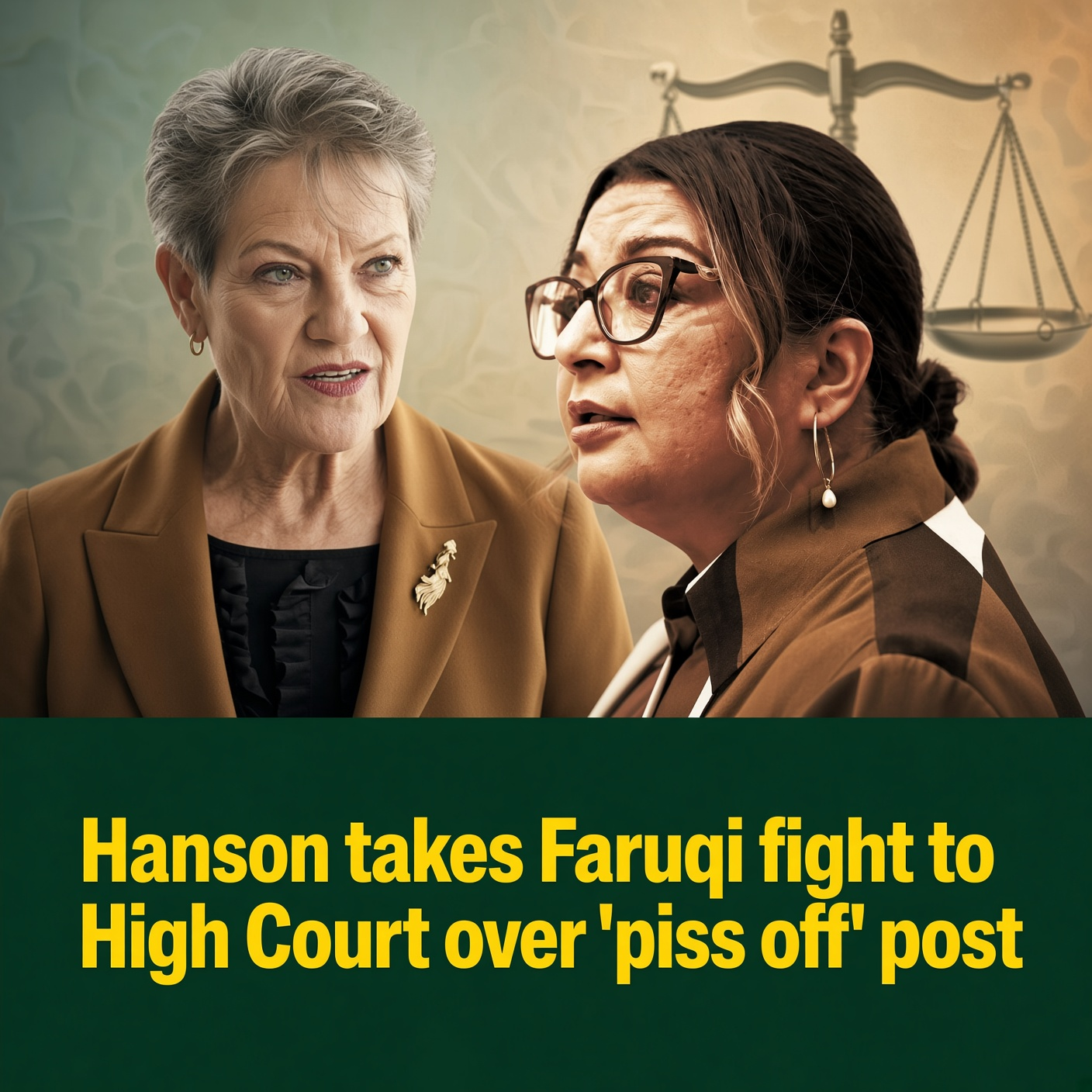
Pauline Hanson is taking one of Australia’s most politically charged free-speech disputes towards the High Court, seeking to overturn the racial discrimination ruling against her and mount a constitutional challenge to a key provision of federal law.
The One Nation leader is seeking special leave to appeal after losing her case before the Full Court of the Federal Court last month.
The dispute began with a social media exchange between Hanson and Greens Senator Mehreen Faruqi following the death of Queen Elizabeth II in September 2022.
But the legal battle Hanson now wants Australia’s highest court to consider is considerably larger than the original argument between two senators.
At stake is the operation of section 18C of the Racial Discrimination Act and the difficult constitutional boundary between laws protecting Australians from racial discrimination and the freedom to participate in political debate.
Hanson is seeking special leave
The first important distinction is procedural.
Hanson has not yet won the right to argue a full appeal before the High Court.
She is seeking special leave to appeal the Full Federal Court’s decision.
The High Court must first decide whether the case meets the threshold to be heard.
If special leave is refused, the Full Federal Court decision stands and the constitutional challenge goes no further through this appeal.
If special leave is granted, however, Hanson will have the opportunity to put her arguments before Australia’s highest court.
That makes Saturday’s announcement the beginning of another potentially significant stage of the litigation rather than its conclusion.
The Federal Court appeal ended in July
The Full Court handed down its judgment on July 27.
The Federal Court’s official public-interest case file identifies the decision as Pauline Hanson v Mehreen Faruqi & Anor, judgment [2026] FCAFC 96.
The appeal followed Justice Angus Stewart’s original 2024 judgment finding Hanson had contravened section 18C of the Racial Discrimination Act.
The original Federal Court case file records the substantive judgment as [2024] FCA 1264, delivered on November 1, 2024.
The Full Court ultimately rejected Hanson’s attempt to overturn that result.
She is now attempting to take the dispute one court higher.
It started after Queen Elizabeth II died
The underlying confrontation occurred on September 9, 2022, shortly after news of Queen Elizabeth II’s death.
Faruqi published a social media post offering condolences while saying she could not mourn the leader of what she described as a racist empire built upon colonised peoples.
Hanson responded by criticising Faruqi for attacking Australia and the monarchy after migrating to the country.
Her response culminated in telling the Greens senator to pack her bags and return to Pakistan, using an expletive.
Faruqi subsequently pursued legal action under the Racial Discrimination Act.
The 2024 court found against Hanson
Justice Stewart found Hanson’s post contravened section 18C.
The court ordered Hanson to remove the social media post and imposed other relief arising from the finding.
Hanson appealed.
The Full Federal Court’s July decision left the central finding against her intact.
Faruqi characterised that decision as a victory for Australians who had been subjected to racist abuse and told they did not belong in the country.
She has consistently rejected the proposition that the dispute should be understood simply as a free-speech case, arguing instead that racial discrimination carries real consequences for minorities.
Now Hanson is targeting section 18C itself
Section 18C is one of Australia’s most controversial restrictions on expression.
In broad terms, it makes certain public conduct unlawful where it is reasonably likely to offend, insult, humiliate or intimidate a person or group and is done because of their race, colour or national or ethnic origin.
The provision has generated decades of argument over whether Australian law has struck the correct balance between racial discrimination protections and freedom of expression.
Hanson now wants that argument placed before the High Court.
She says section 18C casts too wide a net and imposes too great a burden on political communication.
Australia does not have an American-style constitutional right to free speech
This point is essential to understanding the case.
Australia’s Constitution does not contain a general guarantee of free speech equivalent to the First Amendment of the United States Constitution.
Australian constitutional law instead recognises an implied freedom of political communication arising from the system of representative and responsible government established by the Constitution.
That freedom is not a personal right allowing an individual to say anything without legal consequences.
Rather, it operates as a constitutional limitation upon government power.
Hanson’s argument therefore cannot simply be that she has a general constitutional right to free speech.
Her challenge concerns whether section 18C places an impermissible burden on constitutionally protected political communication.
Hanson says her tweet was political communication
That distinction sits at the heart of her proposed High Court case.
Hanson argues the exchange occurred between two elected federal senators discussing the monarchy, colonialism, immigration, citizenship and Australia.
She says that places the communication close to the core of political debate.
In announcing her latest legal move, Hanson argued Australians should be free to disagree and argue about controversial subjects including immigration, race, religion and Indigenous policy without being frightened into silence by legal action.
She has framed the case as being larger than her own tweet or her personal dispute with Faruqi.
There is another constitutional argument
The implied freedom of political communication is not the only issue Hanson wants scrutinised.
Her challenge also raises questions about the constitutional foundation supporting section 18C.
One of the Commonwealth’s foundations for the Racial Discrimination Act is Australia’s implementation of its international obligations under the International Convention on the Elimination of All Forms of Racial Discrimination.
Hanson’s argument is expected to question whether section 18C goes further than the relevant obligations can constitutionally support.
Her side points to the difference between international provisions dealing with serious racial hatred, incitement and discrimination and the substantially lower threshold represented by words such as “offend” and “insult” in section 18C.
That could make this much bigger than Hanson versus Faruqi
If the High Court grants special leave, it does not necessarily follow that the court would strike down section 18C.
There are several possible outcomes.
The court could uphold the law and the decisions against Hanson.
It could accept some constitutional arguments while still concluding the provision remains valid.
It could clarify or alter how constitutional principles apply to the section.
Or, in the most consequential outcome for Commonwealth law, it could find some aspect of the legislative scheme constitutionally invalid.
That is why the next stage matters well beyond the political fortunes of Pauline Hanson or Mehreen Faruqi.
A leading constitutional scholar has questioned the Full Court reasoning
Hanson’s High Court push has also gained significance because constitutional law expert Professor Anne Twomey has publicly raised concerns about the Full Federal Court judgment.
Twomey has said she found parts of the judgment contradictory and questioned aspects of its treatment of relevant High Court authority.
She has also argued that the constitutional questions surrounding the scope of the international convention and section 18C deserve proper scrutiny by Australia’s highest court.
Twomey stressed that there is no certainty about what the High Court would ultimately decide and that it could reach the same result as the Federal Court.
That qualification matters.
Criticism of the lower court’s reasoning is not a prediction that Hanson will win.
But it does reinforce the argument that the proposed appeal raises genuine constitutional questions rather than merely asking another court to reconsider an offensive tweet.
Faruqi sees the case very differently
For Faruqi, the litigation has never primarily been about suppressing political disagreement.
After winning the Federal Court appeal, she said the outcome was a victory for people who had been told to “go back” to where they came from and whose sense of belonging in Australia had been treated as conditional.
She described Hanson’s behaviour as racist and Islamophobic and rejected the idea that hate speech should be protected in the name of free speech.
Asked about Hanson continuing to the High Court, Faruqi indicated she was prepared to continue fighting the case.
Her position represents the other side of the section 18C argument: removing or significantly narrowing racial discrimination protections can itself impose a cost upon Australians’ ability to participate equally in public life.
Section 18C does not operate alone
The political debate over section 18C is sometimes presented as though the words “offend, insult, humiliate or intimidate” are the entirety of the legal regime.
They are not.
Section 18D of the Racial Discrimination Act provides exemptions for certain acts done reasonably and in good faith, including artistic works, academic and scientific debate and fair comment on matters of public interest.
That relationship between sections 18C and 18D has long been central to arguments over whether the law appropriately protects legitimate public debate.
Supporters of the existing framework point to those exemptions when rejecting claims that section 18C simply prohibits anything somebody finds offensive.
Critics respond that the existence of litigation itself can create a chilling effect, particularly when political speakers cannot know with certainty how a court will characterise their words.
The case raises a difficult question about political speech
There is another feature making Hanson v Faruqi unusual.
Both protagonists are federal parliamentarians.
The original exchange concerned unmistakably political subjects.
It involved the British monarchy, colonial history, immigration, citizenship and the conduct of an Australian senator.
That does not automatically make every word used in the exchange constitutionally protected.
But it makes the case different from an ordinary racial discrimination dispute arising from a workplace confrontation or private commercial setting.
The High Court, if it grants special leave, could therefore be asked to determine how Australia’s racial discrimination framework operates when it collides directly with hostile political debate between elected representatives.
Free speech and racial protection are both democratic interests
The political temptation is to reduce the case to two simple propositions.
One side says Australians should be allowed to speak freely.
The other says Australians should be protected from racism.
Neither proposition resolves the legal question.
A democratic society has an obvious interest in protecting vigorous political communication, including speech that is unpopular, abrasive or offensive.
It also has an interest in ensuring citizens are not excluded from public life through racial discrimination.
The difficult issue is where law should draw the boundary between the two.
That is precisely why section 18C has remained politically contentious for so long.
The High Court first has to say yes
For all the political attention surrounding Hanson’s announcement, there is an immediate legal hurdle ahead.
Special leave is not automatic.
The High Court hears only a small proportion of cases that parties seek to bring before it.
Hanson must persuade the court that her proposed appeal raises questions warranting the attention of Australia’s final appellate and constitutional court.
The existence of constitutional arguments may strengthen the significance of the application, but it does not guarantee special leave.
Until the High Court makes that decision, the Full Federal Court judgment remains the controlling outcome in Hanson’s case.
A case that began with 2022 politics could reshape the rules of future debate
Almost four years have passed since Hanson and Faruqi exchanged the posts that started the litigation.
The dispute has moved from social media to a Federal Court trial, through a Full Court appeal and now towards an application before Australia’s highest court.
During that period the underlying political argument has become larger rather than smaller.
One Nation has increased its political prominence, migration and national identity have returned to the centre of Australian debate, and arguments over the permissible limits of political language have intensified.
Hanson is now attempting to transform her defeat under section 18C into a constitutional test of the law itself.
Faruqi, meanwhile, is defending judgments she regards as establishing that racial abuse does not become acceptable simply because it occurs in political debate.
The consequences could extend to every Australian political movement
This is one reason the case should not be viewed purely through partisan loyalties.
A constitutional principle established because of speech by Pauline Hanson would not apply only to Pauline Hanson.
It could affect Labor politicians, Coalition politicians, Greens, independents, activists, journalists and ordinary citizens participating in public debate.
Likewise, a High Court judgment affirming the present operation of section 18C in political contexts could strengthen the legal framework available to people subjected to racially discriminatory public speech.
Constitutional cases have a habit of outliving the politicians who bring them.
Hanson has turned a personal legal defeat into a national legal fight
Hanson says Australians increasingly fear discussing controversial issues because of the possibility of being branded racist, dragged into complaints processes or taken to court.
Her opponents argue those concerns are being used to weaken legal protections against racial discrimination.
Both arguments will now form part of a much larger public debate as her lawyers seek special leave.
The High Court may refuse to hear the case.
If it does, Hanson’s Federal Court defeat remains intact.
But if Australia’s highest court grants special leave, the next proceeding will no longer be merely about whether one senator unlawfully discriminated against another in a 2022 tweet.
It could become a major constitutional test of how far Parliament may go in restricting racially offensive speech when that speech forms part of Australia’s political debate.
And whichever side ultimately wins, the result could help define the legal boundaries of Australian political expression long after Hanson and Faruqi’s original argument has faded from memory.