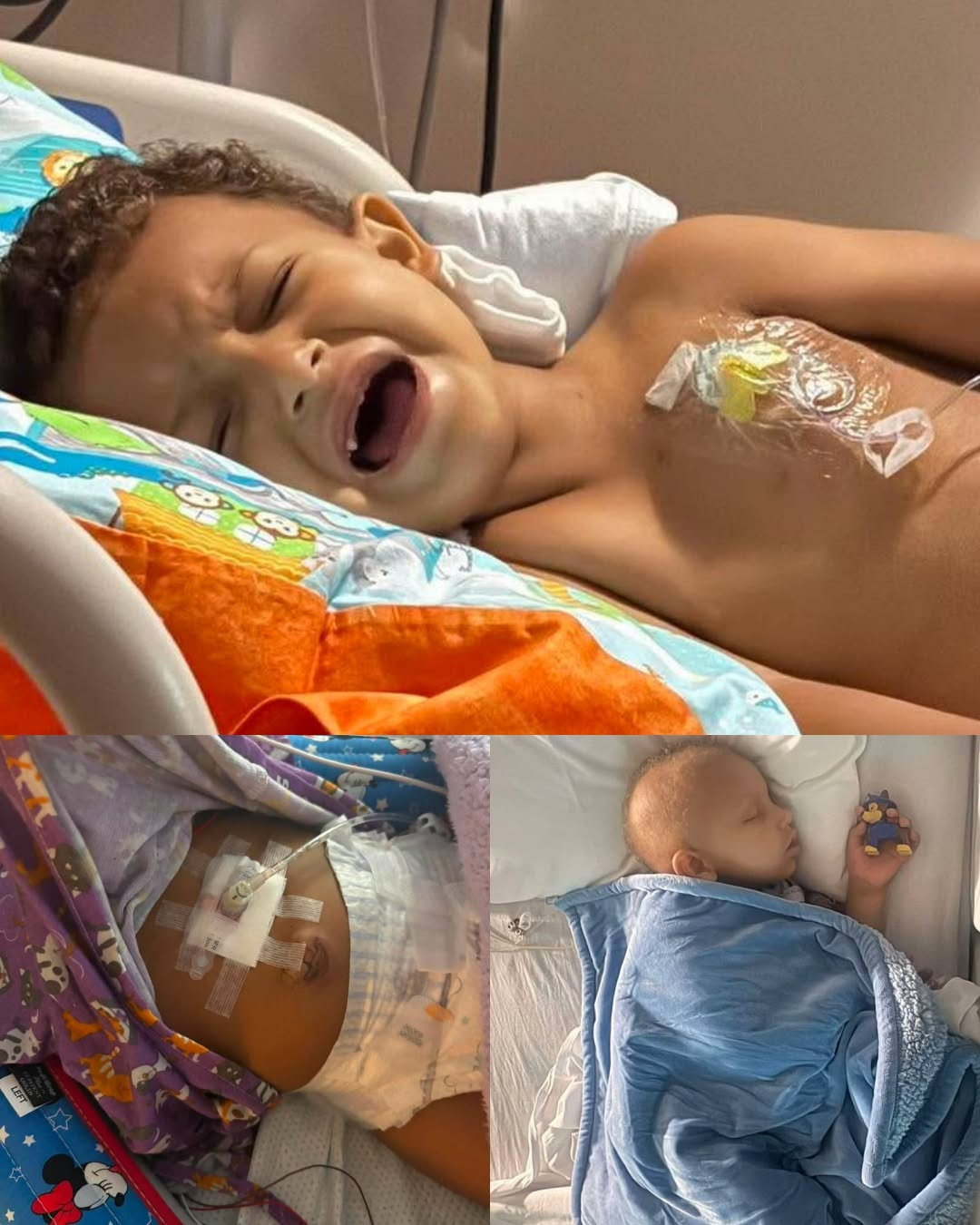
Some photographs do not need a long explanation.
You look at the face of a 3-year-old child crying in pain, and suddenly you understand why his mother is terrified.
That little boy is Bentley.
He is only 3 years old.
At an age when children are supposed to be learning new words, racing toy cars across the floor, laughing at cartoons and discovering something new every day, Bentley is once again enduring something no child should ever have to understand.
Cancer.
Again.
And beside him is his mother, Amanda, trying to find the strength to walk through a nightmare she once truly believed their family had already escaped.
Bentley has spent most of his short life fighting cancer.
There have been chemotherapy treatments, hospital stays, procedures, scans, fears and moments of pain far too heavy for such a small child.
For a while, his family believed they had beaten it.
They allowed themselves to hope.
They allowed themselves to imagine a future beyond cancer.
Then Bentley turned 3.
And the cancer came back.

Bentley’s Fight Began When He Was Only 7 Months Old
Bentley was just 7 months old when his family received the diagnosis that changed everything.
Stage 4 neuroblastoma.
Think about that for a moment.
Seven months old.
At that age, many babies are just beginning to sit up on their own. Some are starting to crawl. They recognize familiar voices, reach for their parents and discover the world one tiny experience at a time.
Bentley was still a baby.
He could not possibly understand the words doctors were saying around him.
He could not understand what cancer was.
He could not understand why his days suddenly became filled with hospitals, treatments, tests and unfamiliar faces.
But his body was already being asked to fight for his life.
Bentley underwent chemotherapy.
His family stayed beside him through the fear and uncertainty.
They learned the language of childhood cancer — words and phrases no parent ever wants to become familiar with.
They learned to wait for blood counts.
They learned to fear fevers.
They learned the anxiety of scans.
They learned what it meant to celebrate small victories because sometimes a single piece of encouraging news was enough to carry them through another difficult day.
And eventually, the news they had desperately prayed for arrived.
Remission.
For Amanda, that word must have felt like oxygen after months of holding her breath.
Her little boy had fought.
The treatment had worked.
Cancer had loosened its grip.
And for the first time in what probably felt like forever, Amanda allowed herself to believe that maybe the worst was behind them.
“I truly believed we had beaten it,” she later said.
Those words carry even more weight now.
Because when remission came, Amanda did what any mother would do.
She hoped.
She imagined Bentley growing up.
She pictured more birthdays.
More laughter.
More ordinary days.
She imagined cancer becoming something they would someday talk about in the past tense.
Something Bentley survived.
Something their family had endured and overcome.
But then Bentley turned 3.
And the nightmare returned.
Cancer Came Back
This time, Amanda says her little boy is facing relapsed, high-risk stage 4 neuroblastoma.
The family is back in treatment.
Back to chemotherapy.
Back to hospitals.
Back to procedures.
Back to waiting for results.
Back to watching a small child endure pain that no 3-year-old should ever have to experience.
And now they are preparing for another major step in Bentley’s treatment journey: a bone marrow transplant.
Amanda is praying the treatments work well enough to get her son there.
For doctors, each phase may be part of a medical plan.
For a mother, every phase carries a thousand questions.
Will the treatment work?
Will Bentley’s body tolerate it?
Will they make it to transplant?
What will the next scan show?
Will tomorrow bring better news or another setback?
Every answer matters.
Every result has the power to change everything.
And hanging over all of those questions is the one Amanda admits sometimes enters her mind — a question no mother should ever have to ask.
Will my child get the chance to grow up?

The Part Hospital Photographs Cannot Show
A hospital photograph can show many things.
It can show a child lying in a bed.
It can show medical equipment.
It can show exhaustion.
It can show tears.
It can show the visible evidence of treatment.
But there is something a photograph cannot fully capture.
A mother’s fear.
“The fear never leaves,” Amanda said.
For parents living through childhood cancer, those words probably require no explanation.
Even on a good day, fear remains.
A fever is not always just a fever.
A new symptom cannot simply be ignored.
A scan is not just another appointment.
Every test can feel like a verdict.
Every phone call from the hospital can make a parent’s heart race.
Every doctor walking into the room can bring hope or change the direction of an entire life.
That is the reality Amanda now lives with.
Hope and fear occupying the same space.
Trying to believe in tomorrow while knowing how quickly tomorrow can change.
Celebrating every good moment while being terrified of what the next scan might reveal.
And somehow, through all of it, continuing to be the mother Bentley needs.
There Is Another Heartbreaking Layer to Bentley’s Fight
Bentley is autistic.
Amanda says that adds another difficult dimension to what her son is experiencing.
Because Bentley does not understand why this keeps happening to him.
He does not understand cancer.
He does not understand why he must return to the hospital.
He does not understand why people need to perform procedures on him.
He cannot fully understand why treatments that are meant to help him may also make him feel sick or uncomfortable.
Imagine being 3 years old and hurting, but not being able to understand why.
Imagine being taken into unfamiliar rooms again and again, surrounded by sounds, sensations and medical procedures you cannot make sense of.
Amanda understands why these treatments are necessary.
She understands that doctors and nurses are trying to help save her son.
But knowing that does not make it easy to watch Bentley experience them.
There are few things more painful for a parent than seeing their child hurting.
Perhaps one of them is seeing that child hurting and knowing they cannot explain the reason in a way the child can truly understand.
Bentley knows he wants the pain to stop.
He knows he wants his mother.
And Amanda can hold him.
She can comfort him.
She can stay beside him.
She can tell him she loves him.
But she cannot take the cancer from his body herself.
That helplessness is one of the cruelest parts of loving a seriously ill child.
“I Wonder If He’ll Get to Grow Up”
There are thoughts parents are almost afraid to say out loud.
Not because they do not love their children enough.
But because they love them so deeply that giving words to their greatest fears makes those fears feel even more real.
Amanda admitted that she sometimes looks at Bentley and wonders:
Will he get to grow up?
It is a devastating question.
Because tucked inside those few words are thousands of moments she desperately wants to experience with her son.
Will Bentley go to school?
Will Amanda watch him carry a backpack through the school doors for the first time?
Will he grow taller?
Will he discover new interests?
Will he celebrate 5?
Ten?
Eighteen?
Will he someday look back at photographs from the hospital and realize how hard he fought when he was too young to fully understand what was happening?
Will the family someday be able to say, “Remember when Bentley had cancer?”
Instead of living with cancer as a constant part of their present?
These should not be the questions surrounding a 3-year-old.
At 3, the future should feel enormous.
It should stretch out endlessly in front of a child.
But cancer has forced Amanda to think about time in a way no mother should have to.

Smiling for Her Son While Falling Apart Inside
Amanda says she has learned how to smile for Bentley while, in her own words, “falling apart inside.”
That sentence says something powerful about parenting through a child’s serious illness.
Bentley looks to his mother for safety.
So Amanda tries to look calm.
Bentley needs comfort.
So she comforts him.
Bentley needs familiar arms when the world around him feels frightening.
So Amanda stays close.
Even when she is scared.
Even when she does not know what the next test will show.
Even when she is exhausted.
Even when she wishes someone could promise her that everything will be okay.
She smiles because her little boy is watching.
Then perhaps there are moments when Bentley is asleep, or when she steps away, and everything she has been holding inside finally becomes impossible to contain.
That is a kind of strength people do not always see.
Strength is not the absence of fear.
Sometimes strength looks like wiping your tears before walking back into your child’s hospital room.
Sometimes it means answering another doctor’s call.
Sometimes it means asking another question.
Sometimes it means saying, “We are going to keep fighting,” even when your own heart feels exhausted.
And sometimes it is simply holding your child through another painful moment and making sure he knows he is not alone.
Amanda Is Asking for More Than Prayers
Amanda reached out because she wants people praying for Bentley.
But she is also hoping that sharing his story might somehow open another door.
Maybe Bentley’s story will reach someone with information.
Someone with a resource.
Someone with a connection.
Someone who has walked through relapsed neuroblastoma with another child.
Someone who knows of an organization, program, specialist or form of support that could help this family through what comes next.
For a parent fighting for a seriously ill child, hope can sometimes come through unexpected places.
A conversation.
A name.
A phone number.
A referral.
A person who knows another person.
One piece of information that leads to another possibility.
Amanda wants to know she has searched every road she can for Bentley.
That is what parents do when their child’s life is involved.
They keep looking.
Keep asking.
Keep advocating.
Keep hoping.
The Lesson Cancer Taught Her the Hardest Way
Amanda also wants other parents to hear something she has learned through this journey:
Trust your instincts.
If something does not feel right with your child, ask questions.
If you still feel something is wrong, keep asking.
Advocate for your child.
Seek another medical opinion when necessary.
Parents know their children in ways test results cannot always immediately reflect.
They know their habits.
Their energy.
The way they eat.
The way they sleep.
The way they behave when something does not feel right.
That does not mean every unusual symptom is something serious.
But it does mean parents should feel empowered to speak up when they believe their child needs further evaluation.
Amanda learned that lesson in the most painful circumstances imaginable.
And now she wants her experience to help another parent trust that quiet voice telling them to keep looking for answers.
Bentley’s Story Is Not Over
Today, Bentley is still fighting.
His family is still fighting beside him.
Amanda is still hoping.
And she is asking the rest of us to hope with her.
Pray that chemotherapy works.
Pray that Bentley’s body responds.
Pray that he reaches the bone marrow transplant his medical team is preparing for.
Pray that his pain is eased.
Pray that there are more good days than bad ones.
Pray that this sweet little boy gets back some of the childhood cancer has already taken from him.
Let him have days that are not defined by medicine.
Days when he is simply Bentley.
A little boy.
A son.
A child deserving of laughter, play and ordinary moments.
And pray for Amanda.
Pray for the mother who has learned to smile while her heart is breaking.
Pray for strength during the waiting.
For peace during the scans.
For courage during the difficult conversations.
For hope when fear becomes overwhelming.
Because what Amanda wants is not extraordinary.
She is not asking for a perfect life.
She is asking for what so many parents assume they will automatically receive.
Time.
More birthdays.
More childhood.
More memories.
The chance to watch her son grow.
Bentley was only 7 months old when cancer first entered his life.
He fought.
He reached remission.
His family believed the nightmare was over.
Then cancer returned.
But Amanda is asking everyone to remember something important:
Bentley is still here.
He is still fighting.
There are still treatments ahead.
There is still hope.
And there are still pages left to be written in the story of this little boy’s life.
Three years old is far too young to understand cancer.
Far too young to endure chemotherapy for the second time in a lifetime.
Far too young for his mother to be wondering whether he will have the opportunity to grow up.
But today, Bentley is surrounded by people refusing to stop believing in him.
So please do not let Amanda carry that fear alone.
🙏 Pray that Bentley’s treatment works. Pray for his upcoming transplant journey. Pray that his pain is eased, his body is strengthened, and this precious little boy is given back the childhood cancer has already taken far too much from.
❤️ And if Bentley’s story reaches someone with knowledge, resources, support or a connection that could help his family, please let this story continue traveling until it finds them.
Amanda is still believing that Bentley’s story is not over yet.
Let’s believe with her.