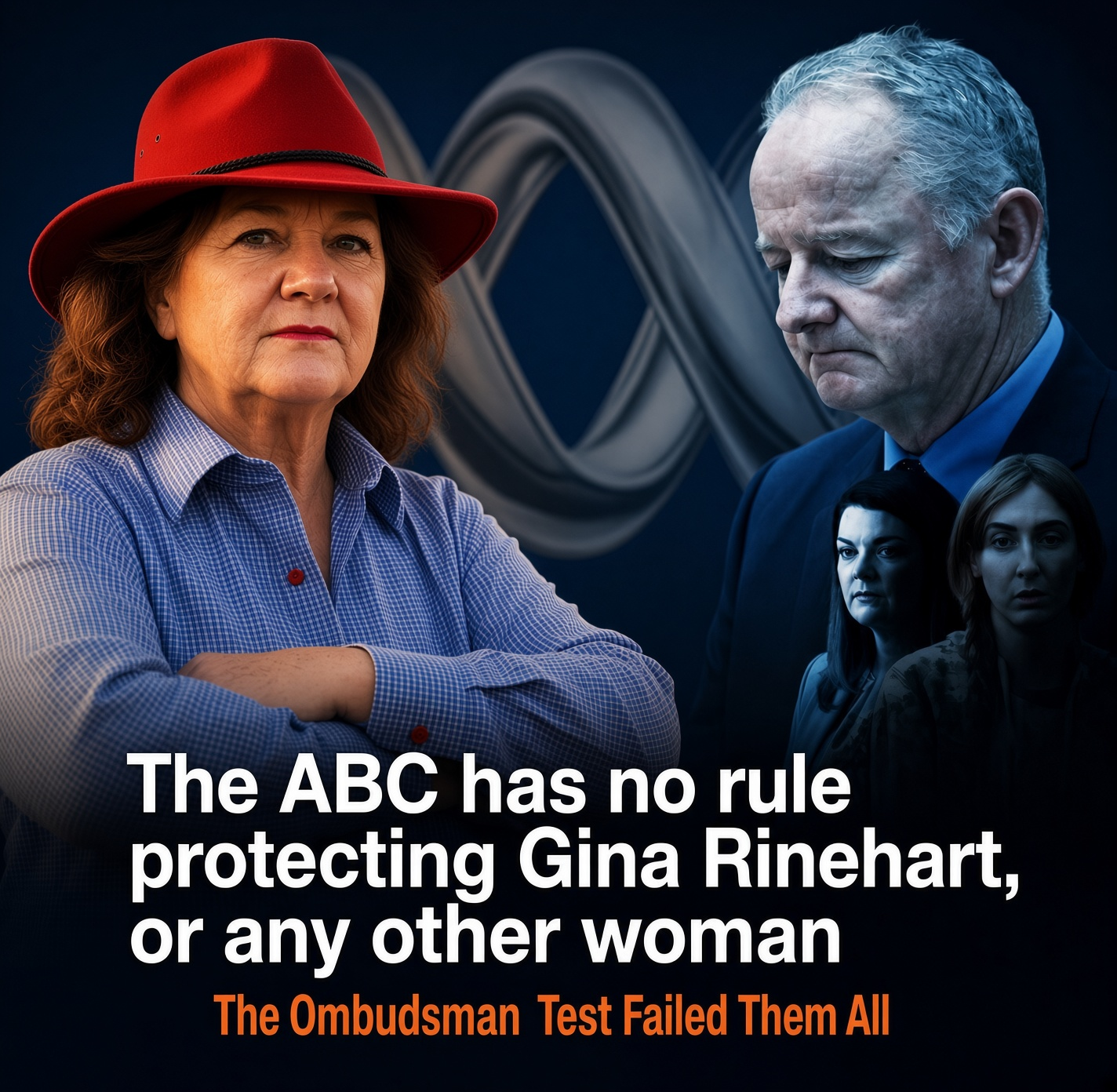
Gina Rinehart got an apology from the ABC. What she did not get was a new rule expressly preventing the broadcaster from airing similarly violent material about another woman.
That distinction has become the next battleground in the controversy surrounding a Race Around the World film that ended with an extraordinarily graphic description of violence against Australia’s richest woman.
ABC Managing Director Hugh Marks has apologised to Rinehart, acknowledged the material fell short of community expectations, removed it from the broadcaster’s platforms and promised changes to editorial guidance concerning violence.
But the ABC Ombudsman’s formal investigation reached a different conclusion on the question of whether existing rules had actually been broken.
Ombudsman Fiona Cameron found no breach.
Her published reasoning shows that complaints alleging the segment encouraged violence against women were assessed under two general ABC standards dealing with harm and offence — neither of which establishes a specific standard governing violence directed at women.
That has prompted Hancock Prospecting to argue that the problem exposed by the episode goes beyond Rinehart personally.
The company says the existing framework failed to adequately protect her and risks failing other Australian women if similarly extreme material is broadcast in the future.
The ABC’s own Ombudsman report provides the clearest evidence of how that happened.
Cameron said her office initially received eight complaints after the July 12 episode aired.
After media coverage drew attention to the final line of contestant Kate McGuinness’s four-minute film A Very Relaxing Video, another 988 complaints arrived.
The complaints raised four principal concerns.
Viewers argued the material was offensive without sufficient editorial justification, violent and graphic, encouraging violence against women and encouraging political violence.
Cameron assessed those complaints against Editorial Standards 7.1 and 7.6.
Standard 7.1 provides that content likely to cause harm or offence must be justified by its editorial context.
Standard 7.6 requires appropriate steps to mitigate risks where editorially justified content may lead to dangerous imitation or exacerbate serious threats to individual or public health, safety or welfare.
Neither provision is written specifically around women.
They are broad standards designed to apply across ABC content regardless of the sex of the person involved.
That does not mean the ABC Code contains no protections capable of applying where women are targeted.
The broader harm-and-offence framework can plainly apply, and ABC editorial standards have also addressed unjustified stereotypes and discriminatory content.
But there is no standalone editorial prohibition saying that violent or degrading material directed at women must satisfy a distinct gender-based test.
More importantly for this particular case, Cameron’s published investigation identifies Standards 7.1 and 7.6 as the standards under which she assessed the complaints.
That matters because some complainants specifically alleged the film encouraged violence against women.
Cameron did address that issue in her reasoning.
She acknowledged that violent language directed towards a named female public figure could have greater impact because violence against women is a major social concern in Australia.
But she then drew a distinction between violence directed at a woman and violence directed at someone because she is a woman.
In Cameron’s assessment, Rinehart’s gender was not the target of the satire.
She concluded the film appeared to be attacking Rinehart’s public profile and status in contemporary political and economic debate rather than her gender.
The remarks, Cameron said, did not rely on gender stereotypes and were not framed as hostility towards women collectively.
That distinction was crucial to the no-breach finding.
The Ombudsman accepted that viewers might find the material more confronting because its target was a woman, but did not consider that sufficient to change the overall assessment.
Instead, she focused on whether a reasonable audience would interpret the film as a genuine endorsement, encouragement or threat of violence.
Her answer was no.
The film was part of a creative competition in which contestants were encouraged to produce unconventional work.
Cameron considered its tone surreal, hyperbolic and satirical.
There was no visual depiction of the violence described in the voiceover.
The judging panel had also criticised the offending line on air, providing what the Ombudsman considered additional editorial context.
The segment’s grotesque final image was therefore treated as an absurd satirical metaphor rather than literal advocacy.
Cameron said exaggerated or fantastical violence had a long history in comedy and satire and found that a reasonable viewer would recognise the distinction.
That was enough to satisfy Standard 7.1.
The editorial context justified the likely offence, she concluded, and the program therefore did not breach the harm-and-offence standards.
It is an outcome that exposes an important difference between three questions that have sometimes been blurred together during the controversy.
The first is whether the segment was offensive.
The Ombudsman did not dispute that it was.
The second is whether ABC management believed it should have gone to air.
Marks ultimately concluded it should not have.
The third is whether broadcasting it breached the ABC’s existing editorial rules.
Cameron concluded it did not.
That gap between editorial judgment and enforceable standards is now the central issue.
Marks effectively acknowledged it when he promised to examine whether ABC guidance adequately reflects contemporary community expectations.
“I think the ABC has to hold itself to a higher standard,” he said after the apology.
He said the broadcaster needed to acknowledge that it had got the decision wrong and make changes so that it did not happen again.
Those remarks are significant because they came after the Ombudsman had found that the existing standards had not been breached.
In other words, ABC management reached the position that the broadcast was unacceptable even though its internal accountability system concluded the material remained within the existing editorial boundaries.
Hancock Prospecting argues that this demonstrates a weakness in those boundaries.
In a statement responding to Cameron’s findings, a company spokesperson said the decision “fails all Australian women and the millions of taxpayers who fund the ABC”.
The company wants changes that extend beyond an apology to Rinehart.
Its argument is straightforward: if the ABC accepts that this material should not have aired, its standards should make sufficiently clear why comparable material should not air again.
There is an important qualification to that argument.
It would be inaccurate to say that Australian women currently have no protection whatsoever under ABC editorial standards.
General rules dealing with harm, offence, dangerous content and discrimination can protect any individual, including women.
Federal anti-discrimination law and other Australian laws also exist independently of the ABC’s editorial code.
The narrower and more defensible criticism is that the Code does not establish a bespoke editorial standard for violent content targeting women, and Cameron’s investigation did not apply a standalone gender-based violence rule because no such rule was identified as governing the complaint.
Instead, gender entered the assessment through context.
That produced the key passage in Cameron’s decision.
She recognised the heightened public sensitivity surrounding violence against women, but concluded Rinehart was being targeted for her wealth, public prominence and place in political and economic debate rather than because she was female.
For Hancock Prospecting, that reasoning is precisely the problem.
If an extreme violent fantasy about a woman can be judged principally according to what motivated the satire, critics can ask whether gender-based safeguards become irrelevant whenever another explanation for the attack can be identified.
Under that logic, a filmmaker could target a woman because she was wealthy, conservative, progressive, famous, powerful or politically controversial without the content necessarily becoming gender-based discrimination.
That does not automatically mean the content would pass ABC standards.
It could still fail the general harm-and-offence test.
But it means the question would continue to be whether the material was justified by context rather than whether the violent treatment of the woman itself crossed a separately defined gender-based boundary.
The Rinehart case demonstrates how consequential that difference can be.
The disputed film did not merely insult her.
Its closing voiceover imagined a stick being forced into her body before her internal organs were violently manipulated and she was transformed into a “sausage roll”.
The ABC Ombudsman nevertheless regarded the scenario as so absurd and impossible that audiences would understand it as satire rather than a genuine threat.
Cameron emphasised that the remarks were not accompanied by images of violence.
She also relied on the broader character of Race Around the World.
The revived program deliberately encourages filmmakers to produce provocative and unconventional work, and Cameron noted that regular viewers would already have been familiar with McGuinness’s absurdist and irreverent style.
Audience expectations were therefore different from those applying to news, current affairs or factual programming.
The Ombudsman also considered the reaction of the program’s judges.
The controversial ending had been criticised within the episode itself as “easy” and “nasty”, which Cameron regarded as part of the context available to viewers.
For her, these elements combined to make the material editorially justifiable despite its capacity to offend.
That approach reflects a deliberate feature of the ABC’s standards.
The broadcaster does not prohibit material simply because audiences find it shocking or offensive.
Its policies are designed to preserve substantial space for journalism, artistic expression, satire and creative risk.
The harm-and-offence rules consequently revolve heavily around context.
Material unacceptable in one setting can be permissible in another.
That flexibility protects creative freedom, but it also means there will inevitably be cases in which the formal standards permit material that ABC management later decides should never have been broadcast.
The Rinehart controversy appears to be one of those cases.
Marks apologised despite Cameron’s no-breach finding.
The offending material was removed from ABC platforms.
The managing director said the episode had fallen short of community expectations.
And he promised to review the broadcaster’s approach to depictions of violence.
That last commitment could prove more important than the apology itself.
If the ABC changes its editorial guidance, it will have to decide whether the problem was simply the intensity of the violence or whether gender should play a more explicit role in future assessments.
Those are different reforms.
A tougher general violence standard could apply equally to violent satire involving men and women.
A gender-specific provision would recognise violence against women as a distinct editorial concern requiring its own considerations.
There are arguments for and against that approach.
A gender-neutral rule avoids creating different standards according to the identity of the person targeted.
It can protect everyone against gratuitous violent content while preserving a consistent editorial test.
But advocates of gender-specific protections can point to the social reality Cameron herself acknowledged: violence against women occupies a distinctive place in contemporary Australian public debate.
Governments, police forces and community organisations routinely treat gender-based violence as a specific policy problem rather than merely one subset of violence generally.
If the ABC accepts that social context when assessing its journalism and programming, critics can reasonably ask why its editorial framework should not reflect it more explicitly.
The classification issue creates another layer.
Cameron noted that Race Around the World had been classified M and was recommended for viewers aged 15 and over, with classification information supplied at the beginning of the broadcast and in program listings.
ABC television classification standards separately regulate matters including violence, sexual material, language and other potentially disturbing content.
Historically, the M classification has permitted more detailed treatment than lower classifications while still imposing limits based on impact and context.
Yet Cameron’s published no-breach analysis centred on Standards 7.1 and 7.6 rather than presenting a separate classification breach finding.
That raises a legitimate question about whether classification standards should receive greater attention when unusually graphic verbal violence appears in entertainment programming.
Classification, however, addresses a somewhat different problem.
Its central purpose is to tell audiences what level of material a program contains and determine where it can be scheduled.
It does not necessarily answer the broader editorial question of whether particular material should be commissioned or broadcast at all.
Marks appears to have concluded that classification alone was not enough.
The ABC now faces the task of translating that conclusion into policy.
It can leave the underlying standards essentially unchanged and strengthen internal guidance for producers and editors.
It can tighten its general treatment of violent comedy and satire.
Or it can consider whether particular categories of violence, including gender-based violence, require more explicit editorial safeguards.
Whatever it chooses, the outcome will matter beyond Rinehart.
The controversy has attracted attention partly because of who she is: Australia’s richest person, a powerful mining executive and a highly visible participant in political and cultural debates.
That prominence also made it possible for Cameron to identify her public and economic status as the target of the satire.
But editorial standards are not written for one billionaire.
They govern what the national broadcaster can publish about everyone.
That is why Hancock Prospecting has deliberately widened its argument from Rinehart to Australian women generally.
The company’s position is advocacy, not an independent finding, and should be understood as such.
But the underlying policy question is real.
The Ombudsman’s decision establishes that almost 1,000 complaints, an extremely graphic fantasy about violence against a named woman and acknowledged concern about violence against women were not enough to produce a breach under the standards Cameron applied.
The ABC is entitled to defend broad boundaries for satire and artistic expression.
It is also entitled to distinguish attacks based on gender from attacks on powerful public figures who happen to be women.
But Marks’ apology demonstrates that satisfying the existing Code was not, in this instance, enough to satisfy the broadcaster’s own chief executive.
That is the unresolved contradiction left behind by the affair.
Cameron concluded that the ABC had remained inside its rules.
Marks concluded that the ABC had got it wrong.
Rinehart got her apology.
The next question is whether the ABC changes its rules — and whether those changes will explicitly address what happens the next time extreme violent satire is directed at a woman.