## CHAPTER 1
I arrived twenty minutes early because early was the only way I knew how to arrive.
Chicago had gone the color of dishwater that afternoon. The wind came off the lake and pushed dead leaves along the iron fence of Sophie’s school. Behind the gates, other drivers idled in a polite line, engines humming like expensive insects.
Advertisement
“Pull up near the front,” I told Marcus.
“She won’t be out for twenty minutes, sir.”
“I know.”
Advertisement
I opened my laptop. Closed it. Opened it again.
That was the rhythm of my life since Rebecca died. Every hour had a container, and I filled each one. Sophie’s tutors on Monday and Wednesday. Her therapist on Tuesday. Piano on Thursday. Saturdays booked solid with museums, swim lessons, anything with a schedule and an adult holding a clipboard. I told myself it was structure. I told myself structure was a kind of love.
Advertisement
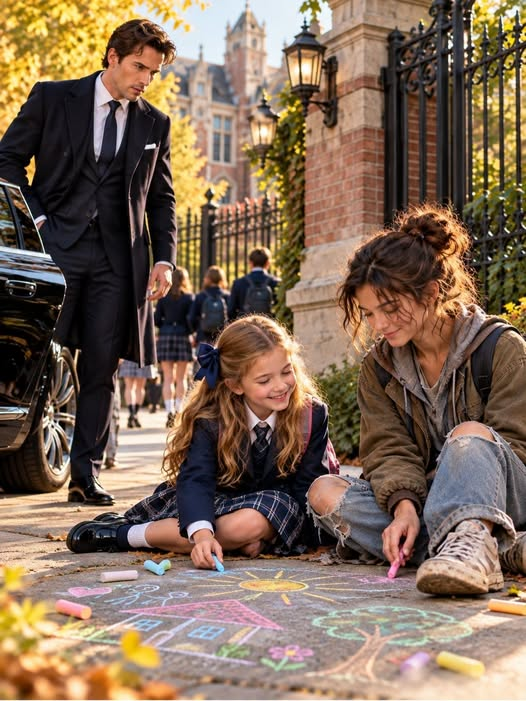
Then I looked up and saw my daughter sitting on the curb.
Not behind the gates. Not in the supervised pickup line. On the sidewalk, on the wrong side of the fence, with her school shoes planted in the gutter and her notebook open across her knees.
Beside her sat a girl in an oversized army-green coat. Maybe seventeen, maybe older. Her sneakers were split at the toes. Her backpack had been mended with silver duct tape in long, careful strips, the way you repair something you cannot afford to replace.
Advertisement
My stomach dropped.
I had my hand on the door handle before I understood I was moving.
The girl held a broken stick, and she was drawing on the concrete. Numbers. Lines. A curve that bent back on itself. Sophie leaned over it, chin nearly touching her knees.
“Don’t memorize it,” the girl said. Her voice was low and unhurried. “Memorizing is how you get tricked. Look for the pattern.”
Sophie frowned at the pavement. Her pencil tapped her lip, a habit she’d gotten from her mother.
Ten seconds passed. Fifteen.
Then her whole face opened.
“Oh!” Sophie slapped the notebook. “That’s why I kept getting it wrong! I was doing the second part *first*!”
Advertisement
And she laughed.
Not the small, polite sound she made for relatives. Not the careful smile she’d learned to produce when adults looked worried. It was a full, helpless, head-back laugh that bounced off the brick wall of the school.
I stopped breathing.
Two years. Two years since the funeral, since the hospital hallway, since the afternoon I had to explain the word *gone* to a six-year-old who kept asking when Mommy would be done being sick. In all that time I had not heard that sound once. Not at Christmas. Not on her birthday. Not once in the car, in the kitchen, in the dark at 2 a.m. when I stood outside her door listening.
Advertisement
I had paid for a child psychologist with a waiting list. A grief specialist from Northwestern. A tutor who’d taught at Exeter.
And this stranger had done it with a stick.
“Stop the car,” I said, though Marcus had already stopped it.
“Sir?”
“Just wait.”
I stepped out. The wind caught my coat. Neither of them looked up.
The girl erased her problem with the cuff of her sleeve, leaving a pale smear on the concrete, and began to draw something else. Something longer. The symbols were ones I recognized from a college course I’d barely survived.
Advertisement
“Try this one,” she said. “But you can’t use the trick from before.”
“That’s not fair.”
“It’s completely fair. You just don’t know the next trick yet.”
Sophie scowled. Then she grinned. Then she bent over the pavement again, tongue between her teeth.
I stood fifteen feet away like a man who had walked into a church by mistake.
I should have felt relief. What I felt, God help me, was something closer to jealousy. Then shame. Then a deep, cold fear that I could not name.
Advertisement
The girl glanced up and saw me.
Everything about her changed in half a second. Her shoulders drew in. Her hand tightened on the stick. She looked at my coat, my car, my driver standing awkwardly by the open door, and I watched her do the math on what I might be.
Not the math on the pavement. The other kind. The kind poor people do about rich people who show up unannounced.
But before she could move, I noticed one more thing, and it stopped me where I stood.
Advertisement
The problem she had just written, the one Sophie was struggling with, wasn’t a third-grade problem. It wasn’t a middle-school problem. I’d have bet money that most of the parents standing behind that iron fence could not have solved it.
And the girl in the duct-taped backpack hadn’t glanced at a single page to write it down.