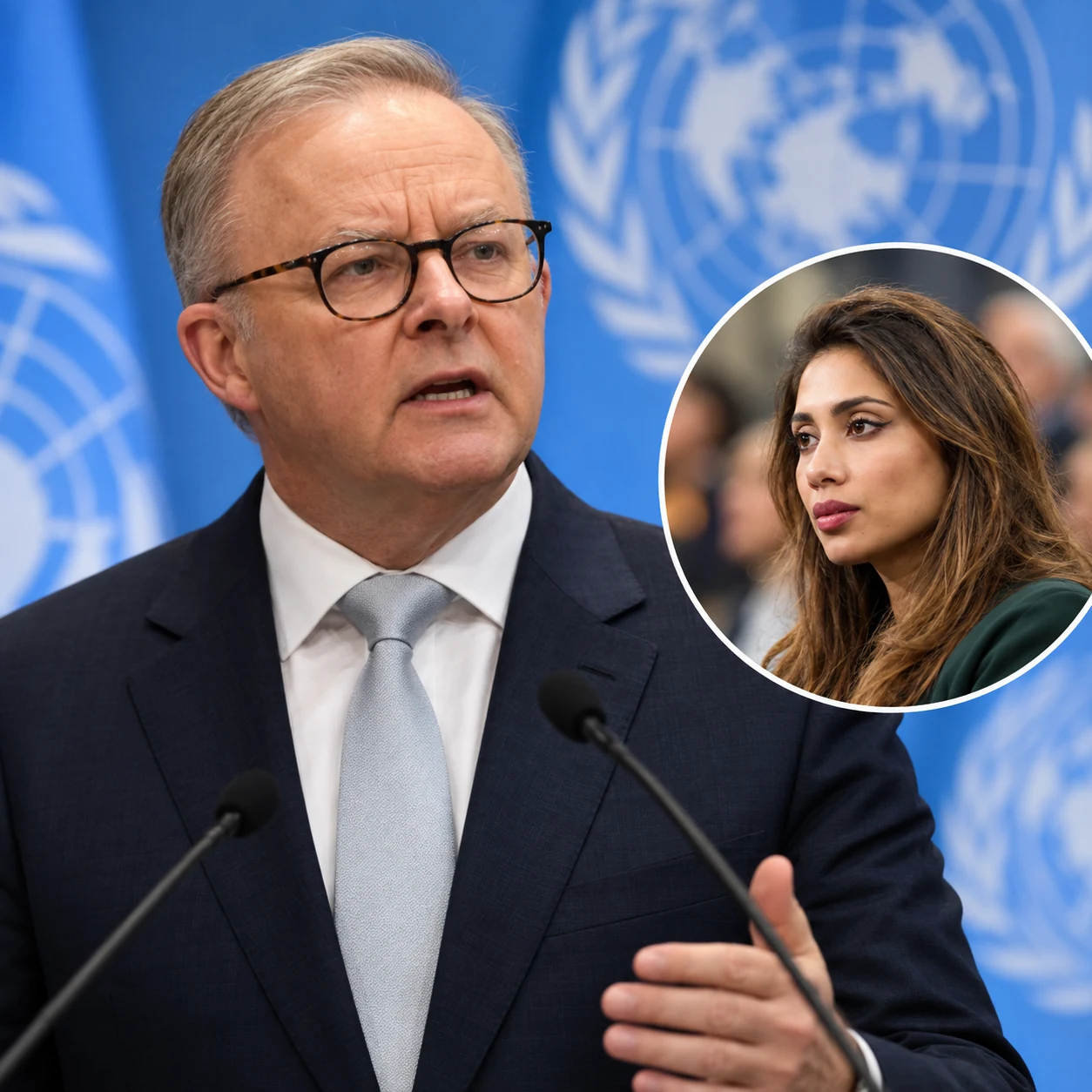
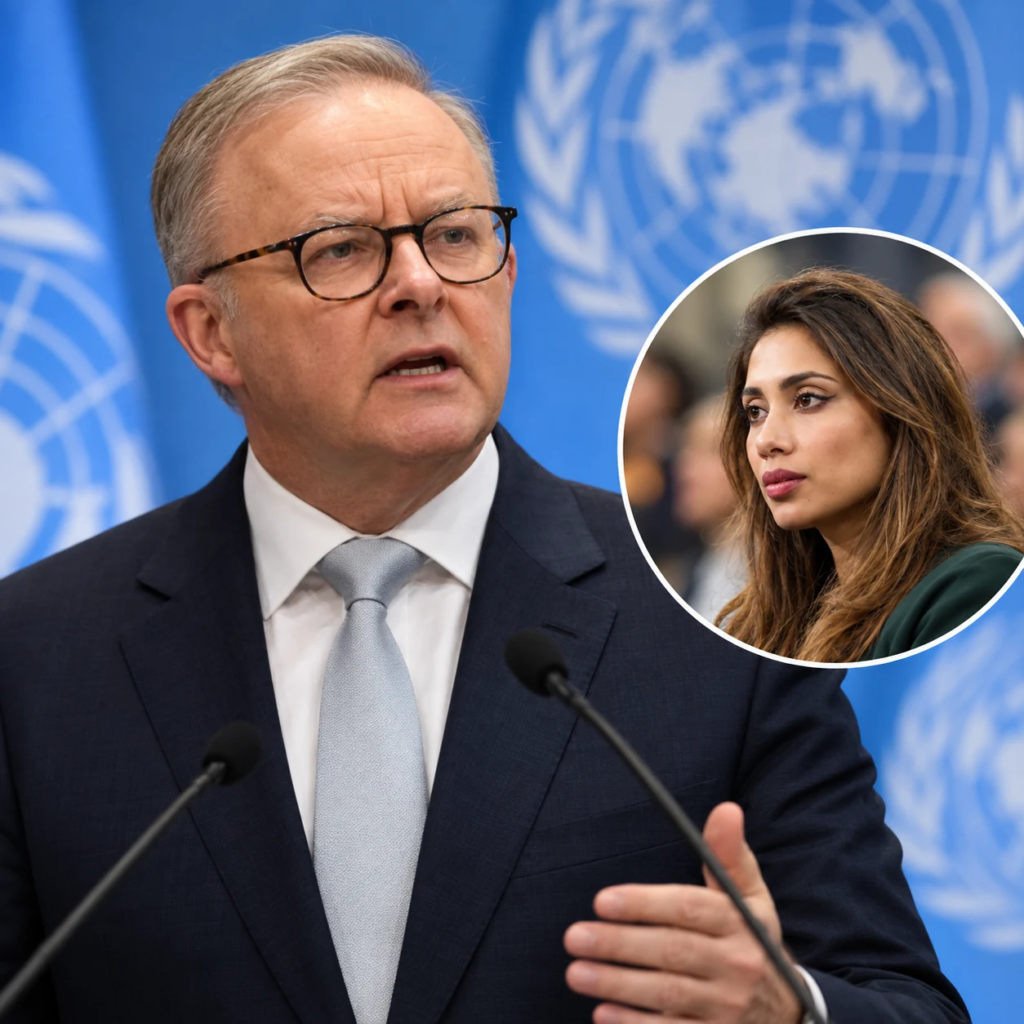
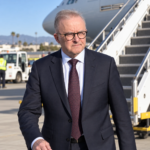
Prime Minister Anthony Albanese’s New York visit shifted abruptly from international diplomacy to domestic political scrutiny after Australian journalist Latika Bourke asked whether he felt like a “fraud” accepting an international leadership award while his government was under pressure at home.
Mr Albanese answered “No” during a press conference at the United Nations on Monday, September 21.
The word “fraud” was the journalist’s characterisation in the question, not a factual finding. The exchange referred to the contrast she drew between the Atlantic Council’s decision to honour Mr Albanese and criticism of his government over domestic issues, including its response to the Bondi terror attack and recent polling.
The moment quickly circulated in Australian media, but it came during a trip with a broader diplomatic purpose. Mr Albanese was in New York to lead Australia’s delegation during United Nations General Assembly week and to launch a campaign for a non-permanent seat on the UN Security Council for the 2029–30 term.
The government says the bid is intended to give Australia a stronger voice on conflict prevention, ocean and climate security and the international governance of emerging technologies including artificial intelligence.
The UN Security Council bid
Australia formally launched its campaign on Monday. In a joint statement, Mr Albanese and Foreign Minister Penny Wong said Australia wants to serve a two-year Security Council term from 2029 to 2030 and argued that international cooperation remains central to the country’s security.
The Security Council is the United Nations body with primary responsibility for international peace and security. It has 15 members: five permanent members — China, France, Russia, the United Kingdom and the United States — and 10 non-permanent members elected for two-year terms.
Australia is seeking one of the seats allocated to the Western European and Others Group. Finland is also a declared candidate for the 2029–30 term.
The vote will take place by secret ballot in the UN General Assembly in 2028. Winning a seat therefore requires years of diplomatic campaigning and support from a broad range of countries, not just Australia’s closest allies.
Australia last served on the Security Council in a term that ended in 2014.
Mr Albanese said the case for seeking another term rests partly on the way overseas events affect Australians at home. Wars can affect fuel, food and commodity prices. Cyber attacks can cross borders instantly. Decisions about artificial intelligence, climate risk and maritime security can also have direct consequences for Australia.
The government’s campaign materials emphasise conflict prevention, climate and ocean security and what it calls peaceful, resilient and inclusive digital futures.
Supporters of the bid can point to the value of having a seat at the table when major security questions are debated. A non-permanent member can participate directly in negotiations, vote on resolutions and influence the council’s agenda.
Critics can question the resources devoted to a campaign or the practical influence available to non-permanent members when the five permanent members retain veto power. Those are legitimate policy arguments and can be considered separately from the personal controversy surrounding the prime minister’s award.
The campaign is also separate from an election at home. A UN General Assembly ballot in 2028 is decided by member states, not Australian voters, and it should not be presented as a measure of domestic political popularity.
What the Atlantic Council award is
The award at the centre of Bourke’s question is not a United Nations honour. It is the Atlantic Council’s Global Citizen Award, presented by the Washington-based foreign-policy organisation during an event held on the sidelines of UN General Assembly week.
The Atlantic Council announced on September 14 that Mr Albanese would be one of four 2026 honourees. The others are Finnish President Alexander Stubb, Formula One president and chief executive Stefano Domenicali and performer Cynthia Erivo.
The organisation said Mr Albanese was being recognised for deepening Australia’s alliances and partnerships and promoting security and stability in the Indo-Pacific. Papua New Guinea Prime Minister James Marape is scheduled to introduce him at the September 23 event.
That description is the Atlantic Council’s assessment. It should not be treated as an independent verdict on every aspect of the Australian government’s performance.
Bourke’s question challenged that international praise by pointing to domestic criticism. Mr Albanese rejected the premise with a one-word answer before the press conference moved on.
The exchange illustrates a routine feature of prime-ministerial travel: domestic politics does not stop when a leader leaves Australia.
Journalists travelling with prime ministers can ask about the official purpose of a trip while also raising cost of living, polling, security, scandals or other issues dominating debate at home.
Governments, for their part, often use overseas visits to demonstrate international engagement and relationships that they say serve Australia’s national interest.
Those two frames can exist at the same time. A government can face political pressure domestically while still conducting legitimate diplomatic work overseas. An international organisation can honour a prime minister even when political opponents or parts of the public strongly disagree with aspects of that prime minister’s record.
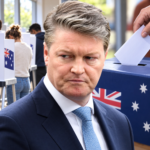
Recent polling was raised in the question and has contributed to the political backdrop of the trip. Polls are measurements of opinion at a particular time, however, not election outcomes. They should be reported with their dates, samples and limitations and should not be treated as predictions of who will win a future election.
That distinction is particularly important because the next federal election remains in the future and voter opinion can change substantially before polling day.
The prime minister’s visit also comes during a period of debate over national security, living costs and Australia’s role in the region. Those issues inevitably shape how international travel is interpreted by supporters and opponents.
The government argues that a more uncertain international environment makes active diplomacy more important, not less. Mr Albanese has pointed to conflict in Europe and the Middle East, cyber security and technological change as examples of issues that cannot be managed by Australia acting alone.
Political critics can argue that the government should devote more attention to domestic problems or challenge its record on specific issues. Those claims need to be assessed on their own evidence rather than inferred from whether the prime minister accepts an overseas award.
Similarly, receiving an Atlantic Council award does not give Australia an advantage in the formal Security Council vote. The award and the UN campaign are separate processes involving different organisations.
The timing has nevertheless made them part of the same political story. Mr Albanese is promoting Australia’s international credentials in New York while being questioned about whether those credentials sit comfortably beside domestic criticism.
His answer was unambiguous: he rejected the suggestion that accepting the award made him a fraud.
The more substantive test of the New York visit will unfold over a much longer period. Australia’s Security Council campaign will run until the 2028 vote, and the government will need to persuade countries across multiple regions to support its candidacy.
At home, voters will continue to judge Mr Albanese and his government on domestic and foreign policy through Australia’s own political process.
The two judgments should not be collapsed into one. The Atlantic Council can make its own decision about whom to honour, UN member states can decide whether to support Australia’s Security Council bid, and Australian voters can make their own assessment of the government’s record.