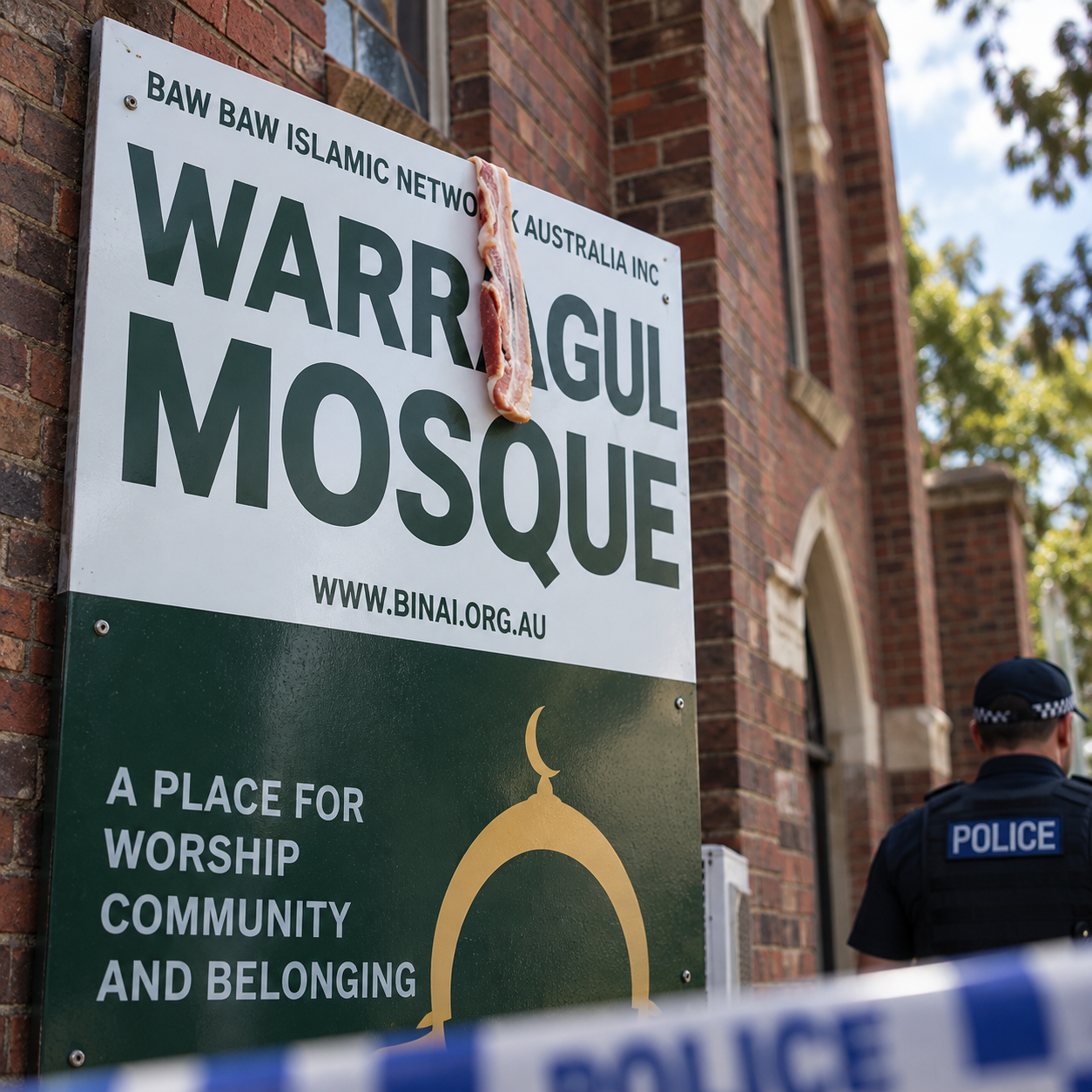
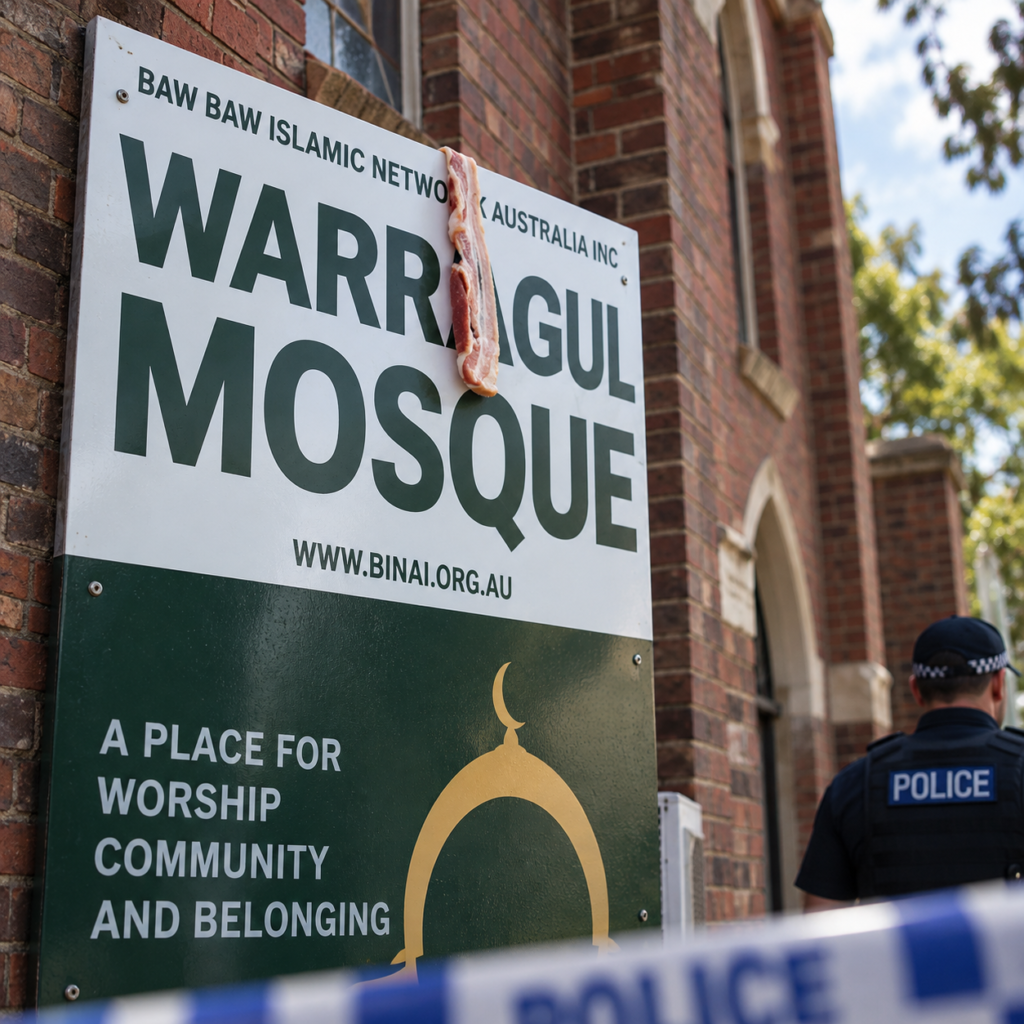
Victoria Police are investigating after a man was captured on CCTV throwing bacon and ham around a regional mosque and placing pork on its sign, days after the former church building became the focus of an angry social media campaign.
The incident occurred at Warragul Mosque in West Gippsland on Wednesday afternoon, with security footage showing a man approaching the building and scattering pork products near its entrance.
Footage released publicly shows the man throwing bacon towards a sign outside the mosque, dumping further pieces of bacon and ham near a walkway and returning to drape a rasher across the top of the sign.
The incident was reported to police, who have launched an investigation and appealed for anyone with information to contact Crime Stoppers.
As of Saturday, Victoria Police had not announced an arrest or publicly identified the man seen in the footage.
The apparent targeting of the mosque with pork has been condemned by Muslim community leaders, who say the action was intended to cause offence and intimidate worshippers.
Pork is prohibited in Islam, and pig products have previously been used in anti-Muslim vandalism and harassment in Australia and overseas.
The Warragul Mosque described what happened as an attempt to “offend, intimidate, and divide” the local community, adding that it would not succeed.
Mansoor Shamsi, vice-president of the Warragul Mosque Committee, said the incident was upsetting but not entirely unexpected because the building had previously been targeted by graffiti and other acts of vandalism.
“Unfortunately, I’m not shocked or surprised,” he told the ABC.
Shamsi said mosque representatives faced a difficult balance between refusing to give attention to hostile behaviour and speaking publicly when they believed attacks on the community needed to be challenged.
He also said support from other Warragul residents following incidents targeting the mosque had been overwhelming.
The latest police investigation comes after the building became the subject of online controversy because it previously served as a Uniting Church.
That history has been presented on social media by some commentators as evidence that an active Christian church had been displaced or “taken over” by Muslims.
The available history does not support that framing.
The former Uniting Church congregation stopped worshipping at the site in 2006 after moving to a larger location. The building was repurposed many years later, with Warragul’s Muslim community using it as a mosque and community gathering place.
The mosque opened in its current form last year and has been promoted locally as a prayer space serving the region’s growing Muslim population.
Its status attracted wider attention this week after former mixed martial arts fighter and Christian activist Nick Patterson filmed a video outside the property.
In the video, Patterson questioned a man at the site about whether the building was being used as a mosque and discussed the possibility that the Muslim community could eventually purchase the former church property.
Patterson then used the video to urge Christians to react to the conversion of former churches to other uses.
Copies of the footage subsequently spread across Facebook, TikTok and X, including through international accounts that regularly post content about immigration, Islam and European or Western identity.
The video attracted hundreds of responses, some expressing anger that a building constructed as a church was being used as a mosque.
ABC News Verify reported that some commenters went considerably further and suggested the mosque should be targeted with pork products.
Two days later, the pork incident captured on CCTV occurred.
There is no publicly established evidence that Patterson was involved in the incident, and police have not alleged that he encouraged or directed the man shown in the CCTV footage.
That distinction is important.
The sequence of events has prompted scrutiny of the online rhetoric surrounding the mosque, but a temporal connection between social media controversy and an alleged act of vandalism does not by itself prove who was responsible or what motivated the individual captured on camera.
Victoria Police have so far described the matter as an investigation and have not publicly announced charges or attributed the conduct to a particular political or extremist ideology.
Muslim leaders, however, have been more direct in describing how the incident was experienced by the community.
Islamic Council of Victoria president Mohamed Mohideen said targeting a mosque with pork was a deliberate act of religious hostility and rejected suggestions circulating online that Muslims were attempting to “take over” Christian churches.
“We are not here to take over churches,” Mohideen said.
“We are not here to take over people’s faith or undermine other people’s faith.”
He said incidents of this kind were painful for Muslim Australians but argued that communities had become increasingly resilient in the face of anti-Muslim abuse.
The Islamic Charity Projects Association also condemned the incident, describing the throwing of pork at a place of worship as a provocative act that violated values of religious freedom, coexistence and mutual respect.
It called on authorities to continue investigating and urged Australians not to allow isolated acts to damage relationships between communities.
The controversy has also moved into state politics.
Victorian Greens leader Ellen Sandell described the incident as a “vile, deliberate act of Islamophobic hate” and called on political leaders to confront what she described as escalating racism and far-right extremism.
“The Greens stand unequivocally with the Warragul Mosque and Muslim communities across Victoria,” Sandell said.
“There can be absolutely no tolerance for Islamophobia, or any kind of racism in Victoria.”
Her attribution of the incident to a wider problem of far-right extremism represents a political assessment. Police have not publicly classified the Warragul incident in those terms or announced a motive.
The mosque has faced trouble before.
In May, police investigated after graffiti was placed on the Warragul Mosque at the corner of Victoria and Albert streets late at night.
Local reporting at the time said an offender targeted the property at about 11.15pm, with investigators seeking witnesses, CCTV or dashcam footage.
The two incidents have increased concern among mosque representatives that the congregation is being singled out because of its religion.
They also come amid broader disputes over anti-Muslim incidents elsewhere in Victoria.
In July, pig-themed stickers were placed around Muslim graves at Maddingley General Cemetery, an act condemned by the Islamic Council of Victoria.
Community leaders have argued that such incidents should be understood not simply as provocative jokes but as attempts to intimidate people on the basis of faith.
At the same time, the Warragul case illustrates the importance of separating verified events from the political narratives quickly built around them online.
It is verified that the site was formerly used as a church.
It is also verified that the former congregation left the building around two decades before the latest controversy.
There is no evidence that Muslims forced Christians from the site, displaced an operating congregation or seized a functioning church.
Former churches across Australia are routinely sold, leased or repurposed as congregations merge, relocate or close. Buildings that once served religious purposes can later become homes, businesses, community centres or places of worship for different faiths.
That does not prevent people from feeling a cultural or emotional attachment to their former use, but it changes the factual basis of claims that one religious community has displaced another.
The Warragul controversy has also demonstrated how quickly a local property dispute or cultural grievance can become international online content.
A short video recorded in a Victorian regional town was redistributed through large overseas social media accounts, exposing the mosque to audiences with little knowledge of its local history.
The resulting commentary often focused on the symbolic image of a mosque inside a former church rather than the fact the Christian congregation had left the property years earlier.
Within days, police were examining footage of pork being thrown at the site.
Investigators will now need to determine who the man in the CCTV footage is, whether any offences were committed and what evidence exists about his intent.
For the Warragul Muslim community, meanwhile, the priority has been to continue using the building while resisting efforts to make worshippers feel unsafe.
Shamsi said the response from the wider community had reinforced that the person responsible for the incident did not represent Warragul as a whole.
That support has included messages from local residents disturbed by the targeting of the mosque and by the broader hostility that followed its appearance on social media.
The incident remains an active police matter.
No individual has been charged, and no court has determined whether the conduct amounted to a criminal offence motivated by religious hatred.
What the footage does establish is that pork products were deliberately placed around an Islamic place of worship after days of highly charged online attention.
What happens next will depend on whether police can identify the man seen in the footage and establish the circumstances behind his actions.