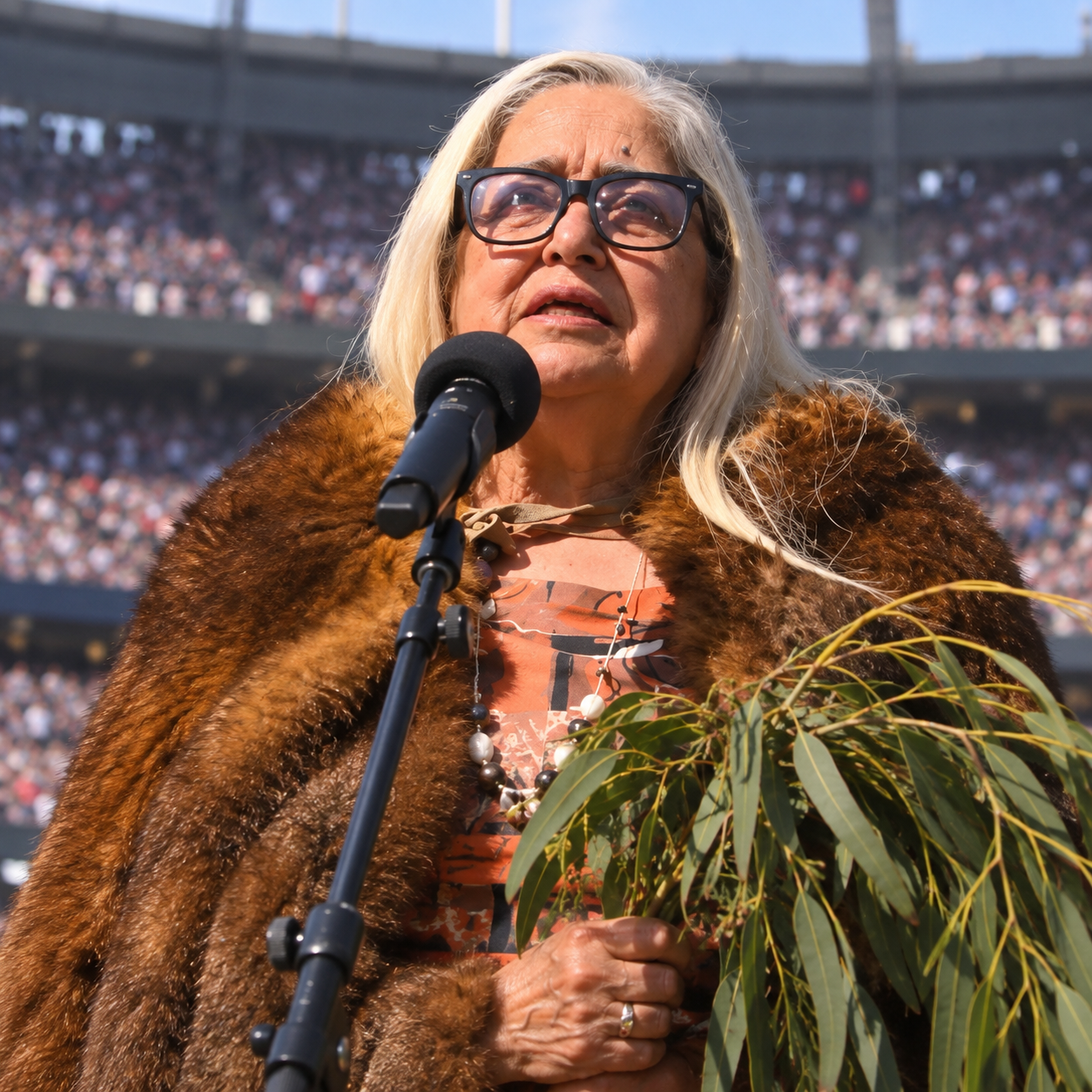
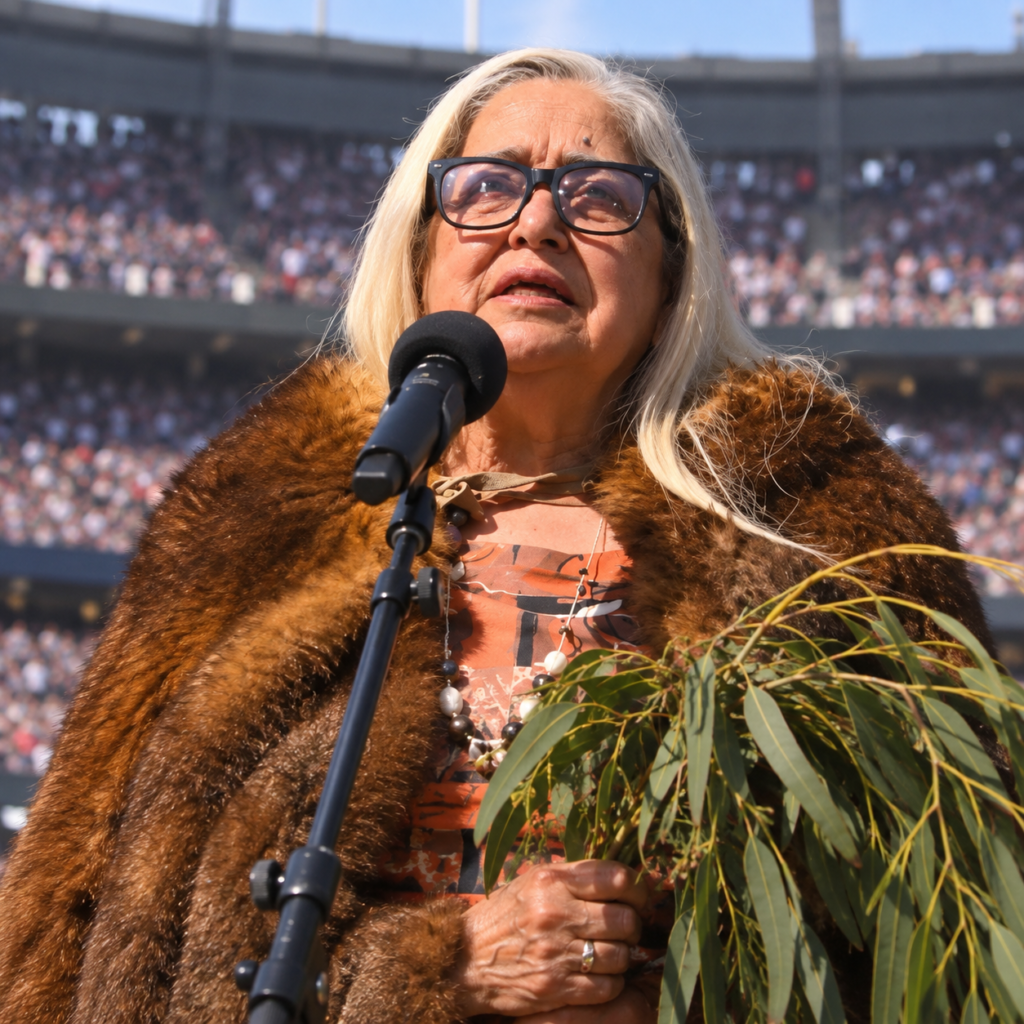
Australia’s first NFL regular-season game has triggered an unexpected culture-war debate in the United States after conservative commentators reacted angrily to a Welcome to Country ceremony performed before more than 100,000 fans at the Melbourne Cricket Ground.
The ceremony was delivered by Senior Wurundjeri Elder Aunty Joy Murphy Wandin AO before Friday’s landmark clash between the Los Angeles Rams and San Francisco 49ers, part of the pre-game program for the first NFL regular-season fixture ever played in Australia.
What is a familiar sight at major Australian sporting events was unfamiliar to many American viewers watching the game from thousands of kilometres away.
Within hours, video of the ceremony was circulating widely on social media, where several prominent US conservative commentators portrayed it as an example of Australia embracing progressive cultural politics.
OutKick founder Clay Travis shared footage with his large X following and wrote: “Australia’s first ever NFL game began with a land acknowledgment. This is insane.”
Travis also drew attention to National Sorry Day and argued that Australians had surrendered ground in what he described as wider cultural battles.
His post attracted a flood of responses, including criticism from American users who had apparently never encountered a Welcome to Country ceremony before, as well as comments from Australians both supporting and opposing the practice.
Conservative commentator Matt Walsh joined the criticism, asking: “Has any country ever fallen off harder than Australia?” before using a homophobic slur in a broader attack on contemporary Australian culture.
Other critics described the ceremony as “woke”, unnecessary or evidence that Australian sporting bodies had become excessively political.
But several of the claims circulating alongside the clip blurred important distinctions about what actually happened at the MCG and what a Welcome to Country represents.
Firstly, the ceremony was not technically a “land acknowledgment”, as Travis described it.
In Australia, a Welcome to Country and an Acknowledgement of Country are related but distinct practices.
A Welcome to Country is performed by a Traditional Owner, or by an Aboriginal or Torres Strait Islander person authorised by Traditional Owners, to formally welcome visitors onto their Country. An Acknowledgement of Country, by contrast, can be delivered by anyone.
Reconciliation Australia describes modern Welcome to Country ceremonies as an adaptation of protocols used by Aboriginal and Torres Strait Islander communities for welcoming visitors across traditional boundaries.
They can take the form of a speech, song, dance or smoking ceremony and are regularly included at government functions, conferences, sporting events and other major public gatherings.
Supporters see them as an act of respect towards First Nations people and recognition of their continuing connection to Country. Critics argue that the ceremonies have become too frequent, politicised or divisive.
That disagreement has become increasingly visible in Australia over the past two years, particularly after Welcome to Country ceremonies at Anzac Day events became the focus of booing and heckling.
Murphy Wandin herself was at the centre of another controversy in 2025 when a planned Welcome to Country before a Melbourne Storm NRL match was cancelled at short notice following disruption at an Anzac Day service earlier that day.
The Storm later blamed the decision on a miscommunication.
The debate has also spilled into federal politics, corporate Australia and professional sport, with critics questioning how often the ceremonies should be performed and supporters warning against abandoning Indigenous cultural protocols because of political opposition.
Public opinion is more complicated than claims that Australians either overwhelmingly support or overwhelmingly reject the practice.
A Dynata poll of 1,001 adults commissioned by the Institute of Public Affairs in April 2026 found 60 per cent agreed that Welcome to Country ceremonies should no longer be performed at sporting matches.
The Institute of Public Affairs has been an outspoken critic of the practice and described the result as evidence of growing public opposition.
However, the Australian Reconciliation Barometer has previously produced a substantially different picture. Its 2024 research found 55 per cent of the general community supported Welcome to Country ceremonies at major sporting events, with considerably stronger support among younger Australians.
The surveys were conducted at different times, used different questions and came from organisations with very different roles in the national debate, making broad claims about a single settled Australian view difficult to sustain.
The terminology used during Friday’s ceremony has also become part of the online dispute.
Murphy Wandin referred to Melbourne by the Indigenous name Naarm, one of several accepted spellings of a Woi-wurrung name associated with Melbourne and the surrounding area.
The term is now routinely used by Indigenous organisations, public institutions and sporting clubs. Melbourne Football Club, for example, has competed under the name Narrm during the AFL’s Sir Doug Nicholls Round and describes Narrm as a traditional Aboriginal name for Melbourne.
Narrm, Naarm and Nairm are all used because Indigenous languages were historically oral languages and their words have been rendered into English spelling in different ways.
The MCG itself sits on Wurundjeri Country, giving the choice of Murphy Wandin — a senior Wurundjeri Elder with a long history of conducting Welcome to Country ceremonies at major Melbourne events — direct relevance to the location.
Another point requiring context was Travis’s description of National Sorry Day as an occasion when Australia “apologizes to the aborigines every year”.
National Sorry Day is observed on May 26 and commemorates Aboriginal and Torres Strait Islander children who were forcibly removed from their families under past government and institutional policies, now collectively known as the Stolen Generations.
The first National Sorry Day was held in 1998, one year after the landmark Bringing Them Home report into forced removals was tabled in federal Parliament.
It is separate from the formal National Apology to the Stolen Generations delivered by prime minister Kevin Rudd in Parliament in 2008.
The cultural argument surrounding Friday’s ceremony briefly threatened to overshadow an otherwise historic day for the NFL.
The San Francisco 49ers defeated the Rams 27-7 in front of an official crowd of 100,021 at the MCG, making the game one of the best-attended regular-season fixtures in NFL history.
Quarterback Brock Purdy threw three touchdown passes as San Francisco controlled the contest, while Los Angeles struggled after adopting an unusually late travel schedule that saw the Rams arrive in Melbourne only shortly before game day.
The 49ers had taken the opposite approach, arriving about a week earlier to acclimatise to the time difference and long journey from the United States.
The contrast attracted scrutiny after the Rams looked flat for much of the match, with head coach Sean McVay later acknowledging that his side had been comprehensively outplayed.
The crowd itself offered a powerful demonstration of the NFL’s Australian following.
Fans from more than 30 countries attended, including thousands who travelled from the United States, with jerseys from all 32 NFL franchises visible around the stadium.
The Melbourne fixture forms part of the league’s accelerating international expansion, with the NFL increasingly taking regular-season games outside the US as it seeks new audiences and commercial markets.
For Melbourne, the match also represented another addition to a sporting calendar already built around events such as the Australian Open, Formula One Australian Grand Prix, AFL Grand Final and international cricket.
Yet the online controversy demonstrated that exporting American sport to Australia can expose international audiences to Australian cultural practices they may have little context for.
To many local spectators, a Welcome to Country before a major sporting event is now routine. To parts of the American audience encountering it for the first time, it appeared strikingly unfamiliar and was quickly interpreted through the language of the US culture wars.
That does not mean criticism of the practice is confined to foreigners.
Australia is having its own vigorous debate about how often Welcome to Country ceremonies should be used, whether they belong at sporting fixtures and how institutions should balance cultural recognition with concern that repeated ceremonies can become formulaic.
But describing Friday’s ceremony simply as an imposed political ritual misses why it was performed, while presenting opposition to it as fringe sentiment would also ignore genuine and measurable Australian disagreement.
The NFL came to Melbourne expecting football to be the main cultural export of the day.
Instead, along with Purdy’s touchdowns, a crowd of 100,021 and a decisive 49ers victory, millions of Americans were introduced to one of Australia’s most contested contemporary cultural traditions — and immediately joined an argument Australians were already having among themselves.