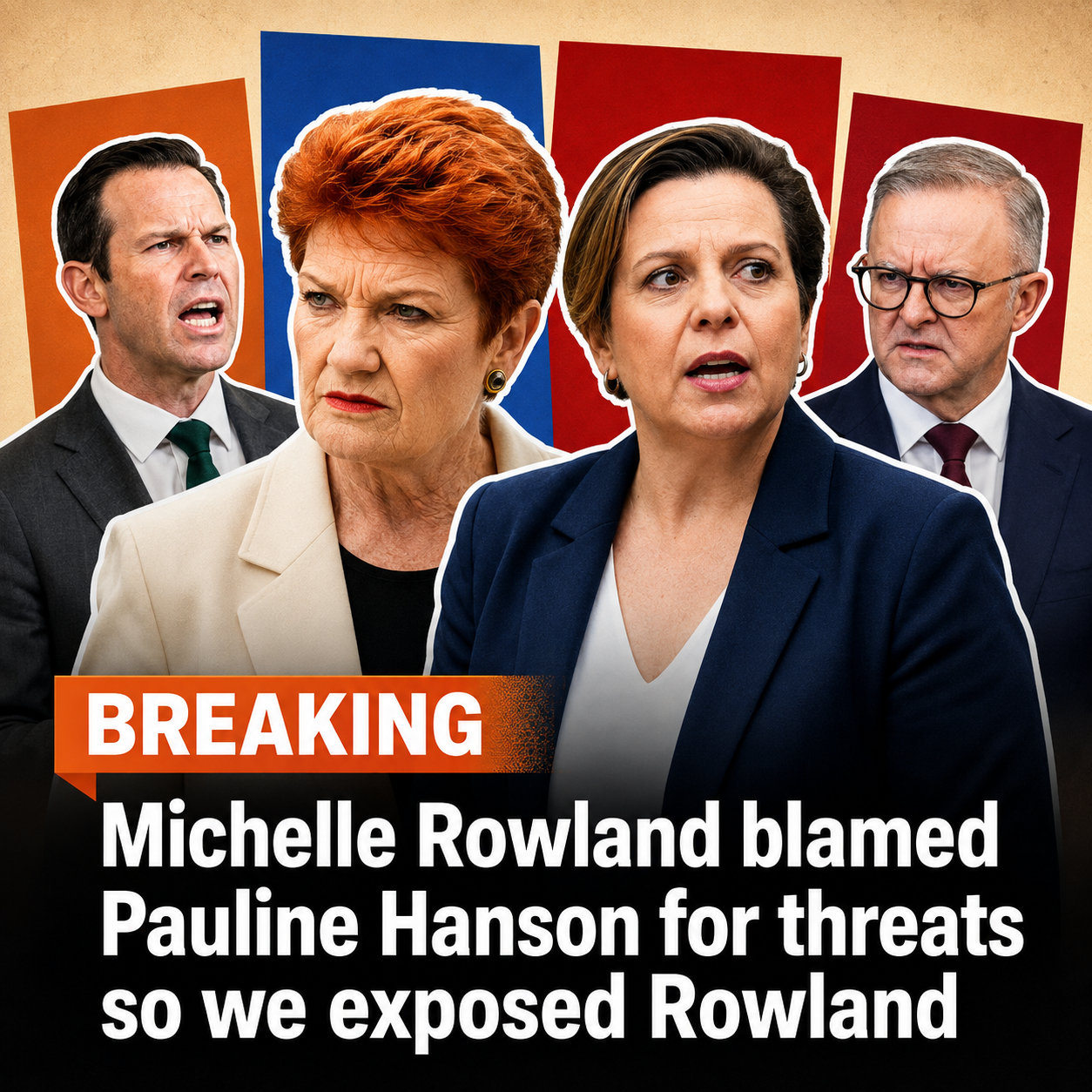
Attorney-General Michelle Rowland is facing a fierce political backlash after telling Pauline Hanson to examine her own behaviour while discussing threats against the One Nation leader, comments critics say crossed the line from challenging political rhetoric into blaming a politician who is already the subject of an alleged death threat.
The dispute erupted after Hanson accused Prime Minister Anthony Albanese of increasing the danger faced by One Nation politicians and supporters through increasingly aggressive attacks on the party.
Albanese had told Queensland Labor’s state conference that hard-right populists were advancing politics that was “dangerous, divisive and downright dishonest”.
He accused such movements of bending facts, spreading misinformation and turning Australians against each other before specifically arguing that parties such as One Nation offered no serious answers to the country’s problems.
Hanson responded by saying the Prime Minister had crossed a line and claimed his rhetoric was contributing to threats against her.
She told the ABC that she now required federal police protection while carrying out some public activities and said she no longer felt as safe campaigning as she once did.
The AFP has declined to disclose the details of Hanson’s protection arrangements, in keeping with its normal policy on security for parliamentarians and high office-holders.
Rowland was asked about Hanson’s accusation during an ABC Radio National interview on Tuesday.
She first acknowledged the broader danger facing politicians, saying abusive algorithms, extremism and threats directed at public figures were unacceptable and increasingly difficult to control.
She then turned the criticism back on Hanson.
Rowland argued that Hanson should consider the people she had associated with, the standards accepted within One Nation and the party’s own experience with extremist infiltration.
She said she wished no politician physical harm regardless of political persuasion, but added that when Hanson made allegations about Labor inciting violence, “one needs to look at oneself and one’s behaviour”.
Those words immediately became the focus of the controversy.
Hanson described them as victim-blaming and demanded an apology and retraction.
Nationals leader Matt Canavan also attacked Rowland’s response, saying a minister should not use language that could be interpreted as offering a justification for violent reactions to political speech.
The criticism is especially potent because Hanson is not speaking only about hypothetical threats.
A Perth man is currently before the courts accused of threatening to kill her.
Anton Raymond Illich, 47, has been charged with two counts of using a carriage service to make a threat.
A Perth court heard in August that he allegedly made three Facebook posts, including one in which he said he would hunt Hanson down and kill her.
Illich has told the court he had no intention of carrying out the threat and described his conduct as stupid and crazy.
He remains on bail and the allegations have not been proven.
The maximum penalty for the offence with which he is charged is 10 years’ imprisonment.
The case is one part of a wider deterioration in the security environment confronting Australian politicians.
The AFP says threats against parliamentarians have doubled over the past three years.
A 2025 survey of federal politicians and staff found 85 per cent had dealt with constituents behaving in a violent, threatening or volatile manner.
ASIO Director-General Mike Burgess has separately warned that politically motivated violence is a growing national-security concern.
Hanson has also faced increasingly confrontational protests.
At a Melbourne event in June, demonstrators shouted slogans including “die Nazi scum” as Hanson and Barnaby Joyce arrived at a One Nation fundraiser.
A known neo-Nazi, Michael Nelson, was also present outside the event in support of Hanson and was moved on by police for breach of the peace.
His presence illustrates the complication underlying Rowland’s criticism.
There is evidence that extremist figures have attempted to attach themselves to One Nation.
Hanson herself said earlier this year that four party branches had been shut down amid concerns about infiltration by extremists.
Guardian Australia also reported on John Drew, a Queensland One Nation branch figure with a history of defending the White Australia policy and making racist statements.
One Nation subsequently distanced itself from him and has promoted a stricter vetting process for candidates, staff and branch officials.
Those facts provide a legitimate basis for questions about party governance and extremist infiltration.
They do not provide a legitimate basis for threatening Hanson or anyone else associated with the party.
That distinction is central to the political argument now surrounding Rowland.
Australia’s criminal law explicitly recognises that political opinion can form the basis of unlawful threats.
Federal hate-crime reforms enacted in 2025 expanded offences covering threats of force or violence against groups and individuals.
The protected characteristics include race, religion, sex, sexual orientation, gender identity, disability, nationality, national or ethnic origin and political opinion.
Under the current Criminal Code, a person can commit an offence by threatening violence against somebody because they believe that person belongs to a group distinguished by political opinion.
The more serious version, where the threatened violence would also endanger the peace, order and good government of the Commonwealth, carries a maximum penalty of 10 years.
A related offence without that additional Commonwealth threshold carries up to seven years.
But the application of those laws is more complicated than some commentary suggests.
A threat against a politician does not automatically become a hate-crime offence merely because the target is political.
Prosecutors would need to establish the statutory elements, including the reason the person was targeted and the required level of fear.
There has been no public finding that the alleged Illich threats satisfy those provisions.
He has instead been charged under separate federal telecommunications law dealing with threats made using a carriage service.
Rowland’s comments therefore do not place her in direct legal contradiction with an identified prosecution under her government’s hate-crime legislation.
They do, however, create an obvious political tension.
As Attorney-General, she administers a legal system that explicitly recognises political opinion as a characteristic that can attract special criminal protection when threats of violence are involved.
Critics argue that this makes it particularly important for the nation’s first law officer to condemn threats without language that could be interpreted as suggesting the target’s political conduct helped cause them.
Rowland’s defenders would make a different distinction.
They argue she explicitly rejected physical harm while separately challenging Hanson’s attempt to blame Albanese for threats made by other people.
No evidence has emerged establishing that the Prime Minister’s Queensland speech caused Illich’s alleged conduct or any other specific threat.
Indeed, Illich was charged in July, well before Albanese made the remarks at the centre of the latest dispute.
That timing alone undermines any claim that the Prime Minister’s weekend speech produced the alleged Perth threat.
The wider argument is therefore about political responsibility for rhetoric rather than direct criminal causation.
The intensity of that fight has been amplified by One Nation’s rapid rise in the polls.
A national Newspoll conducted from August 24 to 28 placed One Nation on 30 per cent of the primary vote, Labor on 29 per cent, the Coalition on 19 per cent and the Greens on 13 per cent.
It was one poll rather than a universal measure of public opinion.
Other recent surveys have placed One Nation below Labor or recorded materially lower support.
Nevertheless, the result has transformed what was once a peripheral political argument into a serious strategic problem for both major parties.
The confrontation has also revived scrutiny of Rowland’s own political record.
In 2023, while serving as communications minister, she acknowledged controversy over financial support her campaign had received from Sportsbet before the 2022 federal election.
The betting company paid $8,960 for a campaign fundraising dinner and later made a separate $10,000 donation.
At the time, Rowland was Labor’s shadow communications minister and would later become responsible for laws affecting online gambling.
The donations complied with the disclosure rules then in force, and Rowland said she had not broken any rules.
She nevertheless acknowledged that voters expected better and committed not to accept gambling-industry donations in future.
Independent MP Andrew Wilkie described the episode as a serious error of judgement and called for stronger political-donation rules.
The matter returned to public attention this year as Labor developed its long-delayed gambling reforms.
In August, Wilkie referred concerns about government gambling policy to the National Anti-Corruption Commission.
He alleged that individuals within the federal government may have been improperly influenced by private-sector interests through donations, relationships, gifts and hospitality.
But there is an important limit to that development.
Wilkie expressly said his referral did not make an allegation against any specific individual.
The NACC independently decides what referrals it investigates, and no corruption finding has been made against Rowland.
It is therefore inaccurate to describe the referral as a corruption case against her personally.
Rowland has also faced scrutiny over parliamentary travel expenses.
The Independent Parliamentary Expenses Authority determined that part of the family travel claimed during a 2023 official trip to Perth fell outside the rules.
In March this year she repaid $7,932 in airfares for three family members and an additional $1,983 automatic penalty because the claim had not been repaid within the required period.
The total original trip cost exceeded $21,000 and included more than $16,000 in family flights.
Rowland accepted IPEA’s assessment and made the required repayment.
The episode was an expenses breach, not a finding of corruption.
Another longstanding criticism concerns the misinformation legislation Rowland championed while communications minister.
The proposed law would have given the Australian Communications and Media Authority greater power to regulate how large digital platforms dealt with seriously harmful misinformation and disinformation.
Critics, including the Coalition, Greens, legal experts and human-rights advocates, warned that the regime could chill lawful speech and cause platforms to over-censor controversial material.
The government maintained that the bill targeted verifiably false content capable of causing serious harm and did not empower bureaucrats to remove individual social-media posts directly.
Rowland abandoned the proposal in November 2024 after concluding there was no pathway to pass it through the Senate.
Those episodes provide legitimate material for assessing Rowland’s political judgement.
They do not establish that her current comments about Hanson were corrupt, unlawful or connected to her previous portfolio controversies.
The stronger issue is simpler.
Australia is entering a period in which threats and political intimidation are rising while major parties increasingly use language portraying opponents as dangerous to the country.
That combination carries obvious risks.
Politicians must remain free to criticise One Nation’s policies, record and associations as forcefully as the evidence permits.
Hanson likewise remains free to accuse Labor of demonising her voters and using inflammatory rhetoric.
Neither side is entitled to convert political disagreement into a licence for intimidation or violence.
Rowland’s comments have become controversial because they appeared to combine those two debates in the same answer: condemning physical threats while immediately asking Hanson to examine whether her own conduct was encouraging danger.
Whether that amounts to victim-blaming is ultimately a political judgement.
What is not open to serious dispute is that threats against Hanson, Labor politicians, Coalition MPs, Greens, independents or their supporters should be dealt with according to the same criminal law.
Australia’s federal legislation expressly includes political opinion for precisely that reason.
At a time when the AFP says threats against parliamentarians are rising sharply, the safest democratic principle is also the simplest one: political arguments can be brutal, but responsibility for a threat of violence lies with the person making it.