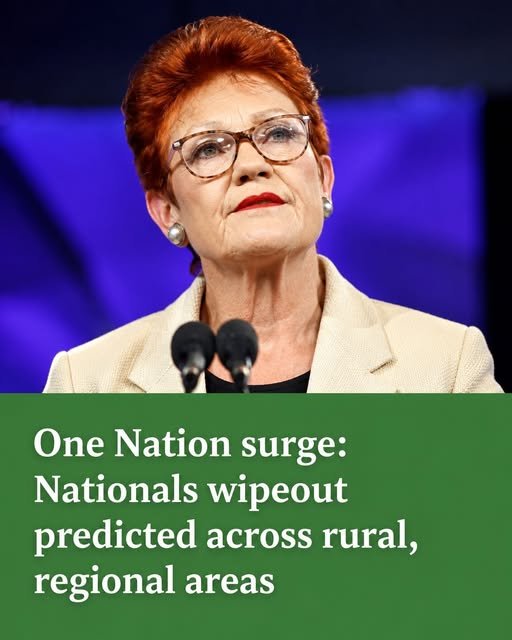
Australia’s conservative political landscape could be heading towards one of its biggest realignments in decades, with new electoral modelling suggesting One Nation is on track to overtake the Nationals across much of regional and rural Australia if a federal election were held today.
The analysis, published this week, projects that the Nationals could be reduced to between zero and two seats in the House of Representatives, while One Nation emerges as the dominant conservative force across many country electorates.
The modelling is based on multilevel regression and poststratification (MRP), a polling technique that estimates voting behaviour in individual electorates using large national survey samples combined with demographic data. The projections indicate One Nation now leads voting intentions in almost every regional and rural electorate across Australia.
If realised at an election, the result would represent one of the most dramatic political shifts in modern Australian history.
The Nationals have traditionally dominated rural and regional Australia for generations, frequently holding the balance of power within the Liberal-National Coalition and representing farming communities across New South Wales, Queensland and Victoria.
Yet recent polling suggests that long-standing loyalty among conservative country voters is weakening.
According to the latest modelling, dissatisfaction over cost-of-living pressures, regional infrastructure, energy policy, housing affordability and immigration has helped fuel a sharp increase in support for Pauline Hanson’s One Nation.
The projections are broadly consistent with several national polls published during 2026 showing One Nation recording historically high primary vote support.
Some surveys have placed the party above 20 per cent nationally, while others have suggested One Nation has become the leading conservative choice in many regional and outer metropolitan communities.
Political analysts caution, however, that polling and electoral modelling should not be interpreted as election forecasts.
Australia’s preferential voting system means statewide or national vote shares do not automatically translate into parliamentary seats. Local candidates, campaign quality, preference flows and electorate-specific issues often determine final outcomes.
Even so, the trend has attracted growing attention from both major Coalition parties.
Former Queensland Nationals premier Rob Borbidge recently warned that One Nation’s resurgence should concern conservatives, arguing that traditional centre-right parties can no longer assume regional voters will remain loyal simply because they have done so historically.
The Nationals currently hold nine House of Representatives seats following the 2025 federal election, while One Nation secured more than 6 per cent of the national primary vote but failed to win a lower house electorate.
The new modelling suggests that picture could change dramatically if current voting patterns continue.
Several regional electorates—including long-time Nationals strongholds—are now projected to become highly competitive contests involving One Nation rather than the traditional Labor-versus-Coalition dynamic.
Support appears particularly strong in communities facing persistent economic pressures.
Regional Australia has experienced rising living costs, workforce shortages, housing constraints and concerns over access to healthcare and essential services. Farmers have also continued debating energy policy, water security, environmental regulation and agricultural competitiveness.
One Nation has sought to position itself as the party most willing to challenge existing policies on migration, climate measures, energy prices and government spending.
Pauline Hanson has repeatedly argued that both Labor and the Coalition have become disconnected from regional Australians, accusing the major parties of failing to respond to everyday concerns affecting country communities.
The Nationals reject that criticism and continue to argue they remain the only party with deep local representation across regional Australia.
Senior Coalition figures have also ruled out any formal federal coalition agreement with One Nation despite speculation generated by the party’s improving polling numbers.
The debate extends beyond party politics into broader questions about the future of Australia’s conservative movement.
Election analyst Antony Green has observed that One Nation’s rapid rise has fundamentally complicated electoral calculations, particularly because strong regional support does not necessarily translate into victories in metropolitan electorates where most House of Representatives seats are located. Preference distributions also remain difficult to predict under Australia’s voting system.
At the same time, researchers note that MRP modelling has become increasingly influential in Australian elections because it provides electorate-level estimates that traditional national polling cannot offer. Nevertheless, these projections remain statistical models rather than vote counts and are subject to margins of error.
Recent examples illustrate that polling organisations continue to produce varying estimates depending on methodology, sampling and assumptions. Different surveys conducted throughout 2026 have shown One Nation’s national primary vote ranging from the low teens to above 20 per cent.
For the Nationals, the challenge is clear.
The party has historically relied on overwhelming support in country electorates to maintain its influence within the Coalition and federal parliament. Losing even part of that regional base would significantly reshape Australia’s conservative politics.
For One Nation, the opportunity is equally significant.
After decades operating largely as a protest party with intermittent electoral success, the party now finds itself being discussed as a genuine contender across parts of regional Australia where the Nationals once appeared politically unassailable.
Whether that momentum ultimately translates into seats will not be known until Australians next vote.
What is already evident, however, is that political competition in regional Australia has entered a new phase. Voters who once consistently backed the Nationals are increasingly willing to consider alternatives, creating an electoral environment unlike any seen in recent federal elections.