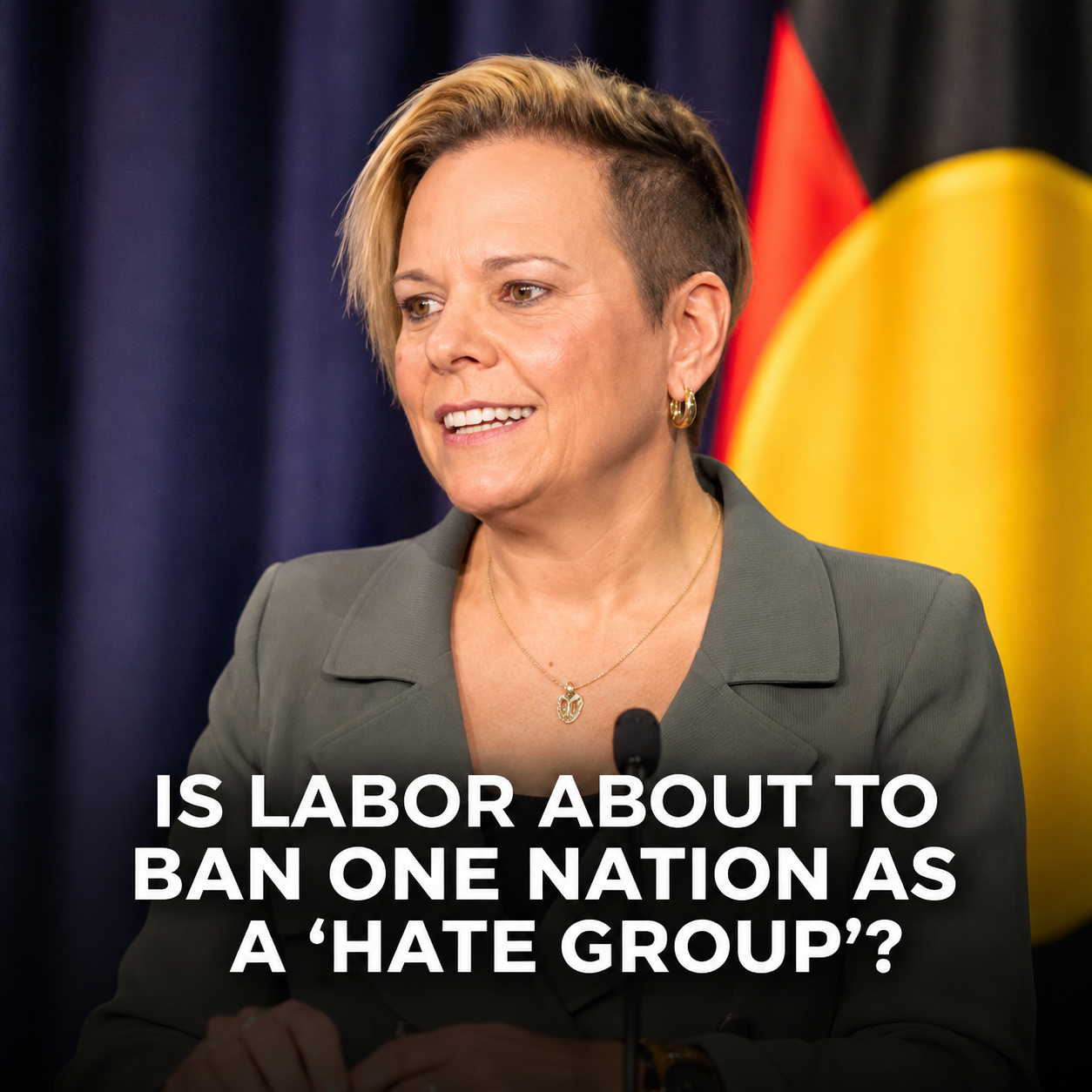
Labor’s increasingly aggressive attacks on Pauline Hanson’s One Nation have prompted speculation that Australia’s new prohibited-hate-group laws could eventually be turned against a mainstream political party — but the legal threshold is considerably higher than simply declaring a political opponent “dangerous”.
The question has emerged after three senior Labor figures sharply escalated their criticism of One Nation as Hanson’s party recorded historic electoral gains and briefly moved ahead of Labor in Newspoll.
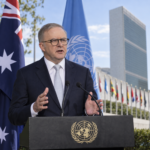
Prime Minister Anthony Albanese told Queensland Labor delegates on Sunday that “hard-right populists” were advancing around the world and promoting politics that was “dangerous, divisive and downright dishonest”.
“We simply must defeat them,” Albanese said. “We owe it to history.”
He accused populist parties of bending facts, spreading misinformation and turning Australians against each other, before specifically arguing that One Nation had no serious answers to the country’s problems.
Treasurer Jim Chalmers separately warned of what he called a dangerous and divisive potential “coalition of chaos” involving the Coalition and One Nation.
The rhetoric intensified again when Attorney-General Michelle Rowland was questioned about Hanson’s accusation that Labor’s language was contributing to threats against her.
Rowland said One Nation had experienced infiltration by extremists and neo-Nazis and criticised Hanson for engaging with controversial individuals, while also making clear that threats of violence against politicians were unacceptable.
Hanson accused Labor of demonising millions of Australians who support her party and warned that describing political opponents as dangerous could have serious consequences.
The confrontation has now produced another question: could the government go beyond political criticism and use the prohibited-hate-group regime enacted in January to effectively outlaw One Nation?
As of September 2, there is no public evidence that such a process is under way.
Australia’s official list contains only two prohibited hate groups: Hizb ut-Tahrir, listed from March 6, and White Australia, formerly known as the National Socialist Network and European Australia Movement, listed from May 16.
One Nation is not listed, and there has been no public announcement from the government, ASIO or the Australian Federal Police Minister indicating that a listing is being considered.
That does not mean the underlying legal debate is imaginary.
The legislation gives the executive government a significant power to prescribe organisations and then criminalises a range of activities involving them, including directing the organisation, membership, recruitment, certain forms of training, funding and support.
Membership of a listed prohibited hate group can carry a maximum sentence of seven years’ imprisonment, while some other offences carry penalties of up to 15 years.
Australian human-rights bodies warned during the legislation’s development that the scheme was unusually broad.
The Australian Human Rights Commission supported stronger action against organisations promoting racial hatred but raised concerns about vague thresholds, the absence of procedural fairness during listing decisions and the possibility that legitimate association could be chilled.
Those criticisms are significant because the legislation does not contain a general carve-out protecting political parties from the regime.
The Criminal Code defines an “organisation” broadly as either a body corporate or an unincorporated body.
The White Australia case demonstrates why that matters.
According to High Court documents, White Australia had incorporated in Victoria and lodged an application with the Australian Electoral Commission in April seeking registration as a non-parliamentary political party.
Weeks later, the Governor-General made regulations specifying it as a prohibited hate group.
The organisation is now challenging the validity of that legislation in the High Court, arguing in part that the Commonwealth cannot constitutionally use executive power to proscribe a political party in the manner contemplated by the scheme.
But the fact that the law is broad enough to raise that constitutional question does not mean ministers can simply outlaw One Nation because they dislike its policies or rhetoric.
The statutory process contains several distinct requirements.
First, the Director-General of Security must provide written advice before the AFP Minister can consider recommending that an organisation be listed.
ASIO’s Director-General can provide that advice where specified conditions relating to politically motivated violence or the promotion of communal violence are met, including circumstances where activities are assessed as increasing such risks.
Second, the AFP Minister must be satisfied on reasonable grounds that the organisation itself has engaged in, prepared or planned to engage in, assisted, or in specified circumstances advocated conduct constituting a “hate crime”.
That expression has a defined legal meaning.
It includes specified federal offences involving threats or incitement of violence based on race or national or ethnic origin, certain prohibited Nazi-symbol offences, qualifying state racial-hatred offences and serious criminal conduct motivated by race or ethnicity.
It is therefore not synonymous with controversial speech, opposing immigration, criticising multiculturalism or being described by another politician as divisive.
The minister must additionally be satisfied that listing the organisation is reasonably necessary to protect the Australian community, or part of it, from social, economic, psychological or physical harm of the kind addressed by the legislation.
There is another important step.
The AFP Minister must obtain the Attorney-General’s written agreement before the organisation can be specified and must arrange for the federal opposition leader to be briefed on the proposed regulation.
The formal regulation is then made by the Governor-General acting through the ordinary executive-government process.
Once made, the regulation is a legislative instrument and can be reviewed by the Parliamentary Joint Committee on Intelligence and Security. It is also subject to parliamentary disallowance procedures.
The government therefore has substantial executive discretion, but the process is more elaborate than the suggestion that Albanese, Chalmers and Rowland could collectively declare One Nation “dangerous” and automatically ban it.
Their recent political statements do not themselves satisfy the statutory test.
Rowland’s allegation that extremists or neo-Nazis have entered One Nation also does not automatically establish that the party as an organisation has engaged in or advocated legally defined hate crimes.
A political party can remove members, reject candidates or be infiltrated by people whose views the organisation does not itself adopt.
For a prohibited-group listing, the relevant legal question would concern the organisation’s own conduct and the other statutory requirements, not merely whether an extremist individual had once been associated with it.
Similarly, Hanson’s historical statements about race, immigration or Islam cannot simply be relabelled as “hate crimes” by political opponents.
The legislation defines the conduct that qualifies, and any attempt to rely on historical behaviour would still have to fit those provisions.
The law does contain features that explain why civil-liberties groups remain concerned.
A criminal conviction is not required before the AFP Minister can conclude that relevant hate-crime conduct occurred.
The statute also expressly says the minister is not required to provide procedural fairness when deciding whether the listing criteria are satisfied.
Conduct occurring before the new regime commenced can also be taken into account where the statutory requirements are met.
Those provisions give the executive considerable latitude and are among the reasons the White Australia constitutional challenge is being watched closely.
But the White Australia listing also illustrates how much more evidence was involved than political rhetoric alone.
The government described the organisation as a racist extremist group with a history under several earlier names and said the decision was informed by classified and unclassified information from security and law-enforcement agencies.
In August, the bipartisan Parliamentary Joint Committee on Intelligence and Security completed its review and backed the listing, finding that White Australia had engaged in conduct constituting hate crimes and that the regulation had been properly made.
The constitutional question remains unresolved.
White Australia Party Inc and its national president, Thomas Sewell, argue that the regime, at least as applied to their organisation, impermissibly burdens the implied freedom of political communication, conflicts with constitutional principles concerning the proscription of political parties and gives the executive punitive powers inconsistent with Chapter III of the Constitution.
The Commonwealth rejects those arguments.
The High Court has listed the case for a Full Court hearing in Canberra on September 8 and 9.
The result could become one of the most consequential constitutional rulings arising from Australia’s new hate-law framework.
If the Commonwealth wins, the judgment may clarify how far the federal government can go when an organisation engaging in political activity satisfies the statutory hate-group criteria.
If the plaintiffs succeed on important parts of their challenge, the government may have to narrow or reconsider the regime.
Either way, the outcome will be more legally significant to One Nation than the current speculation about Labor’s rhetoric.
The political context is also less straightforward than claims that One Nation is now permanently Australia’s most popular party.
Newspoll published at the end of August placed One Nation first on 30 per cent of the primary vote, narrowly ahead of Labor on 29 per cent and the Coalition on 19 per cent.
But polling remains volatile.
A Guardian Essential survey published on Wednesday put Labor and the Coalition both on 26 per cent and One Nation on 23 per cent.
One Nation’s electoral momentum is nevertheless undeniable.
Its candidate Luke Herdegen has just captured the previously Labor-held WA seat of Secret Harbour, following other significant lower-house gains this year.
That rise explains why Labor is increasingly treating Hanson as a major political competitor rather than a peripheral protest figure.
It also makes precision particularly important.
Labor is plainly trying to persuade voters that One Nation’s politics are dangerous and divisive.
One Nation is equally plainly trying to persuade voters that Labor is using state institutions and increasingly expansive laws to suppress political dissent.
Neither political narrative answers the legal question.
At present, there is no evidence that One Nation is being processed for listing as a prohibited hate group.
The government could not lawfully list it merely because senior ministers describe its politics as dangerous, nor because it has become an electoral threat.
At the same time, the prohibited-hate-group law is broad enough to apply to organisations involved in political activity where its demanding statutory criteria are satisfied — and its safeguards have already attracted serious criticism.
The unresolved constitutional question is whether those powers can extend to the effective proscription of a political party at all.
Australia will soon receive a much clearer indication.
That question will not be decided in a Labor conference speech or on social media. It will be argued before seven High Court justices when the White Australia challenge reaches the Full Court next week.