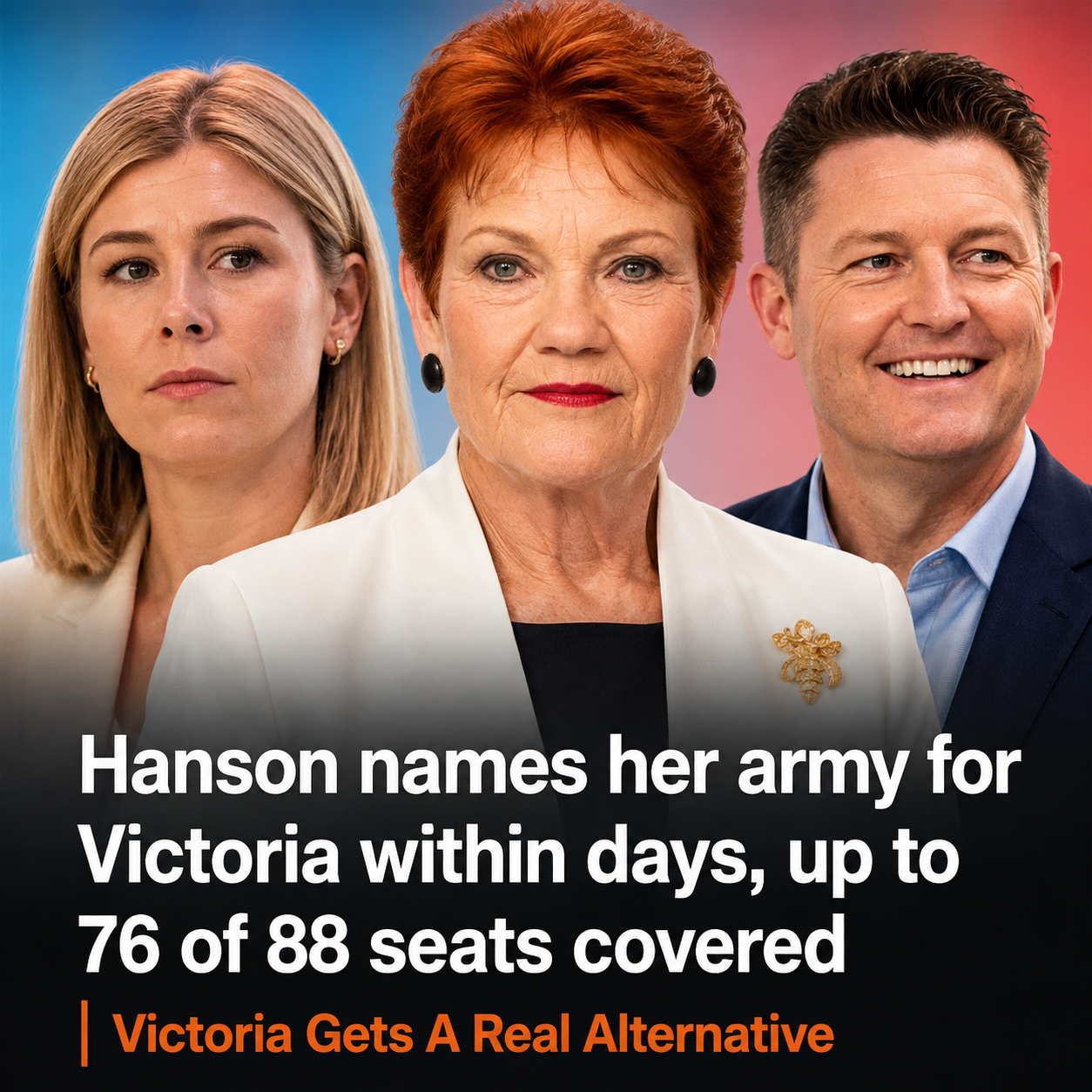
Pauline Hanson says One Nation is preparing for its most ambitious Victorian election campaign yet, with candidates selected for up to 76 of the state’s 88 lower house electorates as the party seeks to convert growing voter support into parliamentary representation.
The One Nation leader said the party received around 1,200 applications from prospective candidates before narrowing the field ahead of Victoria’s state election scheduled for 28 November.
Speaking about the campaign rollout, Hanson said the remaining candidates would be unveiled within days alongside a comprehensive policy platform covering the issues the party intends to take to voters across the state.
The announcement represents One Nation’s largest organisational effort in Victoria since the party was founded nearly three decades ago. While the party has previously enjoyed stronger electoral success in Queensland and, more recently, South Australia, Victoria has traditionally been a more difficult state in which to establish a substantial parliamentary presence.
That political equation, however, may be changing.
Recent polling has suggested One Nation is attracting increased support from Victorians frustrated by cost-of-living pressures, housing affordability, crime, government debt and broader dissatisfaction with the state’s political establishment.
One widely discussed RedBridge survey of approximately 6,500 Victorian voters, commissioned for Victorian Trades Hall, reportedly placed One Nation on 27 per cent of the primary vote, narrowly ahead of both Labor and the Coalition, which were each on 26 per cent.
Those figures generated significant political discussion because they suggested a three-way contest unlike any seen in recent Victorian elections.
However, not all polling has produced the same result.
A separate Newspoll published shortly afterwards estimated One Nation’s Victorian primary vote at 19 per cent, behind the Coalition on 31 per cent and Labor on 28 per cent. Analysts noted methodological differences between polling firms and cautioned that voter sentiment may continue to shift as the campaign develops.
The contrasting surveys illustrate how fluid Victoria’s political environment remains only months before voters head to the polls.
Hanson nevertheless argues that public dissatisfaction with the major parties is creating an opportunity for One Nation to significantly expand its influence.
She contrasted her party’s campaign preparations with the leadership of Victoria’s two major parties.
Liberal leader Jess Wilson assumed the opposition leadership after a relatively short parliamentary career, while Premier Ben Carroll entered the state’s top job following Labor’s leadership transition after Jacinta Allan’s resignation.
Hanson has argued both leaders represent continuity rather than meaningful political change, particularly in relation to Victoria’s economic challenges and public finances.
Labor rejects that characterisation, with Carroll pledging to reset the government’s agenda while maintaining stability after becoming Premier.
The Coalition, meanwhile, has argued that only a Liberal government can deliver the economic reforms and public sector changes required after more than a decade of Labor government.
For One Nation, the immediate challenge extends beyond polling numbers.
Success in opinion surveys does not automatically translate into election victories, particularly in Victoria’s preferential voting system.
Political analysts have repeatedly noted that candidate quality, campaign organisation, local recognition and preference flows can ultimately determine whether strong statewide polling produces parliamentary seats.
Building a statewide candidate network has therefore become one of One Nation’s highest priorities.
Hanson said selecting candidates from approximately 1,200 applicants was intended to ensure the party could present credible local representatives across almost the entire state rather than concentrating only on a handful of electorates.
The party has since begun formally introducing its Victorian candidates, including sitting upper house MP Rikkie-Lee Tyrrell and several newcomers drawn from business, local government and community backgrounds.
Victoria’s election is expected to be fought largely around issues that have dominated political debate throughout the past year.
Cost-of-living pressures remain consistently among voters’ highest concerns, alongside housing affordability, public debt, crime, healthcare access and infrastructure.
One Nation has also campaigned heavily on migration, government spending, energy policy and what it describes as restoring accountability across public institutions.
Labor, by contrast, argues its focus remains on maintaining economic stability while investing in transport, hospitals, schools and essential services.
The Coalition has sought to position itself as the principal alternative government, promising stronger fiscal discipline together with reforms targeting crime, infrastructure delivery and government efficiency.
The emergence of One Nation as a significant polling force complicates that traditional two-party contest.
Even if the party does not secure a large number of lower house seats, analysts say a stronger One Nation vote could influence outcomes through preference flows, particularly in regional and outer suburban electorates where dissatisfaction with the major parties has become more pronounced.
Victoria’s upper house may prove particularly significant.
Minor parties have historically enjoyed greater opportunities to secure representation there under the state’s proportional voting system, although proposed electoral reforms could alter that landscape compared with previous elections.
As campaigning accelerates, One Nation is expected to release its full Victorian policy platform alongside the remaining candidates.
Whether the party’s organisational expansion and encouraging polling translate into election-day success remains uncertain.
What is clear is that One Nation intends to contest Victoria more comprehensively than ever before, ensuring Pauline Hanson will remain a prominent figure in one of Australia’s most closely watched state election campaigns.