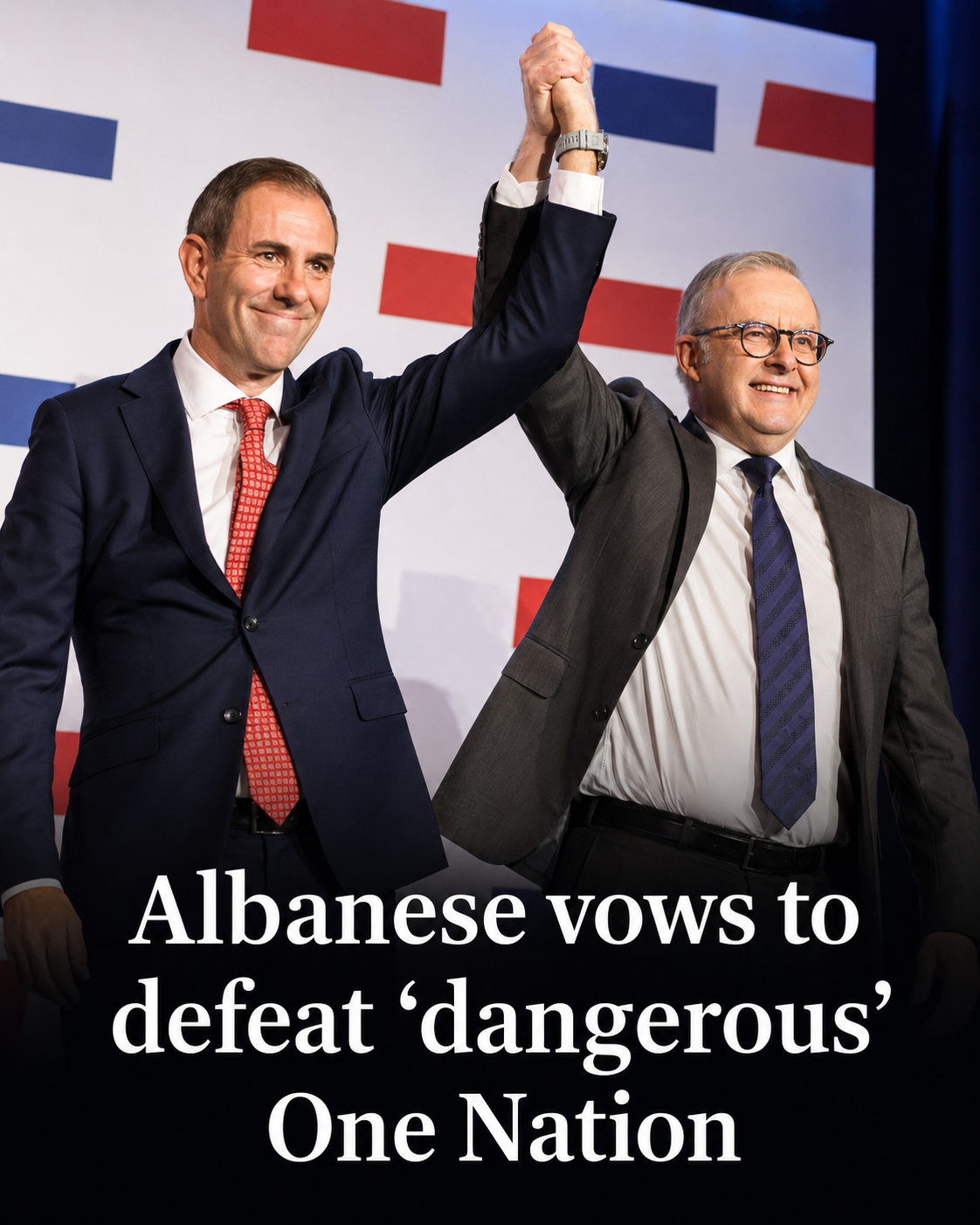
Anthony Albanese and Jim Chalmers have sharply escalated Labor’s attack on One Nation, warning of dangerous and divisive populism just hours after Pauline Hanson’s party converted its national polling surge into a historic lower-house victory in Western Australia.
The Prime Minister used Sunday’s Queensland Labor State Conference in Brisbane to declare that Labor had a historical responsibility to defeat hard-right populism, while the Treasurer warned of the threat he said would be posed by a political combination of the Liberals, Nationals and One Nation.
The language was unusually forceful.
But the timing explains why.
Less than a day earlier, One Nation candidate Luke Herdegen had seized Secret Harbour from Labor in Western Australia, turning a seat with an 11.5 per cent Labor margin into the party’s first Legislative Assembly victory in the state.
At the same time, national polling is now placing One Nation alongside — and in one prominent survey ahead of — the major parties on primary support.
For Labor, Pauline Hanson can no longer be treated primarily as a problem for the Coalition.
She is increasingly competing for voters Labor once expected to retain itself.
Albanese’s speech began as a broader defence of Labor’s economic and social record, covering wages, Medicare, housing, education, technology and Australia’s place in the Pacific.
But his rhetoric hardened substantially when he turned to populist politics.
He warned delegates that hard-right movements were advancing internationally and described their politics as “dangerous, divisive, and downright dishonest”.
Then came the line that immediately defined the speech.
“We simply must defeat them. We owe it to history,” Albanese said.
He quickly brought One Nation directly into the argument, accusing the party of offering simplistic answers to complicated national problems and of exploiting division to win support.
The Prime Minister argued that One Nation was not genuinely aligned with working Australians and attacked positions and comments associated with the party on penalty rates, working from home, multiculturalism and domestic violence.
He also made Labor’s ideological dividing line explicit.
Where Hanson has recently criticised multiculturalism and argued for a stronger emphasis on a common Australian culture, Albanese reaffirmed Labor’s unequivocal support for multicultural Australia and said citizenship and equality should not depend on whether somebody was Australian by birth or by choice.
The contrast was deliberate.
Labor is trying to turn the debate over One Nation from a contest about voter frustration into a contest about values, economic interests and governing competence.
Chalmers used even stronger national-security-style language
Treasurer Jim Chalmers spoke immediately before Albanese and delivered a closely related warning.
But the precise wording matters.
Chalmers did not simply declare that One Nation alone was a “threat to our country”.
Instead, he framed the danger as coming from what he called a “dangerous and divisive coalition of chaos” involving the Liberals, Nationals and One Nation.
He said the threat extended to Australia’s cohesion, its people and its economy.
Chalmers also made clear that Labor’s concern was not a sudden reaction to Saturday night’s result.
He said the government had taken the One Nation challenge seriously before the Secret Harbour by-election and would continue doing so afterwards.
That distinction is important because Labor has spent recent months trying to link all three right-of-centre parties economically.
Chalmers has repeatedly argued that One Nation, the Liberals and Nationals share positions that would weaken wages, working conditions and compulsory superannuation.
It is a political strategy designed to stop Labor voters from viewing Hanson primarily through debates about migration or cultural issues.
Instead, Labor wants them to ask what One Nation would do to their pay packets, retirement savings and workplace rights.
Secret Harbour made the threat tangible
Until this weekend, much of the discussion about One Nation’s resurgence was based on polling.
Secret Harbour changed that.
Herdegen won approximately 39 per cent of first preferences in a seat where One Nation had secured only about 8.4 per cent at the 2025 state election.
Labor candidate Georgia Tree fell to roughly 24 per cent.
After preferences, Herdegen established a commanding lead of about 57 per cent to 43 per cent.
It was an extraordinary transformation in just one electoral cycle.
More significantly, the Liberals did not inherit Labor’s collapsing vote.
They finished third on the primary count.
That means Secret Harbour cannot be explained simply as voters moving from a Labor government to its traditional conservative opposition.
One Nation became the principal vehicle for protest.
The result gave the party its first lower-house seat in Western Australia and demonstrated that its support can become geographically concentrated enough to overcome the difficulties minor parties normally face under preferential voting.
That is the development both Labor and the Coalition will now be studying closely.
One Nation is no longer polling like a conventional minor party
A new national Newspoll has intensified that concern.
It places One Nation on 30 per cent of the primary vote, Labor on 29 per cent and the Coalition on 19 per cent.
No single opinion poll should be confused with an election result.
Voting intention can move sharply between campaigns, and converting a national primary percentage into House of Representatives seats depends heavily on geography and preferences.
But 30 per cent is not a conventional minor-party number.
If support around that level persisted, it would fundamentally change the assumptions under which both major parties campaign.
For the Coalition, the immediate danger is obvious: One Nation is competing directly for conservative and anti-establishment voters.
For Labor, the challenge is more complicated.
The Hanson coalition now reaches into outer-suburban and regional communities containing working families, tradespeople, mortgage holders and voters worried about housing, population growth and cost-of-living pressures.
Some of those areas have deep Labor histories.
Secret Harbour showed that history alone does not guarantee loyalty.
Labor wants the contest fought on economic ground
Both Albanese and Chalmers therefore tried to move the argument towards household economics.
The Prime Minister cited Labor’s record on wages, Medicare, tax cuts, housing, Free TAFE and student debt.
He argued that the best response to populism was to give Australians a genuine reason to believe their lives would improve.
That is arguably the most consequential section of his speech.
Attacking Hanson may energise Labor members, but it will not necessarily recover voters who have already concluded that the government is failing them.
If those voters are worried about rent, mortgage payments, grocery bills, energy prices or the ability of their children to buy a home, the effectiveness of Labor’s response will depend on whether conditions materially improve.
One Nation, in turn, faces a different test.
As its support grows, it will increasingly be required to provide detailed and internally consistent answers rather than broad expressions of dissatisfaction.
The party’s recent confusion over aspects of its migration policy demonstrates the scrutiny that comes with moving closer to major-party levels of support.
A protest party can thrive on anger.
A party seeking significant lower-house representation must eventually demonstrate how its policies would operate.
The 1998 Queensland experience hangs over Labor’s strategy
Albanese also reached back to One Nation’s original breakthrough in Queensland.
In 1998, the party won 11 seats in the state parliament after receiving more than one-fifth of the statewide primary vote.
The breakthrough shocked the political establishment.
But the parliamentary organisation quickly fragmented, and One Nation lost most of that representation within a short period.
Albanese invoked that history as evidence that One Nation’s electoral success can be followed by instability and division.
For Labor, it is an appealing precedent.
There is no guarantee it will repeat.
The political environment of 2026 is different from that of the late 1990s.
Hanson has accumulated decades of political experience, the major parties have experienced a much broader decline in voter loyalty, and social media has transformed the way insurgent parties reach supporters.
Housing affordability and migration have also become central national issues at the same time as younger and outer-suburban voters question whether established economic arrangements are delivering for them.
One Nation’s current rise therefore cannot safely be dismissed as a replay of 1998.
Strong language also creates a risk for Labor
Calling an opponent dangerous is politically powerful, but it carries a strategic risk.
Labor must avoid sounding as though it is condemning people merely for voting for One Nation.
Secret Harbour voters were exercising an ordinary democratic choice.
The useful question for Labor is why thousands of them abandoned a party that had dominated the area for decades.
WA Premier Roger Cook appeared to recognise that after the defeat, acknowledging that Western Australians were under pressure and saying Labor needed to listen.
That response is materially different from assuming voters were simply misled.
Populist parties can exploit misinformation and polarisation while also benefiting from genuine grievances.
Those two propositions can both be true.
If Labor focuses only on One Nation’s rhetoric but does not address the conditions producing support for it, Hanson may benefit from every attack by presenting herself as the target of an establishment unwilling to listen.
Conversely, if Labor successfully demonstrates that One Nation’s economic policies would leave working households worse off, it could undermine the party precisely among the voters it is now trying to attract.
The political battle has entered a different phase
The significance of Sunday’s speeches is therefore not simply that two senior Labor figures criticised Pauline Hanson.
That has happened many times before.
The difference is the political position from which they are now doing it.
One Nation has just taken a Labor lower-house seat in Western Australia.
Its national primary support is polling around major-party levels.
The Liberals are struggling to contain defections on their right, while Labor is being forced to defend working-class and outer-suburban voters it once considered comparatively secure.
That changes One Nation from an irritant on the edge of the political system into a force capable of reshaping how both major parties construct electoral majorities.
Albanese has chosen confrontation, arguing that Labor must defeat the politics One Nation represents.
Chalmers is attempting to define the same contest economically, warning that a Liberal-National-One Nation combination would threaten wages, cohesion and the economy.
Hanson’s answer will be that the increasingly aggressive attacks prove the established parties are frightened because voters are deserting them.
Secret Harbour means neither side can now rely solely on rhetoric. One Nation has to prove it can turn voter anger into credible policy and disciplined representation. Labor has to prove it understands why those voters are angry in the first place. After a historic WA defeat and polling that places Hanson at the centre of national politics, Albanese and Chalmers have made their strategy clear: One Nation is no longer a peripheral opponent — it is now one of Labor’s central political targets.