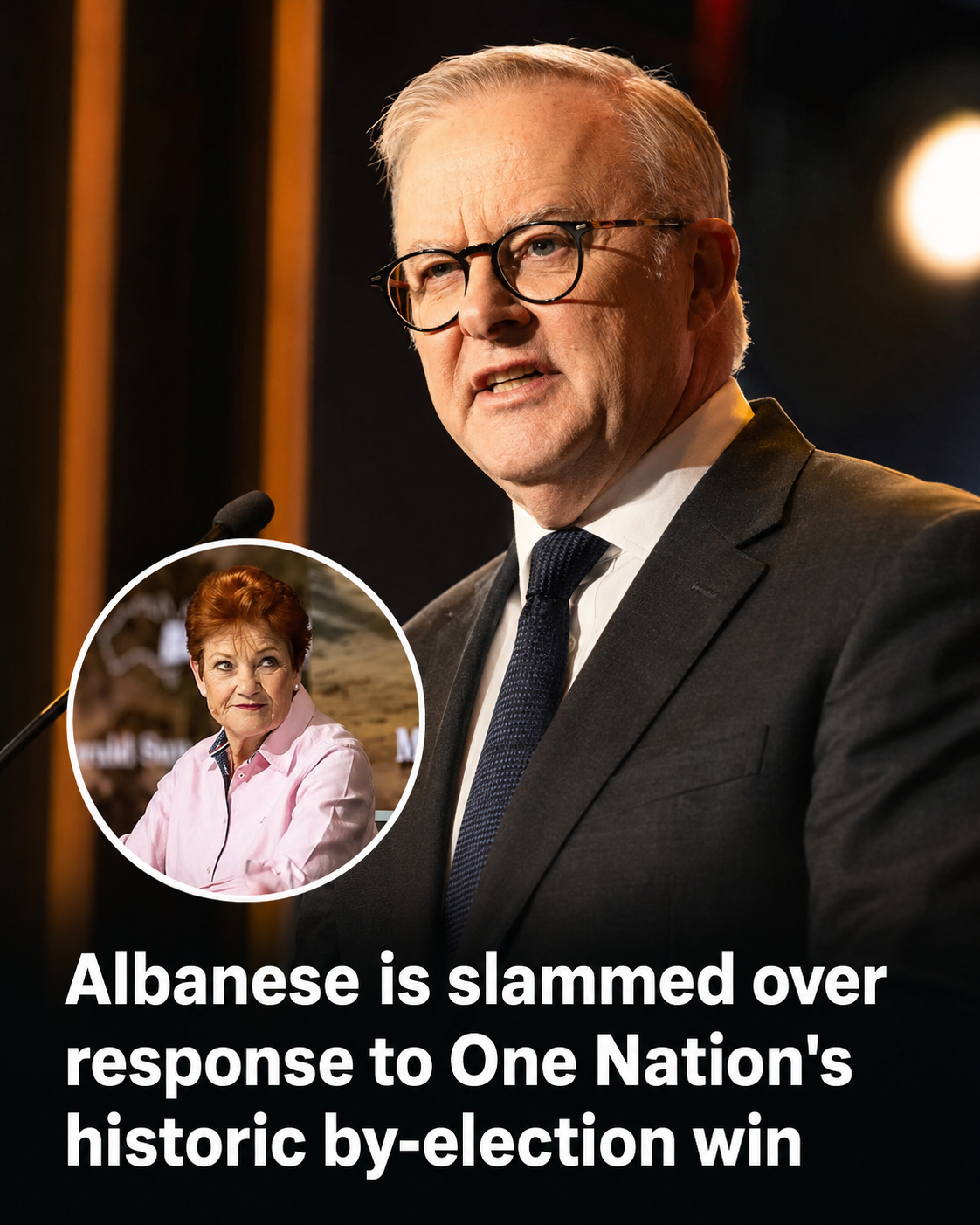
Anthony Albanese has intensified Labor’s confrontation with One Nation, accusing Pauline Hanson’s party of believing Australians are “lazy and overpaid” and declaring Labor has a historic duty to defeat it — just hours after voters in Western Australia handed One Nation its first lower-house seat in the state.
The Prime Minister used his Sunday address to the Queensland Labor State Conference to portray One Nation as a threat to working Australians, multiculturalism and political stability.
But the timing ensured his attack would be judged against a result Labor had just suffered at the ballot box.
In Secret Harbour, south of Perth, One Nation candidate Luke Herdegen defeated Labor’s Georgia Tree after producing one of the most dramatic swings of the current political cycle.
That victory transformed Albanese’s speech from a conventional attack on a minor party into something more consequential: a major-party prime minister openly acknowledging that One Nation has become a political competitor capable of taking Labor seats.
“Across the world hard right populists are on the march,” Albanese told delegates.
“We simply must defeat them. We owe it to history. And we will defeat them.”
‘They think Australians are lazy and overpaid’
Albanese’s sharpest language came as he accused One Nation of offering grievance rather than workable solutions.
He said the party would “say anything and do anything to win votes”, bend facts, spread misinformation and turn Australians against each other.
Then came the line that quickly became one of the most circulated sections of the speech.
“They think Australians are lazy and overpaid,” Albanese said.
He followed it by accusing One Nation of regarding people who work from home as “bludging”, suggesting domestic violence could sometimes be a woman’s fault and wanting Australia to become a monoculture.
The distinction between quotation and characterisation matters.
“Lazy and overpaid” was Albanese’s description of One Nation’s attitudes. It should not be presented as a direct quotation from Hanson unless a corresponding statement can be established.
Other elements of his attack, however, refer to positions or remarks that have generated significant public controversy.
Hanson has explicitly argued that Australia should move away from multiculturalism towards a monocultural national identity.
She also drew condemnation in July after describing domestic violence as a “two-way street” and telling women they should not put up with abuse, comments that prompted criticism from domestic-violence advocates and Australian human-rights officials.
That gives Albanese factual material with which to attack One Nation, even if his broader language remains partisan political argument.
Secret Harbour made the speech impossible to separate from election reality
The Prime Minister’s intervention came the morning after One Nation did something it had never previously achieved in Western Australia.
It won a seat in the Legislative Assembly.
With 74.5 per cent of the count reported, Herdegen was leading Tree by 57.0 per cent to 43.0 per cent after preferences.
That represented an 18.6 percentage-point swing away from Labor on the two-candidate count.
The primary-vote movement was even more dramatic.
One Nation jumped from 8.4 per cent at the 2025 state election to 39.1 per cent, an increase of 30.6 percentage points.
Labor fell 22.1 points to 24.4 per cent.
The Liberals also went backwards, finishing third on 17.3 per cent.
That matters because the result cannot be understood simply as voters moving from a Labor government to its traditional Liberal opposition.
One Nation became the principal vehicle for discontent.
The ABC called the seat for Herdegen a little more than four hours after counting began, and Tree conceded the following morning.
The formal Electoral Commission process is continuing, but the political outcome is no longer in doubt.
Labor now has to decide how to fight Hanson
Albanese’s speech reveals the first part of Labor’s answer.
The party intends to attack One Nation on values, credibility and economic policy rather than concede that Hanson owns the language of working-class frustration.
Albanese sought to turn the argument directly onto wages.
He asked how cutting penalty rates would help workers in communities such as Logan, Gladstone, Strathpine, Ipswich and Mount Isa.
He contrasted One Nation with Labor’s record on minimum and award wages, Medicare, cheaper medicines, Free TAFE, apprenticeships and paid work placements.
The political objective was clear: Labor wants voters considering One Nation to believe that Hanson may articulate their anger but would make them materially worse off.
That is a more substantive argument than simply labelling One Nation extreme.
It is also harder to execute.
To persuade voters that Labor is the party delivering for working households, those households must feel some of that improvement themselves.
If mortgage payments remain painful, rents remain high, groceries feel expensive and home ownership continues to look distant for younger Australians, government statistics and program announcements may struggle to overcome lived experience.
That tension is central to One Nation’s rise.
Backlash focused on whether Albanese was attacking the messenger or the message
Criticism of Albanese spread quickly after the speech, particularly online.
Some commentators argued the Prime Minister appeared more interested in condemning One Nation than understanding why thousands of voters had just moved towards it.
Others interpreted his comments as an indirect criticism of the Australians choosing the party.
That interpretation goes further than Albanese’s actual words.
He attacked One Nation and its politics, not the legal right of Australians to vote for it.
Indeed, his speech argued that the way to defeat populism was to give people “real hope of a better future”.
Nevertheless, the political risk is obvious.
Whenever a major party describes an insurgent opponent in highly moral language, supporters of that opponent can hear an implied judgment about themselves.
If those voters already believe mainstream parties regard them as ignorant, angry or misinformed, an aggressive attack can reinforce rather than weaken their attachment to the alternative.
That is why Secret Harbour matters so much.
Labor is not dealing with a theoretical focus group. It is dealing with thousands of voters who changed their ballots.
Barnaby Joyce rejects Labor’s characterisation
One Nation MP Barnaby Joyce rejected the Prime Minister’s framing, accusing Albanese of relying on familiar stereotypes about the party.
Joyce argued that claims presenting One Nation as racist, homophobic or indifferent to women experiencing domestic violence were false characterisations.
That response points to One Nation’s own strategy as its electoral support grows.
The party wants to retain the disruptive anti-establishment appeal that brought voters to it while rejecting labels that could make it unacceptable to a broader electorate.
That balancing act will become increasingly difficult as One Nation receives greater scrutiny.
A party polling in the single digits can campaign largely through broad grievances.
A party competing with Labor and the Coalition must answer detailed questions about legislation, budgets, migration numbers, workplace law, health, defence, taxation and the consequences of its proposals.
One Nation’s recent confusion over the precise meaning of its proposed 130,000 migration figure illustrates the problem.
The stronger the party becomes, the less room it has for policy ambiguity.
Hanson’s multiculturalism position gives Labor a clear dividing line
Albanese also used multiculturalism to define what he sees as a fundamental difference between Labor and One Nation.
“We unequivocally support multiculturalism because we know it’s part of Australia’s strength,” he said.
He added that every Australian was equal whether “Australian by birth or Australian by choice”.
That section was a direct response to Hanson’s National Press Club speech in June, when she argued multiculturalism had failed and called for Australia to become monocultural.
Hanson’s argument is that a country can contain people of many racial backgrounds while expecting them to share a dominant Australian culture and identity.
Her critics argue that this understates both the reality and success of Australia’s multicultural model and risks treating migrant cultures as inherently incompatible with national cohesion.
The disagreement is genuine and significant.
It also gives Labor a clearer political target than vague arguments about extremism.
Rather than debating whether One Nation belongs on an ideological label, voters can compare two identifiable propositions: Labor’s explicit defence of multiculturalism and Hanson’s push for a monocultural national identity.
Queensland history was deliberately invoked
Albanese also reminded delegates of One Nation’s extraordinary breakthrough in Queensland in 1998, when the party won 11 seats.
He argued that success quickly produced chaos and division.
One Nation’s original Queensland parliamentary force did indeed fragment rapidly, and by the 2001 election the party had been reduced to three seats.
For Labor, that history offers an obvious warning to voters: protest parties can be easier to support than to organise and govern.
But relying too heavily on a 28-year-old precedent would be risky.
One Nation in 2026 is not operating in the same political or media environment as One Nation in 1998.
Hanson is vastly more experienced, the party has established a continuing federal parliamentary presence, social media allows direct communication with supporters and dissatisfaction with the two-party system has deepened.
Most importantly, One Nation is now drawing support from more than one traditional political constituency.
Secret Harbour showed Labor voters moving towards it while the Liberals simultaneously failed to capture the anti-government swing.
A national polling surge changes the calculation
Recent national polling makes Albanese’s focus even easier to understand.
One Newspoll has One Nation on 30 per cent of primary support, Labor on 29 per cent and the Coalition on 19 per cent.
Individual polls should never be treated as forecasts of an election result, particularly because Australia’s preferential system means primary support does not translate directly into lower-house seats.
But numbers at that level represent a structural change in the political contest.
One Nation is no longer merely drawing a few percentage points from the Coalition’s right flank.
It is increasingly competing for voters who once formed part of Labor’s outer-suburban and regional base.
Those voters often sit at the intersection of issues driving contemporary political frustration: high housing costs, mortgage pressure, anxiety about migration, weak productivity, strained services and declining trust in institutions.
Secret Harbour provided a concentrated demonstration of that mix.
Calling One Nation dangerous will not be enough
Albanese appears to understand that criticism alone cannot reverse the trend.
The second half of his argument was that the antidote to populism is successful government.
He pointed to wage increases, healthcare spending, training, housing policy and economic reform and told Labor members that people needed optimism rather than a catalogue of grievances.
That may be the most important part of the speech.
If One Nation’s growth is driven primarily by material dissatisfaction and distrust of established parties, defeating it requires more than exposing controversial statements by Hanson.
Labor must convince voters that it understands their economic pressures and can improve them.
One Nation, meanwhile, must demonstrate that its rapid rise can survive the transition from opposition rhetoric to detailed scrutiny.
Both sides now face a tougher test than they did even a few months ago.
Albanese has chosen to confront One Nation directly, accusing it of regarding Australians as “lazy and overpaid” and declaring Labor owes it to history to defeat the party. But Secret Harbour has changed the terms of that fight. Hanson’s movement is no longer merely producing provocative speeches and strong opinion polls — it is taking seats. If Labor wants to stop that advance, attacking One Nation’s record may be part of the answer, but understanding why voters are walking away from the major parties will matter far more.