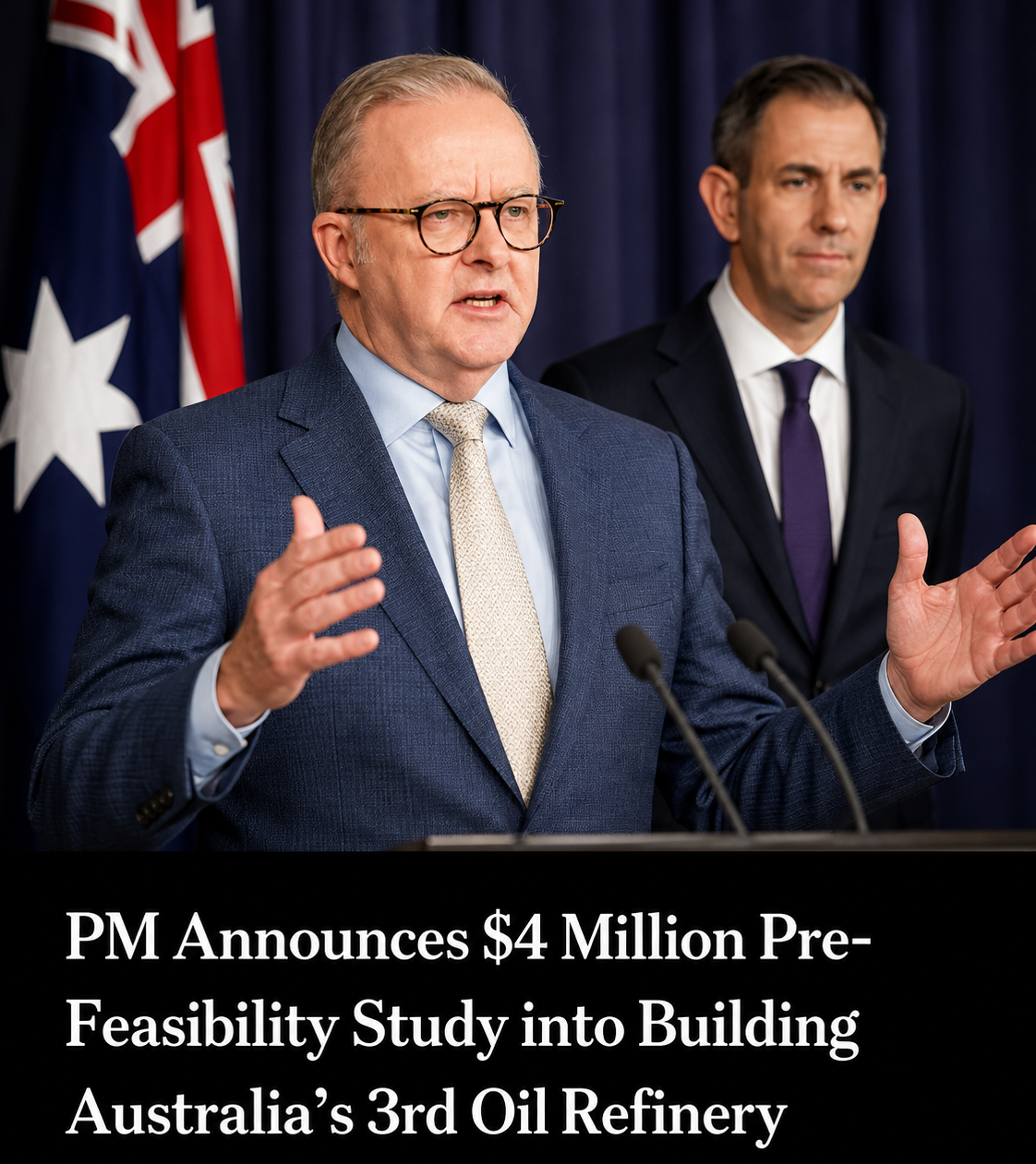
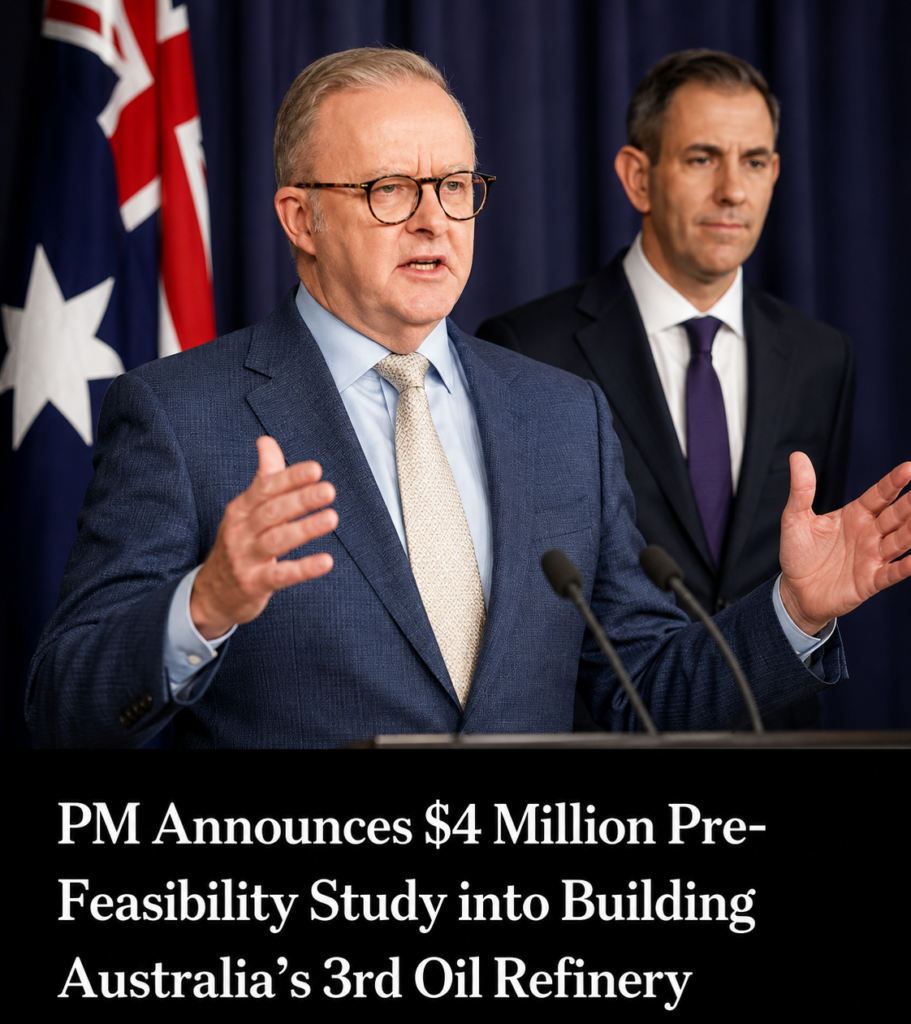
Prime Minister Anthony Albanese and Western Australian Premier Roger Cook have announced a jointly funded A$4 million pre-feasibility study into a proposed large-scale oil refinery at Karratha in the Pilbara, marking what could become Australia’s first new oil refinery built since the 1960s.
If the project ultimately proceeds, the facility would become Australia’s third operating oil refinery, joining the existing refineries in Brisbane and Geelong after decades of refinery closures that have left the country heavily dependent on imported fuels.
Speaking in Karratha, Albanese said the proposed refinery represented an important first step towards strengthening Australia’s long-term fuel security while supporting economic development in Western Australia’s resource-rich Pilbara region.
“We want to make sure that we get the right location, but we want to make sure as well that it’s a project that stacks up, that can go forward,” the Prime Minister said while announcing the study.
The refinery proposal has been put forward by Perth-based industrial group Perdaman, which is best known for its fertiliser and chemical projects in Western Australia. The company would lead development if the project is eventually found to be commercially viable.
The A$4 million study, jointly funded by the Commonwealth and Western Australian governments, will examine a wide range of issues including engineering requirements, environmental impacts, commercial viability, crude oil supply options, infrastructure needs and potential refinery locations around Karratha.
Government officials say no decision has been made to proceed with construction, emphasising that the pre-feasibility study is intended to determine whether the proposal is technically and economically achievable before any larger investment is considered.
The announcement comes as Australia reassesses its energy security following renewed instability in global oil markets.
Recent conflict in the Middle East has highlighted Australia’s heavy reliance on imported refined fuels, with Treasury warning that global fuel markets have become increasingly vulnerable to supply disruptions and geopolitical shocks. Australia currently imports around 80 per cent of its liquid fuel requirements after the closure of several domestic refineries over the past three decades.
Most of Australia’s refineries were constructed during the 1950s and 1960s, but rising operating costs and competition from larger, more efficient Asian refineries resulted in the closure of most facilities.
BP shut Western Australia’s Kwinana refinery in 2021 and converted the site into an import terminal, leaving only Viva Energy’s refinery in Geelong and Ampol’s refinery in Brisbane still processing crude oil domestically.
Premier Roger Cook said restoring refining capacity in Western Australia would improve fuel resilience for industries that underpin both the state and national economy.
Mining operations throughout the Pilbara rely heavily on diesel-powered equipment, while agriculture, freight and regional communities also depend on reliable fuel supplies.
Cook said a refinery in Karratha could provide significant economic benefits while strengthening Australia’s capacity to respond to future international supply disruptions.
Government estimates suggest construction and operation of the refinery could create thousands of direct and indirect jobs while generating additional investment across engineering, logistics, manufacturing and maintenance sectors.
Supporters also argue the project would encourage broader industrial development in the Pilbara, a region already recognised as one of Australia’s most important centres for mining, liquefied natural gas and export infrastructure.
The refinery proposal forms part of the Albanese government’s broader effort to improve Australia’s fuel security following repeated warnings that the country holds comparatively limited domestic refining capacity.
Recent government initiatives have included strategic fuel reserves, refinery support payments and measures designed to maintain existing refining operations while exploring opportunities for additional domestic processing capacity.
However, the proposal has also attracted significant scrutiny from energy economists and industry analysts.
Experts note that although refining imported crude oil in Australia could diversify supply chains, the country would still rely heavily on imported crude because domestic oil production is insufficient to support a large refinery.
As a result, some analysts argue the project would improve refining resilience but would not eliminate Australia’s dependence on international energy markets.
Commercial viability represents another major challenge.
Modern refineries require substantial capital investment—potentially running into many billions of dollars—and typically compete against much larger facilities throughout Asia that benefit from greater economies of scale.
Analysts have suggested a new Australian refinery may require long-term commercial agreements or government support to remain competitive over its operating life.
Questions have also been raised about Perdaman’s experience.
While the company has developed large industrial and fertiliser projects, it has not previously built or operated a major oil refinery, leading some observers to caution that additional technical partners may ultimately be required should the proposal advance beyond the study stage.
Environmental organisations have likewise questioned whether investing in new oil refining infrastructure is consistent with Australia’s long-term transition toward lower-emissions energy systems.
Critics argue future investment should focus more heavily on renewable fuels, hydrogen and electrification rather than expanding fossil fuel infrastructure.
The government has responded by emphasising that liquid fuels will continue to play a critical role in heavy transport, mining, aviation and defence for many years, even as renewable energy expands across the broader economy.
Karratha has emerged as a logical location because of its proximity to major ports, established industrial infrastructure and large mining operations requiring substantial diesel supplies.
The city already serves as one of Australia’s principal energy and resources hubs, supporting iron ore exports, offshore gas production and extensive heavy industry throughout the Pilbara.
The proposed refinery would process imported crude oil into products including diesel, petrol, aviation fuel and other refined petroleum products for domestic use.
Supporters believe increasing Australia’s refining capacity would reduce vulnerability to overseas disruptions while strengthening sovereign industrial capability during periods of geopolitical uncertainty.
Whether those benefits outweigh the substantial financial and commercial risks will now become the central question addressed by the pre-feasibility study.
The assessment is expected to examine technical design, investment requirements, environmental approvals, market demand, logistics and supply-chain resilience before governments consider any decision regarding construction.
For Albanese, the announcement represents one of the most significant shifts in Australia’s fuel security strategy in decades.
If the project ultimately proceeds, it would reverse more than half a century without the construction of a new domestic oil refinery and mark a significant expansion of Australia’s downstream energy infrastructure.
For now, however, ministers stress that the study represents only the first step. The future of the Karratha refinery will depend on whether the detailed analysis demonstrates that the project can be delivered economically while genuinely strengthening Australia’s long-term energy security.