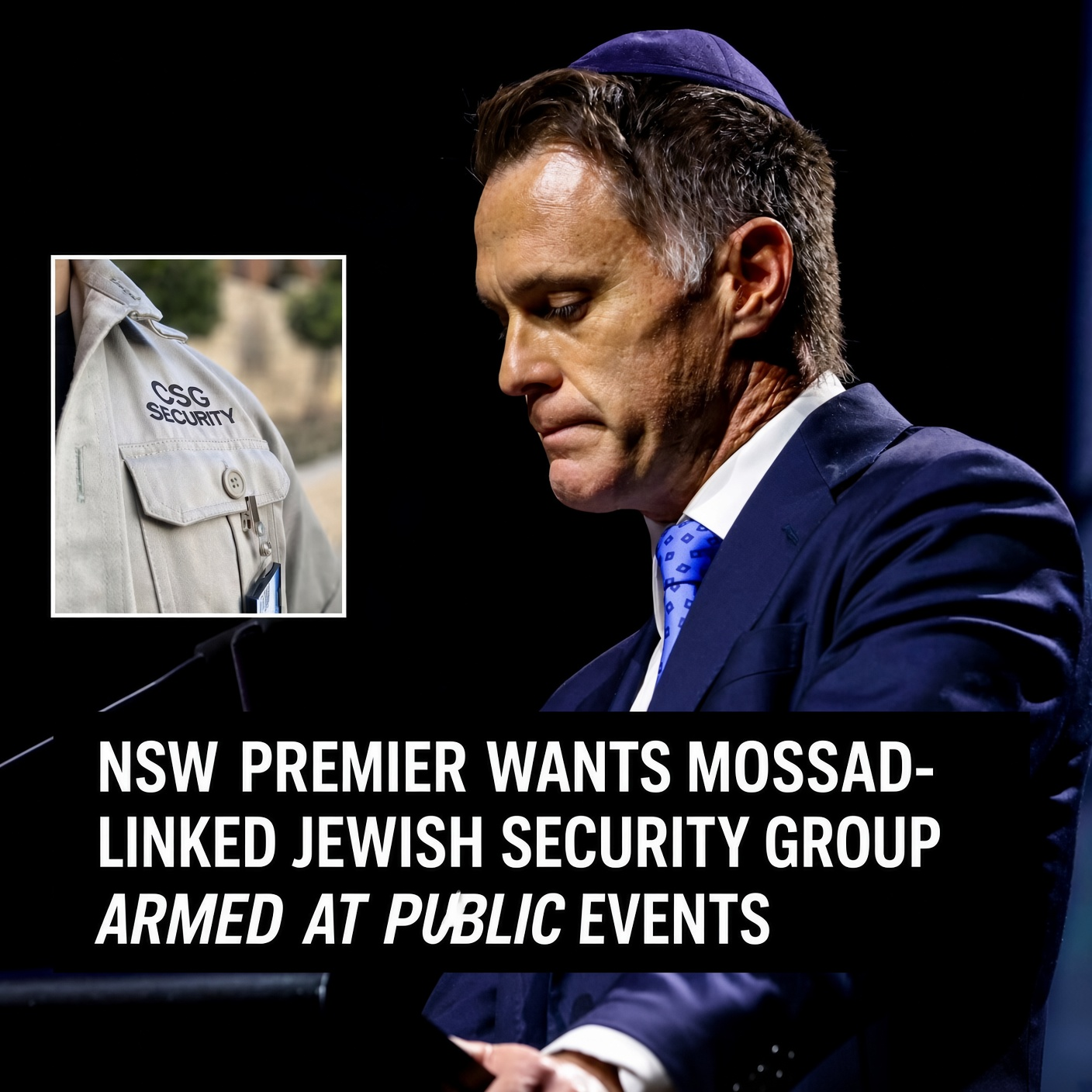
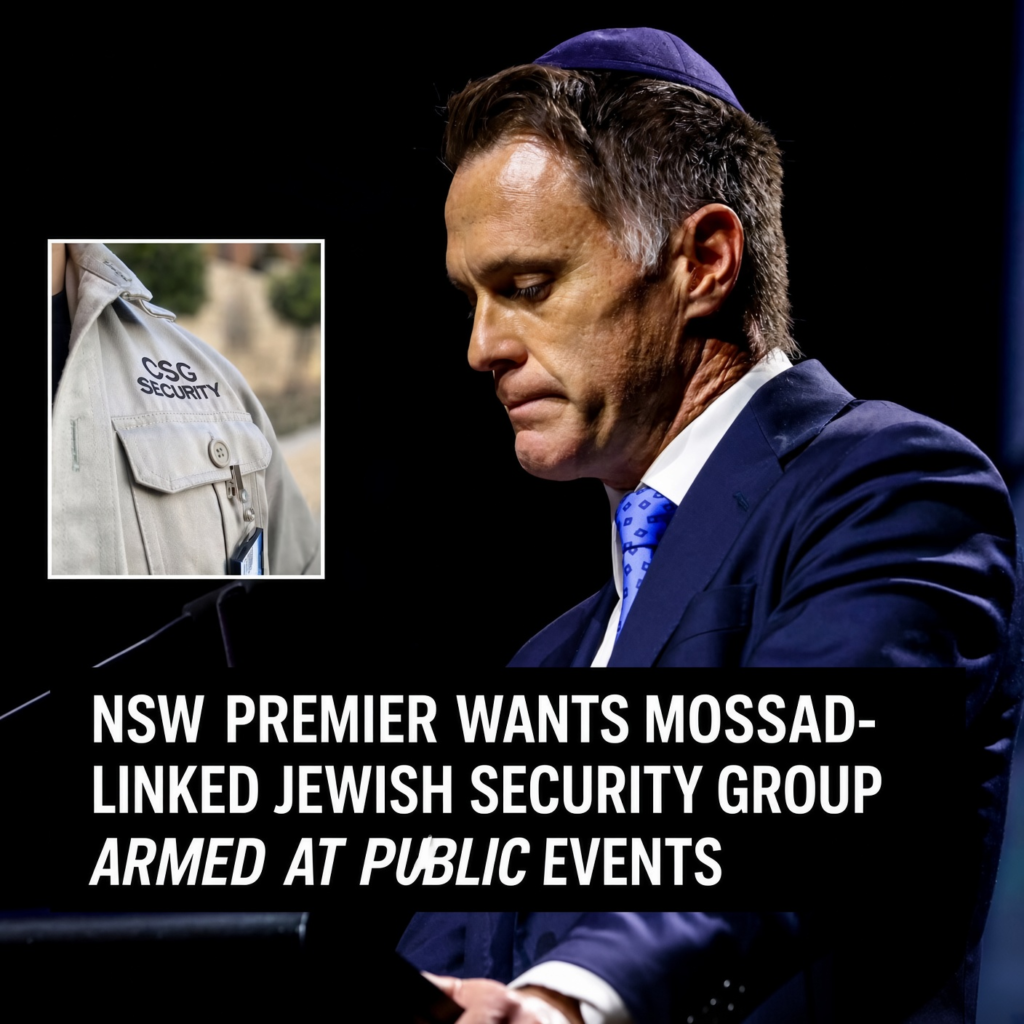
NSW Premier Chris Minns has backed consideration of a controversial trial that could allow members of a private Jewish community security organisation to carry firearms while protecting some high-risk public events, despite senior police warning that granting special security powers to one community could create division and perceptions of favouritism.
The proposal concerns Community Security Group NSW, commonly known as CSG NSW, which provides security support to Jewish schools, synagogues, institutions and community events.
CSG personnel can already operate armed in certain circumstances at protected Jewish facilities. The contentious question now before the NSW Government is whether that capability should extend to public land during selected Jewish events assessed as facing an elevated threat.
Mr Minns has argued the idea deserves serious consideration after the deadly antisemitic terrorist attack at Bondi Beach on December 14, 2025, which killed 15 people attending a Hanukkah celebration.
But the Premier is pushing into an area where some of the state’s most senior policing figures have urged caution.
NSW Police Deputy Commissioner David Hudson has repeatedly expressed reservations about extending armed security capabilities to a private community organisation, warning that giving one section of society privileges unavailable to others could damage already fragile relationships between communities.
The Police Association of NSW has also questioned where such a policy would ultimately lead if one private organisation were given permission to carry weapons in circumstances not available to comparable groups.
Minns says an armed-security trial should be considered
Mr Minns revisited the issue during NSW budget estimates, where he was questioned about CSG and security arrangements for the Jewish community.
His position was not that the Government had already approved an armed patrol program. Rather, he argued that existing arrangements meant the possibility should not automatically be rejected.
CSG personnel, he noted, already provide armed protection at some Jewish schools, synagogues, community centres and other sites.
The proposed change would concern their ability to carry firearms while protecting selected events on public land.
Mr Minns has also indicated that any such measure would be narrowly targeted rather than a blanket authority for armed CSG patrols across NSW.
He has spoken about events considered to face a particularly high risk of a mass-casualty attack and the need for coordination between private security and NSW Police.
The Premier has argued that security fears following Bondi are sufficiently serious that the proposal warrants examination, particularly when members of the Jewish community may be reluctant to attend public gatherings without visible protection.
As of late August, however, the NSW Government had not reached a final decision.
Bondi fundamentally changed the debate
The argument cannot be separated from the December 2025 Bondi terrorist attack.
The Hanukkah gathering targeted that evening had CSG NSW volunteers present, but they were not armed.
Evidence presented to the Royal Commission on Antisemitism and Social Cohesion subsequently revealed significant questions about the policing and security arrangements surrounding the event.
CSG NSW had conducted its own threat assessment before the celebration and assessed the risk of violence as high amid elevated reports of antisemitic incidents.
The organisation requested police assistance.
The royal commission’s interim report said CSG was advised NSW Police could not provide static resources for the entire event, although mobile patrols would check and monitor the location.
Information supplied by NSW Police showed three general duties officers and a supervisor were allocated to the event, while another officer attended at various times.
An email sent three days before the attack indicated officers did not need to remain for the entire celebration.
The commission also found NSW Police had not prepared a written risk assessment specifically for the event.
Those revelations have driven an intense debate about whether police resources alone can provide the level of protection now sought for large Jewish gatherings.
Royal commission recommended stronger security
The Royal Commission on Antisemitism and Social Cohesion delivered its interim report in April, making 14 recommendations after examining the Bondi attack and the security environment surrounding it.
Among them was a recommendation that NSW Police procedures used for Jewish High Holy Days should be extended to other high-risk Jewish festivals and events, particularly those with a public-facing element.
The commission also called for broader counter-terrorism and firearms reforms.
Importantly, Commissioner Virginia Bell did not conclude that urgent new legislative powers were necessary to prevent another comparable terrorist attack. The report said no Commonwealth or state agency had advised the commission that immediate legislative or regulatory reform was required for that purpose.
That leaves governments facing a more complicated question: whether better deployment of existing police capabilities is sufficient, or whether private security should assume a larger armed role.
Senior police officer warns of ‘friction’
Deputy Commissioner Hudson has taken a cautious position.
Giving evidence to the royal commission in May, he said police had “considerable reservations” about providing CSG with additional powers or privileges.
He warned that isolating one group for special powers could create a disconnect between different sections of society and generate friction if one community was seen to have protections unavailable to others.
When the issue returned before the commission in July, his position had not changed.
Mr Hudson warned that giving selected parts of society special security privileges could further fracture relationships that were already tenuous and could be interpreted by other communities as government or police favouritism.
His argument goes beyond the competence or intentions of CSG itself.
It raises a broader public-policy question about whether armed protection in public places should remain principally the responsibility of sworn police, who operate under established chains of command, statutory powers and public accountability.
Police Association of NSW president Kevin Morton has made a similar argument, maintaining that NSW Police is the organisation charged with protecting the people of the state.
The concern is precedent: if one private community security organisation is authorised to operate armed at public gatherings, other communities may seek equivalent arrangements.
Supporters say armed CSG could save lives
Supporters of the proposal see the issue very differently.
Prominent businessman Steven Lowy told the royal commission that armed CSG personnel could strengthen security at Jewish gatherings and supplement police resources.
He argued that had armed security been present at the Bondi celebration, the scale of the tragedy could have been smaller.
Security consultant Gavriel Schneider has also argued before the commission that private security can provide valuable additional capacity when police resources are stretched, particularly at open-air events where an attacker may have significant freedom of movement before police can respond.
The dispute therefore involves two competing security philosophies.
One prioritises a centralised police responsibility for armed public protection and worries about social cohesion, accountability and precedent.
The other argues that the threat confronting Jewish events has become sufficiently acute that trained private security should be permitted to provide an additional armed layer of defence.
What are CSG’s connections with Israel?
The debate has also revived scrutiny of overseas training undertaken by people associated with the Community Security Group.
That issue became public through an Administrative Review Tribunal case involving an Australian Defence Force officer identified by the pseudonym HWMW.
The officer volunteered with a Sydney-based CSG between 2014 and 2023.
He travelled to Israel in 2016 and 2019 for security training connected with his CSG activities. Tribunal material showed the courses were conducted by Ami-Ad, an organisation the officer understood was financed by the Israeli Government and responsible for providing security training to Jewish groups internationally.
The training included areas such as tactical planning, self-defence and firearms.
The officer said many instructors had backgrounds with Shabak, also known as the Israel Security Agency.
More significantly, evidence before the tribunal showed the officer believed Mossad could identify potential recruits from people participating in such courses. He described the environment as a potential or natural recruiting pool.
Those facts have subsequently been used by critics to characterise CSG as “Mossad-linked”.
That description requires care.
The tribunal evidence establishes links between the former volunteer’s overseas training and Israeli Government-funded security programs, as well as his own statements about the possibility of Mossad recruitment.
It does not establish that CSG NSW itself is controlled, directed or operated by Mossad.
ASIO case was about one officer’s conduct and disclosures
The distinction is important because the security-clearance case centred on the individual officer’s conduct, loyalties and disclosure obligations rather than a finding that membership of CSG was inherently a national-security problem.
ASIO assessed that the officer had demonstrated greater loyalty to Israel than to the Australian Government and had failed to fully disclose relevant overseas training and contacts.
Among the matters considered was his statement that he did not regard Israel in the same way as another foreign government and evidence concerning whether he would provide sensitive information to Israel if requested.
The tribunal upheld the adverse security assessment.
But the tribunal material also records that the respondent accepted involvement in CSG, by itself, would not justify revocation of a security clearance.
ASIO Director-General Mike Burgess has similarly acknowledged the legitimate security role played by community security groups while stressing the importance of disclosure when Australian security-clearance holders undertake overseas training.
That makes the documented position considerably more nuanced than simply describing CSG as an arm of Israeli intelligence.
The central question is who should carry guns in public
For NSW, the immediate policy issue is ultimately much closer to home.
The Government must decide whether the extraordinary security threat demonstrated at Bondi justifies expanding the circumstances in which private security personnel can be armed in public.
That decision comes as NSW Police itself expands its armed response capabilities following evidence that frontline officers were dangerously outgunned during the Bondi attack.
Deputy Commissioner Hudson told the royal commission that responding officers carrying 9mm Glock pistols were placed at significant risk against attackers armed with long guns.
NSW Police has been developing an Armed Response Command designed to give officers greater access to long-arm weapons and improve the state’s ability to respond rapidly to heavily armed attackers.
That creates an obvious policy choice.
The Government can invest further in police protection at high-risk events, permit trained private security to supplement that protection with firearms, or develop some combination of the two.
No final approval yet
Despite the increasingly heated political argument, no general authorisation has been announced allowing armed CSG personnel to patrol public Jewish events.
Mr Minns has backed consideration of a trial in selected high-risk circumstances, but the proposal remains under examination.
Any final model would need to address how armed guards interact with responding police, who commands security operations, what licensing and training standards apply, where firearms can be carried and how authorities prevent confusion during an active attack.
There is also the larger question raised by senior police: whether granting one community access to a security arrangement unavailable to others would make NSW safer while preserving social cohesion.
For supporters, Bondi demonstrated the potentially catastrophic cost of inadequate protection and the need to reconsider assumptions that existed before the attack.
For opponents, the same tragedy is an argument for strengthening NSW Police rather than expanding armed private security in public spaces.
Mr Minns has made clear he believes the proposal deserves to be considered. Whether NSW ultimately crosses that line — allowing a community security organisation already permitted to operate armed at certain private sites to extend that role into selected public events — is now one of the most consequential security questions facing his government.